For Tiers of Joy, Start with the Best Cake Pans
Every perfectly baked treat will be a reason to celebrate.

“A party without a cake is just a meeting,” Julia Child once famously claimed, and it’s true that cakes have been deemed essential to celebrations since the ancient Greeks, where candle-festooned cakes were said to mirror the glow of the moon and smoke from the candles transported wishes to the wish-granting gods. That’s a lot to ask from a humble cake, so as a baker it pays to set yourself up for success with the best cake pans. A well-made cake pan can make a big difference in the final baking, ensuring you have a cake that bakes up evenly throughout with a tender crumb, a golden brown exterior that easily releases from the pan, and straight sides ready for layering or frosting.
To find the best cake pans on the market today, we looked for ones that were good conductors of heat, supplying a steady temperature while cradling the batter and encouraging even rise with a delicate, golden crust. (The high proportion of sugar, fat, and liquid means most cake batters are generally thin, so it is best not to team them with a thin-sided or flimsy pan.)
We found that shallow pans with dark sides encouraged batters to bake quickly, often resulting in over-baked, dry layers. And material matters, too: A pan constructed of anodized aluminum is coated, rendering it non-reactive to batters with acidic ingredients such as citrus, buttermilk, and cocoa, so there’s no residual metallic taste.
When creating your cake pan collection, it’s important to consider both round and square shapes, as well as a springform pan for certain recipes such as cheesecake. Plus, some bakers consider nonstick pans a must-have thanks to the combination of thick gauge metal and easy release coating, so we’ve considered those as well. But fancy cakes don’t necessarily require intricate cake pans: “Some of my greatest baking fails have stemmed from using fussy tins—cake pans whose nooks and crannies don’t want to yield half the cake after baking,” says Julia Duke, owner/baker of Sea Biscuit Baking in Rockport, Maine. I like to keep it simple—my go-to pans are straight-edged aluminum, as they bake evenly, are lightweight, and easy to use.”
A small but sensible, well-made collection of pans allows you plenty of incentive to act when cake inspiration strikes. Here’s where to start.
Our Top Picks
- Best Non-nonstick and Value: Fat Daddio's Anodized Aluminum Round Cake Pan, 8 x 3 Inch, Silver
- Best Nonstick Square Cake Pan: Williams Sonoma Goldtouch® Pro Nonstick Square Cake Pan
- Best Springform Pan: SAVEUR SELECTS 9-Inch Springform Pan
- Best Overall 9”: USA PAN 9 Inch Round Cake Pan
- Best Celebratory Set: Wilton® Countless Celebrations Adjustable 10-Piece Set
Best Non-nonstick and Value: Round Cake Pans | Fat Daddio's
Best Non-nonstick and Value
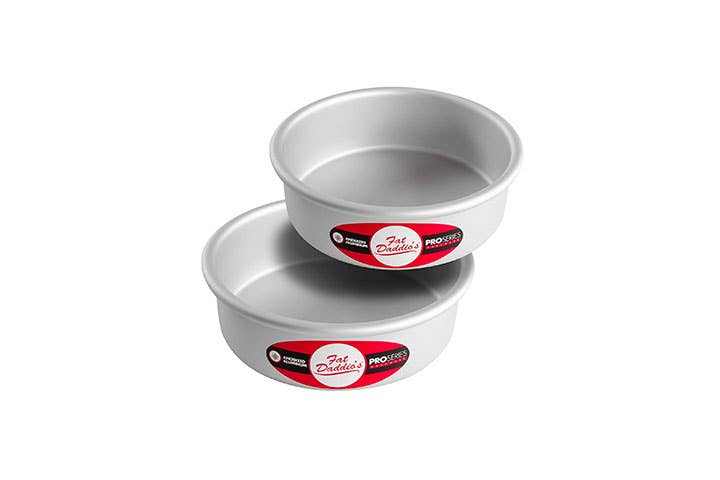
Material: Anodized Aluminum | Shape: Round | Max Oven Temp: 550 degrees Fahrenheit | Dishwasher Safe: No | Interior Dimensions: 8” x 3”
Pros
- Heavy duty, durable, commercial quality, promotes even heat
- Light-colored anodized aluminum won’t create a dark crust or react with acidic ingredients
- Straight sides; great for layering
Cons
- Depth often requires extending the bake time
- Hand-wash
- Best to order directly from manufacturer - pans should be marked "Fat Daddio's PRD-83"
Why we chose it: Professionals stock their kitchens with Fat Daddio’s cake pans for a reason: Made of light colored, heavy duty anodized aluminum, they boast even heating, easy release and don’t cost a fortune. We recommend the 8-inch wide and 3-inch tall version.
Slightly deeper than many traditional layer cake pans, which vary between 1 1/2 inches and 2 inches, pros applaud these pans in commercial kitchens and at home. Capable of accommodating classic box mixes and most 9-inch cake recipes; the end result will be a slighter taller layer with a delicate crust and crumb. The extra depth allows the cake to rise and bake evenly, preferable to shallow pans that sometimes dome or overflow. (Note that the depth also extends bake times; the manufacturer recommends baking at slightly lower temperature, particularly if your oven runs hot.) Testers love the straight sides, which allow for beautifully clean layer cakes. Additionally, cake batters that utilize acidic ingredients, for example citrus, buttermilk, or cocoa, are perfectly at home in these non-reactive pans. These are also preferred by some bakers as an excellent cheesecake pan; just be sure to line it with a circle of parchment paper. At $13 a pan, the comfortable price point coupled with its quality takes the cake.
Best Nonstick Square Cake Pan: Williams Sonoma Goldtouch® Pro Nonstick Square Cake Pan
Best Nonstick Square Cake Pan
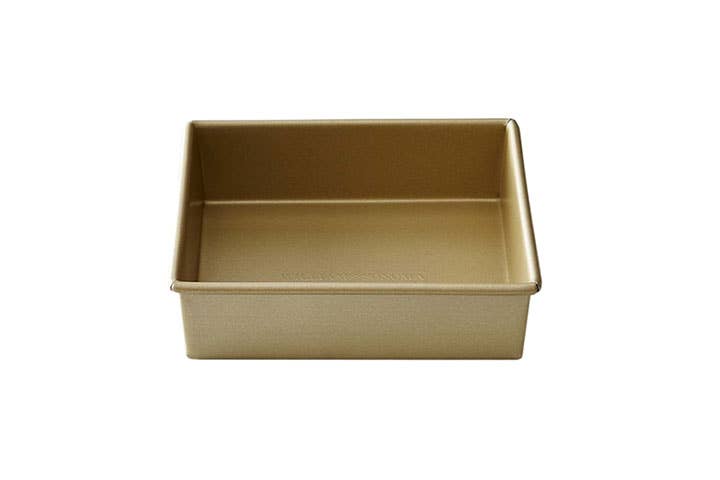
Material: Aluminized steel with Goldtouch Pro nonstick lining | Shape: Square | Max Oven Temp: 450 degrees Fahrenheit | Dishwasher Safe: Manufacturer says dishwasher safe - best to hand-wash | Dimensions: 8” x 8” x 2”
Pros
- Cakes bake with evenly smooth tops
- Excellent release and quick clean-up
- Free of PFOA or PFOS
Cons
- Monitor oven time- might require less time and slightly lower temperature
- Hand wash to maintain finish
- Not suited for cutting baked goods while in the pan; use silicone to prevent scratches
Why we chose it: A cake baker’s dream of a square pan, realized. There is something magical about the pan’s ceramic based, nonstick surface which turns out square layers with defined edges.
For both occasional and dedicated bakers, a square cake pan is essential for more than bar cookies and brownies. A square, single-layer cake is ideal for casual cake consumption and also for celebratory events. Made of commercial-grade aluminized steel, testers applaud the pan’s even heat distribution which turns out a golden, evenly baked layer without the drama of sticking. Square pans are often stubborn around the edges; the Williams Sonoma Goldtouch Pro released corners unscathed, which is often the biggest gripe when using a square pan.
Best Springform Pan: SAVEUR SELECTS 9-Inch Springform Pan
Best Springform Pan
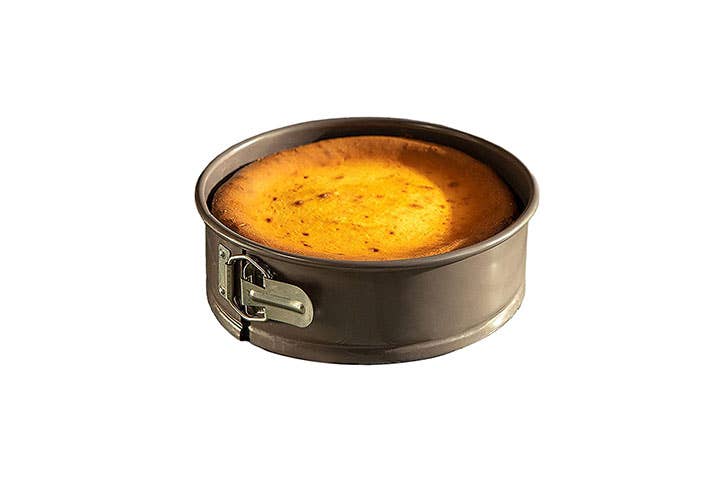
Material/Color: Steel/Gray | Shape: Round | Max Oven Temp: 450 degrees Fahrenheit | Dishwasher Safe: Yes, but preferable to hand-wash | Dimensions: 9.5'' L x 9.5'' W x 3” H
Pros
- Tight seal prevents leakage
- Durable and warp resistant
- Easy to clean nonstick surface
Cons
- Hand-wash to extend pan’s longevity
- Best used with silicone tools to avoid scratches
- Dry thoroughly before storing to deter water from pooling in the seams of the pan
Why we chose it: The SAVEUR Selects springform pan is a winning combination of a well insulated, nonstick pan with a tight seal and an easy-to-open hinge on the side.
Anyone who has ever gone to the effort of preparing a cheesecake only to discover that the springform has leaked deserves a solid, well-constructed pan with a tight seal. Many springforms promise the moon but not every one delivers. Testers were impressed with the nonstick finish of this pan, which provided easy release even after cakes had cooled down and been refrigerated. The hinge is truly a game changer, providing a seriously tight seal. Although the manufacturer gives this pan the green light for the dishwasher, testers say this top-quality pan is better suited to hand-washing. Testers also rave about using this pan for tortes, tarts and multi-layered desserts.
Best Overall 9”: USA PAN 9 Inch Round Cake Pan
Best Overall 9”
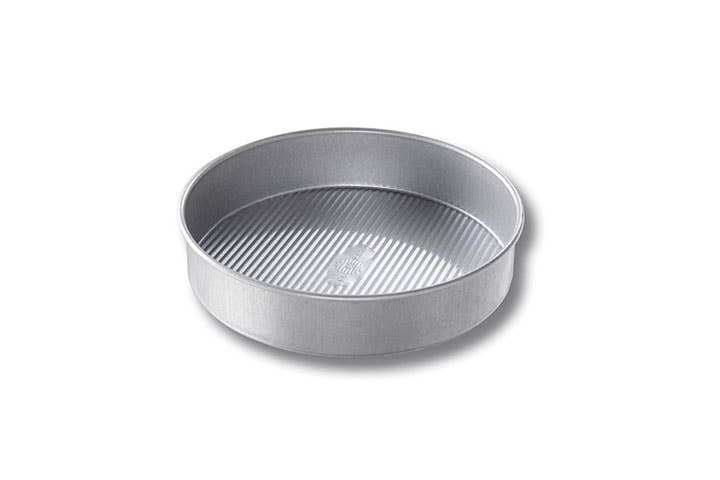
Material: Aluminized Steel Coated with Nonstick Silicone | Shape: Round | Max Oven Temp: 450 degrees Fahrenheit | Dishwasher Safe: No | Dimensions: 9” x 9” x 2”
Pros
- No PFOAs or PTFEs
- Limited lifetime warranty
- Corrugated surface makes for even baking.
Cons
- Hand-wash to protect finish
- Cooking spray is not recommended; may need to reduce oven time and temperature
- Use only silicone, nylon, or wooden utensils
Why we chose it: Professional quality, this is a sturdy pan crafted to last. A ribbed, corrugated bottom promotes excellent air circulation which delivers evenly baked cakes with beautifully smooth tops. Cakes release from the pan leaving few, if any, crumbs behind, meaning clean up is a breeze.
Professionals and home bakers rave about the quality of these Pittsburgh-manufactured cake pans. Their unique corrugated surface allows air to circulate, meaning cake layers bake and brown evenly. Cakes release from the pan with just the slightest coaxing, edges are smooth, and tops are level. The pans are sturdy, yet not in the least bit cumbersome when filling, transferring, and removing them from the oven. For anyone who has been using past-their-prime cake pans, adding a USA cake pan to the mix is transformative for both the cakes and the baker.
The Best Celebratory Set: Wilton® Countless Celebrations Adjustable 10-Piece Set
Best Celebratory Set
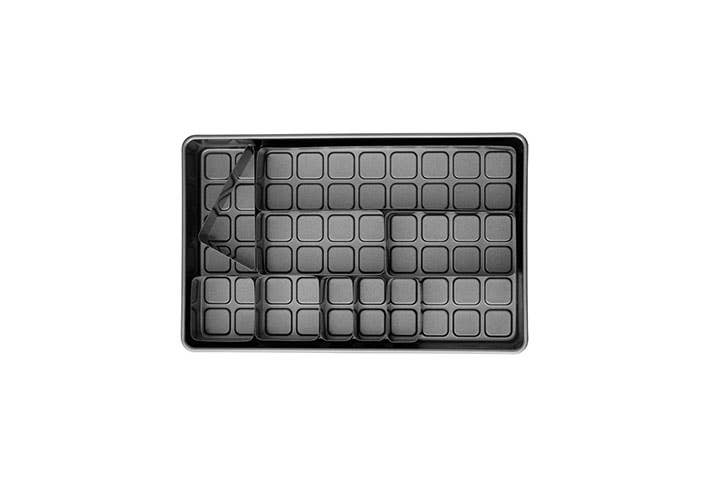
Material/Color: Steel | Shape: Rectangular| Max Oven Temp: 450 degrees Fahrenheit | Dishwasher Safe: Yes | Dimensions: 14.5” x 9”
Pros
- Easier to store than odd-sized, unwieldy single-themed cake pans
- Includes clear directions
- Limited 10-year warranty
Cons
- Cakes may need to be trimmed for neatness
- Dishwasher safe, but better suited to hand-washing
- Important to keep all of the various pieces together
Why we chose it: One pan and a series of inserts allows bakers to personalize cakes for many occasions.
A quirky addition to your bakeware for bakers looking to personalize a celebration cake, this nonstick, rectangular pan with a gridded bottom invites creativity. By selecting the appropriate inserts, anyone can design a cake baked into the shapes of numbers or letters. There is a bit of a learning curve, but bakers found it relatively easy to use once they ensured the inserts were securely in place to avoid leaking.
How We Chose These Products
All of the pans were tested using made-from-scratch classic yellow cake batter. Traditional pans were lightly greased, lined on the bottom with parchment paper, greased again and dusted with flour. Nonstick pans were lightly greased and dusted with flour. (The one exception was the springform pan; we tested several pans with a made-from-scratch cheesecake batter; pans were lightly greased and lined with graham cracker crust before using.) In addition to hands-on testing, we asked a number of professionals and serious home bakers to weigh in.
Features to Keep in Mind
Construction & Material
Look for sturdy pans that conduct heat evenly, are capable of withstanding frequent use, and release cakes without a problem when properly prepared. A quality pan should also wash up without too much effort.
Overall Heat Conductivity
Dark-colored pans absorb more heat. Light-finish pans bake more evenly, producing taller, more level layers, encouraging the exterior of the cake and the middle of the cake to bake in tandem, without a dark crust and an under-baked middle. Straight-sided pans make stacking and icing cakes easier, with a more professional end result. Domed layers often indicate uneven heat transfer and are common with thin-sided, flimsy pans.
Versatility
Before purchasing cake pans, identify the types of baked goods you prepare most often. Layer cakes, or snack cakes? Cheesecakes or loaf cakes? Consider this and stock your kitchen accordingly. “My thoughts are that while it may be tempting to try and have a cake mold do the “decorating” for you, it’s better to start with a solidly delicious, and intact cake from a simpler tin, and go wild with aesthetics from there,” says Julia Duke, owner/baker of Sea Biscuit Baking in Rockport, Maine.
Maintenance
Treated with care, cake pans will last for years and years. Nonstick pans are better suited to hand-washing and should not be used with abrasive utensils or cleaners. Traditional cake pans should be lined with parchment paper and greased/floured before each use, which will make releasing the cake layers easier. Additionally, the less cake left behind in the pan the better, and the easier the clean-up. Always avoid submerging a hot nonstick pan in cold water directly after using, which can damage its finish.
Ask the Experts
Q: Are silicone cake pans safe?
Flexible and colorful silicone cake pans are indeed safe up to 428 degrees Fahrenheit, but other than in high-volume restaurant use (generally designated for individually plated desserts), they did not warrant a place in our testing. They are not the best conductors of heat and are fiddly to unmold and clean.
Q: How do I prevent a cake from sticking to a pan?
Preparation is key. For nonstick pans, always dab some butter or shortening on the bottom of the pan, follow with a parchment paper circle/square, grease that, then lightly flour, knocking out the excess. Even though parchment paper is treated with silicone, to ensure a smooth release, it pays to take the extra few minutes to lightly grease and flour the parchment paper. Not only does it encourage a smooth bottom surface, it makes cleanup easier. Note: Certain nonstick pans specifically advise consumers not to use baking spray with their products and to grease and flour pans instead.
Q: How do I get a cake out of a pan?
A freshly baked cake needs a little time to set, which will prevent it from cracking and sticking; depending upon the size of the cake, approximately between 15-30 minutes. A slightly warm cake is easier to turn out than a room temperature or chilled cake. Carefully run a thin bladed offset spatula around the edges of the cake, holding it vertically to avoid tearing. To protect nonstick pans, it’s preferable to use a non-abrasive silicone tool to loosen the cake. Place a cooling rack over the cake, place it firmly on top of the cake and gently flip it so the cake is right side up on the cooling rack. Remove the parchment paper and let the cake cool completely.
Q: How do I line a cake pan?
For round cake pans: The most efficient way is to tear off a piece of parchment just slightly larger than your cake pan. Fold it in quarters to form a square and then in half diagonally to form a triangle. Place the tip of that triangle on the center of your cake pan, then trim off the excess parchment hanging over the edge. Unfold the paper to reveal a parchment circle, then lightly grease the bottom of the pan, place the parchment circle on the bottom of your pan, grease the parchment and the sides of the pan, dust with flour then knock out the excess. Square and loaf pans can be lined with parchment by simply tracing the pan on top of the parchment, cutting it out, lightly greasing the bottom of the pan and placing the parchment in the pan. Grease the parchment, as well as the sides of the pan(s), dust with flour, then knock out the excess. For certain square cakes and loaf cakes, you may want to line the sides of the pan with parchment strips as well.
Our Take
Sturdy, high quality cake pans are well worth the investment. The most foolproof picks are light-colored, heavy duty pans that create even heat distribution and turn out well-baked cakes with golden crusts, smooth tops, and tender crumbs. A small variety of pans will afford bakers unlimited creativity.
Keep Reading
Continue to Next Story