In the departement of the Lot, just east of Bordeaux in southwestern France, feudal castles and bastides loom high above strategic limestone cliffs, and lush green hills hide secret chateaux and prehistoric caves. Rivers flow gently through fertile valleys, connecting medieval market towns, hamlets, and farms. Like the neighboring region of the Dordogne, the Lot is famous for its foie gras, confit of goose and duck, black truffles, and other delicacies—and is fiercely loyal to traditional methods of food production. Roadside signs, some as modest as a weathered piece of wood nailed to a tree, turn this ancient countryside into a landscape filled with culinary opportunities—as though every family farm here had its own specialty. It was by following one of these humble signs that I was led to my first taste of exquisite handmade walnut oil, which has been produced in the region since the 11th century.
Andre Castagne, the proprietor of Huilerie Familiale du Lac de Diane, near the town of Martel, was busy feeding a fire with walnut shells and working a hydraulic press when I arrived at his small mill. The rich aroma of roasting walnuts filled the air. Warm and friendly, Castagne welcomed me, and then proceeded to carry on a lively conversation with me while he bounced back and forth between the three pieces of equipment that make up his entire operation—an ancient mill made of granite, which grinds walnut meat to a paste; a cast-iron basin in which Castagne roasts the paste over a wood-burning fire; and a hydraulic press layered with stacks of steel plates, which extracts the rich, golden oil.
Castagne bought his mill in 1985 and rebuilt it to its original form. Now, he presses oil daily through the winter (once dried, walnuts keep well, and each fall's harvest lasts all year) and also sells foie gras and pate made from his own ducks, among other farm products. "How about a taste?" he asked, having already poured the oil onto little plates for sampling. The flavor of the roasted nuts was immediate, followed by a delicate hint of maple. As I purchased bottles of oil and loaded up with walnut liqueur, tins of foie gras, and duck rillettes, he reminded me that "Walnut oil has no cholesterol."
Walnut oil, probably first made in Greece in the fourth century b.c., has gone in and out of favor through the ages. It enjoyed great popularity in Paris during the 12th and 13th centuries, for instance, until poppy seed oil became more fashionable. The 15th-century French king Rene d'Anjou had an irrational fear of olives and their by-products; he preferred walnut oil, planting groves of the trees in Aix. But a century later, the physician to King Francis I deemed walnut oil "too hot and caustic". And the 16th-century French poet Pierre de Ronsard described it as "useless". Until at least the end of the 18th century, however, walnuts remained sustenance for the agrarian poor. (Walnut shells were used to make bread in times of famine; the meat has been used to make a milk.) Today, with demand for flavorful, unsaturated oils on the rise, walnut oil has resumed its place of prominence.
Walnut oil, which smells and tastes a bit like a more rustic version of vanilla, is rarely used for cooking—it has a low smoke point, which means that it burns easily— but is a seasoning and dressing oil par excellence, treasured for its intense aroma, bold, nutty flavor, and unmistakably earthy character. In the Lot and adjacent regions, walnut oil is commonly drizzled over grilled duck or foie gras, or used in salads or as an ingredient in walnut cake (see recipe). In earlier times, the oil was also used in lamps, as a painting and varnishing medium, as a home remedy prescribed for everything from bed-wetting to mental illness—and even to treat cases of indigestion in sheep.
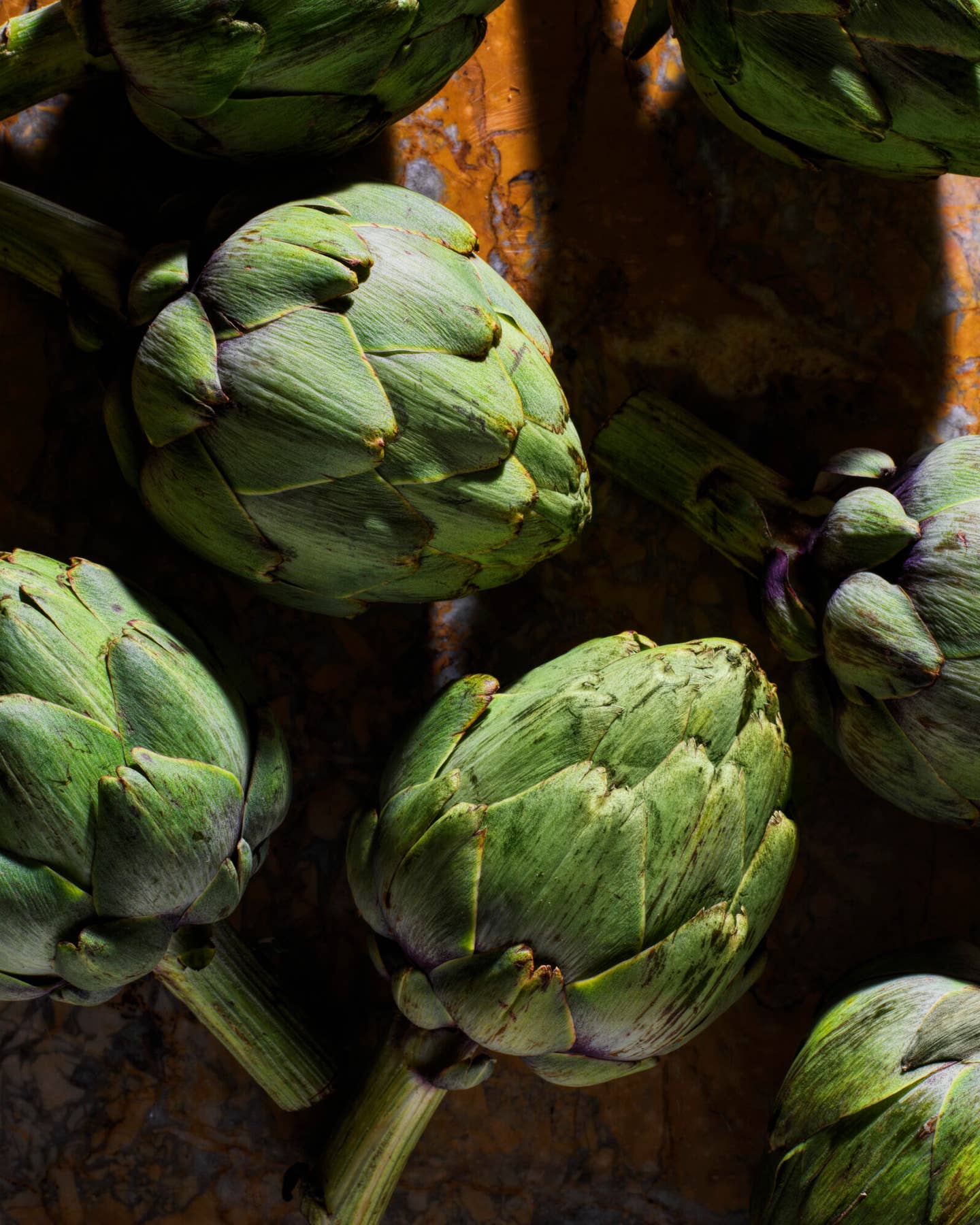
Its uses can also be somewhat more refined. Jean-Georges Vongerichten, chef-owner of New York's Jean Georges, Jo Jo, and Vong restaurants, for example, uses it to finish a sauce for lamb. "The strong flavor of the walnut oil stands up to that of the meat," he says. In the fall, he also drizzles walnut oil over mashed potatoes and uses it in a vinaigrette for a dish of sweetbreads with warm potato salad. Chef Gray Kunz of Lespinasse, also in New York City, fondly remembers "a wonderful dish I had in Bordeaux of roast leg of lamb with white beans, served together on a platter with a sprinkling of walnut oil." In his kitchen, Kunz uses it very economically, to season salads and to accent a dish of foie gras with toasted brioche. "Because it is so strong," he says, "I have my cooks keep it in squeeze bottles so they never use more than a few drops at a time." I like to pour it sparingly over asparagus, artichokes, or haricots verts myself, letting the steam carry its haunting scent.
The main production of walnut oil on small farms like Andre Castagne's takes place after the fall harvest in October, continuing through winter. In this period, whole families head for their orchards, filling burlap sacks with walnuts. (The most commonly grown varieties are the franquette, the mayette, the marbot, and the corne.) The nuts, quite damp when fresh, are then dried over a gas stove. Most of the shelling is done by hand at these small mills, and the occasional soiree denoisillage, or nut-cracking party, still takes place. At these get-togethers, veterans whack the nuts with a traditional wooden hammer. Skilled nut crackers can shatter the shell while leaving the meat intact; whole walnuts bring a higher price than the cracked ones that are used for oil.
These broken pieces, known as les invalides, are sent to a mill for crushing. In traditional production, the nut paste is then roasted in a woklike cast-iron basin over a wood-burning fire. Perfect roasting is crucial to the quality of the oil and can make or break a miller's reputation. If the fire is too hot, the paste can scorch at the bottom and create a bitter, caustic oil; conversely, oil made from undercooked paste will lack the characteristic roasted flavor. The paste must be removed at that perfect moment when the aroma is opening and a round, roasted flavor has developed. Some producers claim to time the process with their noses, not their watches.
The roasted nut paste is next put into a hydraulic press where heavy steel plates apply up to 200 tons of pressure to squeeze the oil out. It's collected in a basin, and the remaining cake of solids, called tortaux de noix, is fed to the animals—especially chickens, as it is said to increase their laying. The oil is left to settle for about three weeks before it is bottled. It takes about five and a half
pounds of nutmeat to produce two pints of oil, making the typical price tag of $10 a pint seem like a bargain.
Unfortunately, walnut oils made by this painstaking process are rarely seen outside southwestern France. Much of the walnut oil sold in the United States, both French and domestic, is processed mechanically, and solvents are often used in extraction; some producers add chemical preservatives as well.
In the days before World War II, Castagne remembers, virtually every village in the Lot and the Dordogne had its own walnut mill, where residents brought their harvest to be pressed. Today, Castagne's mill is one of two mills that are still in operation in the Lot; there is only one in the Dordogne. However, walnut oil and other products based on walnuts (including aperitifs, digestifs, and, now, preserves) are increasingly popular, and it seems possible, considering local interest in traditional products, that more old mills might be reopened in the future. "Working at the mill," adds Castagne, "is a good way of keeping the children at home."
Keep Reading



Continue to Next Story