May 14, 2012
8
reviews
Rate & Review

Seeded Rye Loaf

Dark and deeply flavored from a rye sourdough starter that's made 10 days in advance, this earthy loaf is easily customizable depending on what seeds and grains you have on hand and want to add to the dough. This recipe first appeared in our May 2012 issue along with William Alexander's story American Bread.
Print Save Recipe
Seeded Rye Loaf sourdough starter Enlarge Image Credit: Todd Coleman

INGREDIENTS

6 cups (16 oz.) rye flour
3 ¼ cups plus ⅓ cup (1 lb. 12 ⅔ oz.) tap water, heated to 115°
¼ tsp. active dry yeast
2 ¼ cups (12 ⅓ oz.) bread flour
1 ½ tsp. (3/8 oz.) kosher salt
Canola oil, for greasing bowl
¼ cup each sunflower, pumpkin, or sesame seeds, cracked wheat or rye (any combination), mixed together in a bowl
½ cup ice cubes

INSTRUCTIONS

1. In a bowl, stir ½ cup rye flour, ¼ cup water, and yeast until a smooth paste forms. Cover with plastic wrap, and let sit for 24 hours. Repeat this process for the next eight days, adding the same amounts of rye flour and water, to make starter (which you can keep alive, in the fridge, by adding the same amounts once weekly.)

 
2. On 10th day, place ¼ cup starter in a bowl. Stir in ½ cup rye flour and ⅓ cup water until smooth to create sourdough culture for this loaf. Let sit for 8 to 24 hours.

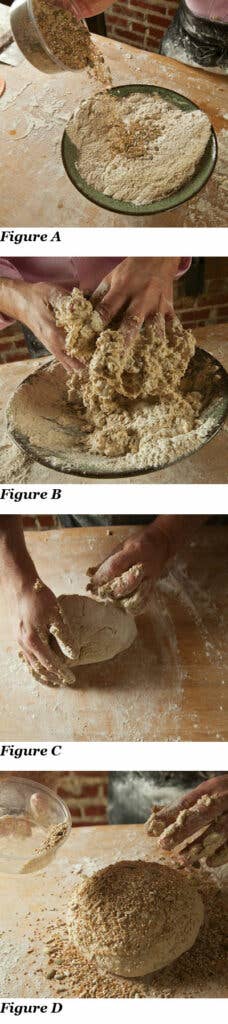
3. Uncover culture, and add remaining 1 cup rye flour and ½ cup water, along with bread flour, salt, and half the seed mix (Figure A). Stir until dough forms (Figure B); let dough sit for 20 minutes. Transfer to a floured work surface; knead until smooth and elastic, about 10 minutes (Figure C). Transfer to a greased bowl; cover with plastic wrap. Place in a cold oven; let sit until slightly inflated, about 1 hour. Transfer to a work surface and flatten. Fold top and bottom edges toward middle. Return dough to bowl, seam side down; cover, and return to oven. Let sit until doubled in size, about 3 hours.

4. Transfer dough to surface. Positioning your hands on outside edge of dough, rotate dough over surface to form a taut dome, pinching edges underneath. Transfer, seam side up, to a floured kitchen towel in a colander. Cover loosely with plastic wrap; let sit until doubled in size, about 3 hours. One hour before baking, place a cast–iron skillet on bottom rack of oven; position another rack above skillet; place a baking stone on top of it. Heat to 400°.

5. Invert dough onto a parchment paper sheet on a rimless baking sheet. Spray with water, and cover with remaining seed mix (Figure D). Using a razor, slash a hash tag pattern in top of dough. Using paper, slide loaf onto stone. Place ice in skillet. Bake until dark brown, about 1 hour; let cool before serving.

Seeded Rye Loaf sourdough starter

This article was first published in Saveur in Issue #147

Ratings & Reviews (8)

noAvatar
This recipe yields a dense dark loaf with a sturdy crust and a faint sourdough flavor, but is definitely not worth the effort or the time. If I didn't have so much leftover starter I'd probably never bother to make it again. Since I do have a lot of extra starter, I may try it again using all wholewheat bread flour instead of the white flour and adding some vital wheat gluten.
I made the recipe as written and found that there were many unnecessary or unclear steps. This makes far more starter than is useful or necessary- start with a large container. The rye flour began turning vaguely pinkish-red as it broke down. Not mold/bad bacteria, just a very different shade than I was expecting from previous sourdough experiences. The description of the seed mix is also unclear. I assumed it meant 1 cup mixed seeds, 1/2 cup in the bread, 1/2 cup sprinkled on top of the finished loaf. I saw no point in the reforming of the loaf after a 1 hour rest in step 4, nor did I bother with the colander for the final rise.
I also question the combination of ice and cast iron in a hot oven. This seems like a good way to crack a nice pan. I just used a metal cakepan. This is the third bread recipe I've tested from this issue and they all come out just like the picture but none have been significantly better than the breads I usually make. I bake bread 1-2 times each week
noAvatar
I didn't make this recipe, primarily because -- like the prior reviewer -- I found the recipe unclear and vague in key areas.
noAvatar
I didn't make this recipe, primarily because -- like the prior reviewer -- I found the recipe unclear and vague in key areas.
noAvatar
I didn't make this recipe, primarily because -- like the prior reviewer -- I found the recipe unclear and vague in key areas.
Does anybody know if you leave the starter out at room temp, in the oven, or in the fridge? It seems like the other recipes specified.
noAvatar
I'll try posting this again... the last review got eaten.

Scassid2, I'd leave the starter at room temp until it is established. Then put it in the fridge.

Surely the instructions should read to add the yeast to the starter only once. And I'd be inclined to use less yeast and a LOT less rye flour if only 1/4 cup (weight please!) of starter is required for the final bread.

Also, the weight for the rye flour appears to be off. Every other online conversion page says that 6 cups rye flour weigh 612gm (21.5oz).

This bread looks pretty fabulous though. Too bad the instructions are a little on the iffy side.
noAvatar
The instructions are convoluted. I teach an artisanal bread baking class and even I was taken aback by the instructions. To improve the presentation of the recipe, I wish you Saveur editors would break it down into "Starter" and "Loaf." I also think it is rather unnecessary to use commercial yeast when making a starter because its completely antithetical to using a starter in the first place! A 10-day old starter is going to have enough developed wild yeast to get your bread to rise! try substituting malt or even sugar for the yeast in the starter portion of the recipe.
noAvatar
This bread was not worth the time or money it took to make. Now that I look at the recipe more closely and compare it to other seeded rye recipes I have, I can see the key problems. The loaf does not contain enough water- it is less than 50% hydration. Additionally, the seeds added to the bread have not been soaked. I already threw this starter out, but I would be interested to see what would happen if the seed mix were soaked in an equal weight of boiling water overnight. All in all, if you want to make a starter, go with Nancy Silverton's La Brea Bakery starter. Copies of the book are cheap on Amazon and although the starter takes a while to develop, you can make many types of bread from it, not just rye.
Seeded Rye Loaf 2 5 5 8

Your Rating & Review

Please log in to leave a comment. Not a member yet? Sign up here.