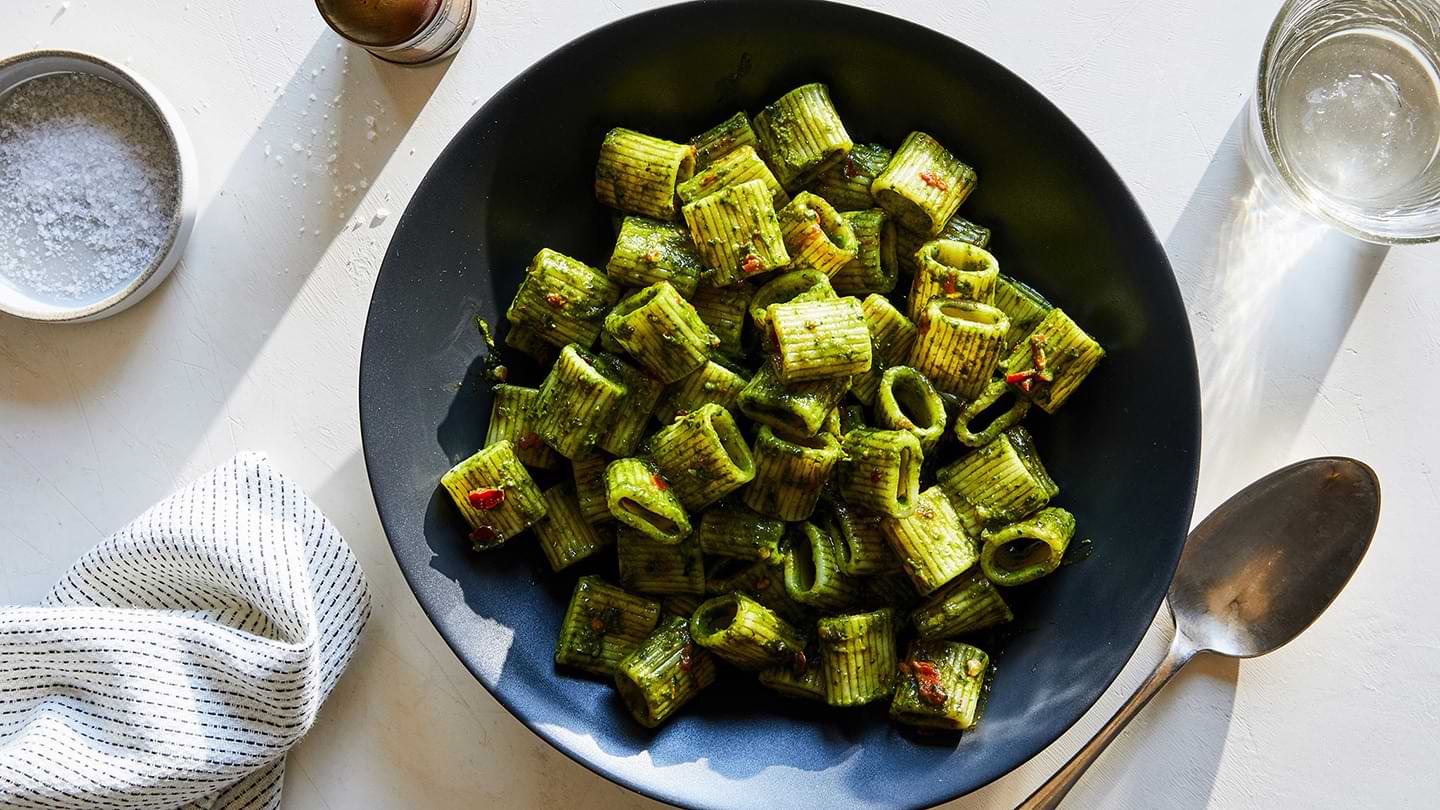
The Soft Approach: In Praise of Soft-Cooked Vegetables
A cook ventures past the point of al dente
I blame Julia Child for our national aversion to soft vegetables. It wasn't until she started urging American cooks—in her books and on her PBS series, The French Chef—to blanch everything from green beans to kale and then shock them in cold water, that a bright green color and firm texture were programmed in our minds as the platonic ideal. Well, I grew up on soggy broccoli rabe, and that's still my favorite way to eat it. Granted, broccoli rabe that's cooked just beyond its bright green state yet is still unpalatably bitter is a foul punishment. But something happens if you keep cooking it past that point. Eventually it becomes mellow, unctuous—creamy, even—the stems melting away in the mouth as ethereally as the florets.
That was how my grandmother, who hailed from the Abruzzi region of Italy, prepared it, but early on I noticed that broccoli rabe like my nonna's was nowhere to be found outside our home. In restaurants and on cooking shows, it was prepared one way: blanched, then sauteed. And served one way: safely on the firm side of tender. When I got a kitchen of my own and started collecting cookbooks, I realized that the most respected food authorities were opposed to certain long-cooked vegetables. In the vegetable volume of Time-Life's The Good Cook series (1979), the editors advised to "keep the cooking time brief" for all crucifers lest they "become sulfurous." Yet I knew full well that Nonna's broccoli rabe—and my own—never had that offensive smell. And then there was food science writer Harold McGee, whose On Food and Cooking (Scribner, 1984) proclaimed, "Prolonged cooking makes members of the onion family more sweet and mellow, but the cabbage family gets more overbearing and unpleasant." Full stop.
McGee explained the chemistry behind that cabbagey stink, but he failed to account for the sweetness that comes around if you brave through that stage and keep on cooking. But, I thought, what about the greens that simmer to sweetness for hours in kitchens across the American South? Or the many Middle Eastern dishes of vegetables rendered luscious via long stewing? None of my heroes acknowledged these foods; none of them, it seemed, had ever left the pan on the heat for too long and made a happy discovery. What did they serve, I wondered, in the heart of winter, when everything else on the plate was roasted, and a bit of squishy comfort was warranted?

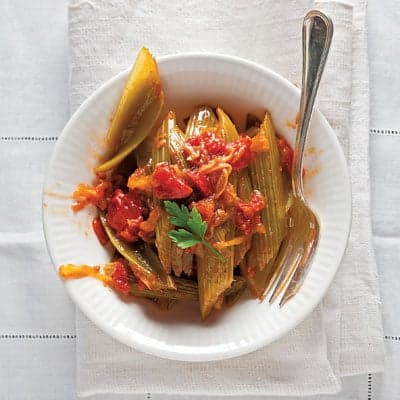
Braised Celery and Tomato (Sedano e Pomodori Brasati)
Celery stalks’ stringy fibers, often removed before cooking, here act as a brace to help the vegetable keep its shape through a long simmer. The result is a sweet and luscious side dish.
Photo: Todd Coleman
It was one thing to note this omission in cookbooks, but another thing entirely to find that among my peers I was nearly alone in thinking there were more options than just al dente. I discovered as much in culinary school, on day one of Vegetable Cookery. Chef Ted, an imposing Doric column of a man, was to lead the lecture. We walked into our kitchen classroom that day to find several pots of water and various vegetables already bubbling on the stove. Without a word, Chef Ted pulled some green beans from a pot and distributed them for us to sample.
"Is that cooked?" he asked the first student who bit into it. "Yes," came the answer. He looked at another student. "What do you think?" Again came the answer: yes. Then he looked at me. I took the bean, bright green and firm, and bit down. And there—a telltale squeak between my teeth that I didn't like. "Um, no?" I said. The rest of the class, save one other person, agreed that these beans were perfectly cooked.
"You," said Chef Ted, pointing to me, "and you," to the other who had sided with me, "are the only two who know what a cooked vegetable should taste like." When I asked Chef Ted about it later, he said, "You find in big cities, or with people who think they're more educated about gastronomy, that they'll think crunchy vegetables are properly cooked. It's the influence of French nouvelle cuisine; it was a reaction against classical French not to overcook vegetables. Like anything else that's good, it got misinterpreted in the wrong hands."
Still, "crisp-tender" was the institution, and so we fussed over ice baths and obsessed over "setting the color." I became aware of the divide in my thinking in the kitchen: One kind of cooking was restaurant food, and then there was how I preferred to cook at home.
Until the day I stumbled on a dissenting voice, a plea on behalf of the overcooked; unsurprisingly, it came from an Italian, Marcella Hazan. Her cookbooks are full of recipes for vegetables rendered soft and yielding in slow-simmering water—olive oil baths, the cooking liquid itself as delectable as a broth. Nothing complements roast chicken like her braised artichokes and leeks, olive green and silky; her braised celery stalks reveal a luxuriousness you wouldn't expect from celery. I was certain there must be scientific corroboration for what Hazan and generations of cooks before her knew based on experience at the stove. I phoned Dr. Keith Harris, assistant professor of food science at North Carolina State University, to see if he could shed light on that elusive vegetal sweetness that comes with long cooking. "It's true that when vegetables, especially cruciferous vegetables, are cooked, the damage to the plant's tissue brings about reactions between compounds that are usually kept separate," he said—hence the sulfuric aroma. But, he emphasized, if you continue to cook these foods, "at a certain point the aroma will dissipate, and you'll end up with the flavor compounds left in the plant, including its sugars—especially if it's cooked and served in a way that the sugars aren't poured out with the cooking water."

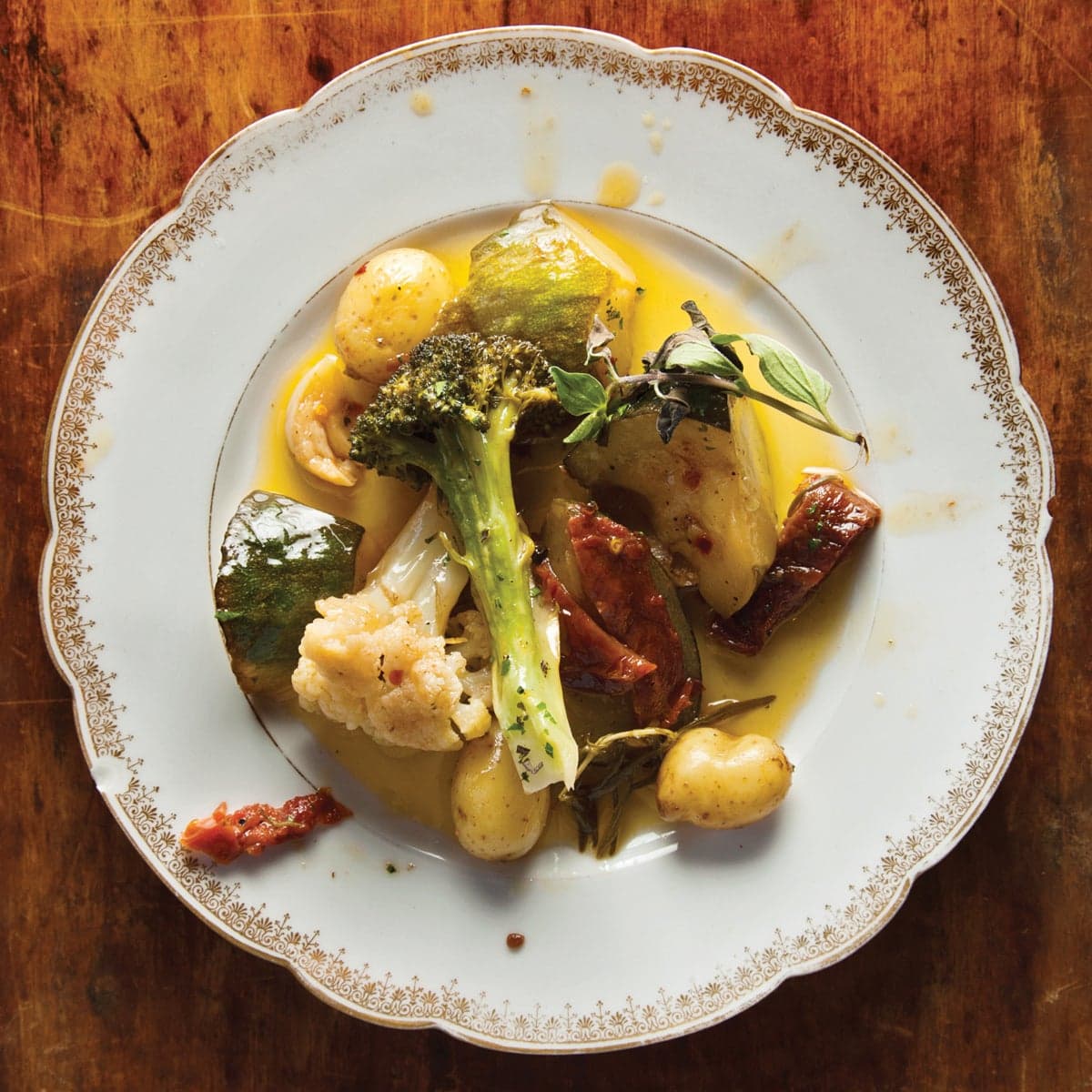
Olive Oil-Braised Vegetables
This flavorful mix of broccoli, cauliflower, zucchini, and potatoes is braised in olive oil that’s been infused with rosemary, chile flakes, lemon, and anchovies. Get the recipe for Olive Oil-Braised Vegetables »
Photo: Todd Coleman
In the last few years, I've been delighted to detect signs of rebellion among Hazan's culinary heirs. When I was working at a culinary magazine, I walked into the test kitchen one day to find one of the food editors serving green beans cooked in water and olive oil long enough that you could practically bite through them with your tongue alone. And on the menu at Pizzeria Mozza in Los Angeles, I spied a savory pie topped with "long-cooked broccoli" soft enough to spread like butter.
When I talked to Mozza's chef and co-owner, Nancy Silverton, it was like finding a long-lost family member. "You've got to really push the envelope, push through the just-cooked stage, and you arrive at that sweet complexity again," she said. "When I was at Campanile in the '80s, we were doing the California thing of barely cooking baby vegetables; we were so proud of their purity. But the Italians who visited us pooh-poohed it, because they know that more mature vegetables actually have more flavor. They would push us to go for longer cooking times. True Italians have no tolerance for crunchy vegetables."
So there it was: The more I searched, the closer I came to my roots. Still, my own family remains divided on the issue. My husband and son are happiest on the days that I blanch and then quick-saute the broccoli rabe with olive oil, chile flakes, and garlic. But there are times when I must honor where I came from. I remember the first time I brought a bowl of long-braised broccoli rabe to a gathering of my extended family after both my grandparents had died. "Mmmm," my uncle smiled, after tasting a forkful. "This is just how Dad liked it."
Keep Reading

Continue to Next Story