Season of Plenty: Yunnan’s Mushroom Harvest
From remote mountain forests to bustling urban markets, in China’s Yunnan Province, mushrooms are foraged treasure
Last summer I visited a restaurant called Delicious Fragrant Mushroom Found Between Mountain Mushroom Bamboo Garden—or, in Mandarin, Shan Jian Ling Xiang Jun Zhuyuan. I was in Kunming, the capital of Yunnan Province, in southwestern China. It was the height of the foraging season in perhaps the best place on Earth for finding and eating mushrooms. At the front of the restaurant there was a glass case displaying the various fungi on offer that evening. Some I recognized: porcini, with their bulbous heads the color of cafe au lait; ruffled, apricot-colored chanterelles. Others were unfamiliar, even fantastic: a mushroom the color of tobacco, with a parasol top and curlicue stem; another with a poisonous-looking green head; a funguslike coral, its clusters of delicate forked fingers tinged pink at the ends; and a phallic thing seven or eight inches long, with a lobed brainlike gray head, from which there hung a lacy white veil.
Upstairs, in a small private dining room, this last specimen, called bamboo mushroom, or zhusun jun, was served simply, almost reverentially, quick-sauteed with no seasoning at all—nothing to interfere with its earthy flavor. The texture was silky, with a slight crunch; the honeycombed head and lacy veil were like very fragile tripe. "This is one you can enjoy with your mouth, your eyes, and your belly," said Yuan Wenshou, the restaurant's owner.
His friend, the gregarious Dr. Dequn Zhou, a mycologist at Kunming University of Science and Technology, kept the conversation flowing while Yuan poured out tiny cups of truffle-infused corn wine. A parade of mushroom dishes continued to appear, including a fried rice made with meiwei niugan, or delicious cow's liver mushrooms—known in the West as porcini or cepes. Zhou called the mushroom by its botanical name, Boletus edulis, and explained that it's one of Yunnan's most valuable mushroom exports, largely because no one's figured out how to cultivate it. With a wry smile, he remarked, "Unfortunately, we cannot cultivate Boletus. Fortunately, we cannot cultivate Boletus."
But the main attraction was the mushroom hot pot bubbling away at the center of the table, its broth enriched with some 40 species of mushrooms. Every so often a young woman would appear to add a different fresh mushroom to the pot; every time she ladled some into our bowls, it had been transformed into a new, more intensely concentrated soup. Yuan explained that his was one of the oldest mushroom hot pot restaurants in town—that is, it's been in business for a decade now. It turns out that the kind of elaborate hot pot meal we'd sat down to is a recent development, a product of the mushroom boom that's transformed life in Yunnan over the past 20 years. This meal was a tribute to the almighty mushroom.
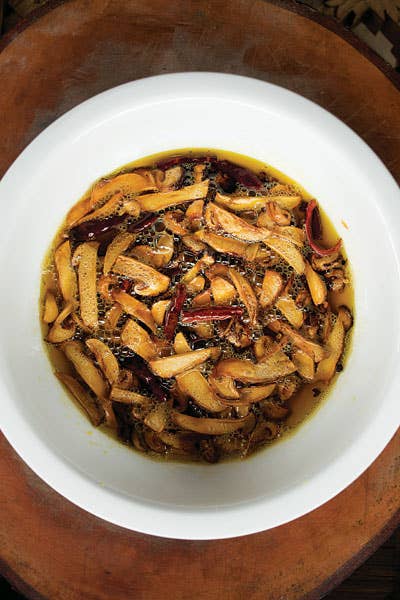
photo by Ariana Lindquist
The following morning at Kunming's main mushroom market, a sprawling covered arcade redolent of the pheromone scent of wild fungus, dozens upon dozens of mushroom entrepreneurs hawked their foraged treasures. A few of them dealt in other foraged specialties of Yunnan, as well—edible flowers, hunks of honeycomb alive with wriggling larvae—but otherwise the market was given over entirely to mushrooms. "More than 800 varieties of edible mushroom grow in Yunnan," said Zhou Yuankuang, secretary general of the Yunnan Mushroom Association, as he walked me through the workings of the local trade. "It is one of the most biodiverse places in the world."
He explained that every day, between two and three in the morning, mushrooms arrive from all over the province. Large-scale dealers and exporters operate independently of the mushroom market, buying in quantity in county seats around Yunnan and taking the mushrooms back to Kunming or transporting them by airplane directly to other parts of China and to Japan, Italy, France, and the United States. Annually, mushroom exports earn dealers in Yunnan more than 650 million yuan ($100 million); sales to the rest of China bring in another 3 billion yuan ($450 million).
Later I pondered all this over lunch at Huoche Nanzhan 1910, or 1910 South Railway Station restaurant. The dishes here were, I was told, more-traditional Yunnan fare: chewy wood ear mushrooms in a tangy, chile-hot salad; Boletus sliced thin and stir-fried with hot-sweet green lantern pepper. There were also mushrooms that aren't typically exported but are beloved within Yunnan: deeply umami jicong ("chicken-taste") mushroom, julienned and sauteed and piled onto a silken savory egg custard; blue-black ganba, shredded and fried to intensify its powerful, sinus-clearing evergreen fragrance.
I thought about the far-off corners of Yunnan these mushrooms had come from. I imagined cool pine forests, and the people foraging there, and how they might cook what they'd found. I wanted to know what these mushrooms would taste like freshly plucked from the earth.
Yunnan is a singularly diverse place, not only biologically but also in terms of climate, topography, and culture. The province borders Tibet, Sichuan, Guizhou, and Guanxi, and the countries of Vietnam, Laos, and Burma. In Yunnan's tropical lowlands, you'll find peacocks and elephants; not so far away but considerably higher in elevation, in the foothills of the Himalayas, yaks roam the snowy mountainsides. A full third of China's ethnic minorities lives in Yunnan, 25 different groups in all, each with its own language and customs.
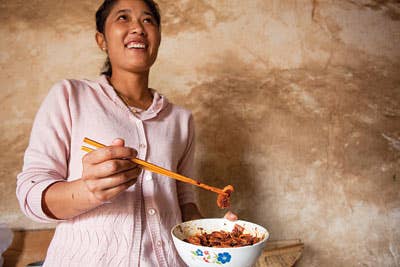
photo by Ariana Lindquist
My next destination seemed about 200 years from Kunming, along the old Tea Horse Road that was once the main trade route between China and Tibet. The Shaxi Valley lies in northwest Yunnan Province, a protracted 56-mile drive from the nearest airport along a rocky road that hugs the edges of sheer cliff faces for much of the distance. Along the way, Wu Yunxin, a local guide who'd picked me up in his Volkswagen Jetta, pointed out signs of a highway under construction that promises to bring the world to his doorstep.
Wu lives in a small farming village called Duan Jia Deng, nestled in the valley's fertile bottomland between two pine-forested mountains, in an area populated primarily by people of the Bai ethnic minority. For the last few years, Wu has run a guesthouse with his wife, Duan Jan Pin; a trickle of tourists, mostly Europeans, Americans, and Australians, has begun to find its way to Shaxi, drawn by the area's natural beauty and the opportunity to see a way of life in China that's fast disappearing.
At this time of year, foragers set out from the village each morning at sunrise to collect mushrooms. They ascend the eastern mountain, because that's where the best quality song rong are to be found. This is the mushroom the Japanese call matsutake and value above all others. In the early 1990s, after Japanese harvests of the mushroom began to dwindle, "a whole new economy came into play here," Wu told me. "It changed people's lives. Families were making enough money from gathering mushrooms to build new houses."
As Wu led me up the mountain one morning, the combination of the near-vertical incline and high elevation had me gasping for breath. By the time we got up to the forested part of the mountain where the song rong grow, the foragers had been at it for hours. We stopped and listened. Wu called out, "Whoop!" No response. "They are very protective of their hunting grounds," he told me. He called out again, this time identifying himself. After a minute, we heard an answering call from within the trees.
Hacking through branches and brush, we finally came upon two women who looked to be in their 50s, with large baskets strapped to their backs. Their names were Duan Fu Yu and Cun Long Mei; Wu addressed them both as aliang (auntie). Duan Fu Yu allowed me to trail her as she moved through the trees, scanning the ground. Invariably, I was unable to see whatever it was that made her stop and gently push aside the pine needles at her feet; invariably, there would be mushrooms. "Today's a happy day for us," said Cun Long Mei. "We'll even fill the extra bags we brought." In addition to song rong, they'd collected termite mushrooms and a local variety called huangpi huzhang; they'd sell some of these mushrooms, but later they'd also trade with each other to make sure they both had enough of each kind for cooking. The song rong, however, they'd keep aside for selling. They were too valuable to eat.
Later that afternoon, on top of the mountain, we crossed a meadow dotted with edelweiss to reach a small settlement called Xitu, a collection of low-slung whitewashed houses with peaked tile roofs. Wu had spotted the donkey of a neighbor from his village tied up nearby. Yang Jia Ping is a mushroom buyer, and he'd climbed the steep and narrow mountain trail, leading his donkey behind him, to survey the haul brought in that day by the family that lives there.
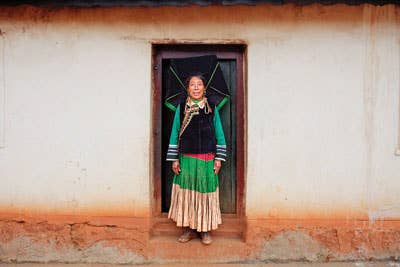
photo by Ariana Lindquist
The family, named Sha, is, like many of the people who live up this mountain, ethnically Yi. Inside one of the houses, it took a few moments for my eyes to adjust to the dark. In the center of the room was a wood fire, and squatting and seated around it were a few men in Western-style dress and a couple of women in traditional Yi garb: embroidered head scarves and long tiered skirts in shades of yellow, fuchsia, and green. Everyone was watching in hushed anticipation as the mushroom buyer weighed out on his balance scale the song rong the women had gathered. A man handed me a glass of hot tea and a potato dug out of the embers of the fire. Suddenly I realized I was ravenous; the smoky flesh of the roasted potato tasted wonderful. An older woman in a winged black headdress stood in the doorway overseeing the transaction. When the buyer announced his price, she furrowed her brow, considering; the two younger women looked at each other, smiled, and accepted his terms.
Following Yang down the mountain, we could barely keep up, though the mushroom buyer was simultaneously smoking a cigarette, talking on his cell phone, and leading a donkey burdened with baskets of mushrooms. Within eight hours, the mushrooms in those baskets would be arriving in Kunming; within 48, some might be on display in supermarkets in Japan.
I wanted to know how people in Shaxi used these mushrooms in the days before they became an international commodity and the centerpiece of grand hot pot feasts. The next afternoon, Wu's wife, Duan Jan Pin, agreed to show me. We were at the house where she grew up and her parents still live, along with her brother and his family. Duan washed the mushrooms and other vegetables under a spigot in the brick courtyard and chopped and prepped them out there, too. In the kitchen, she cooked everything in a massive cast-iron wok set over a wood fire.
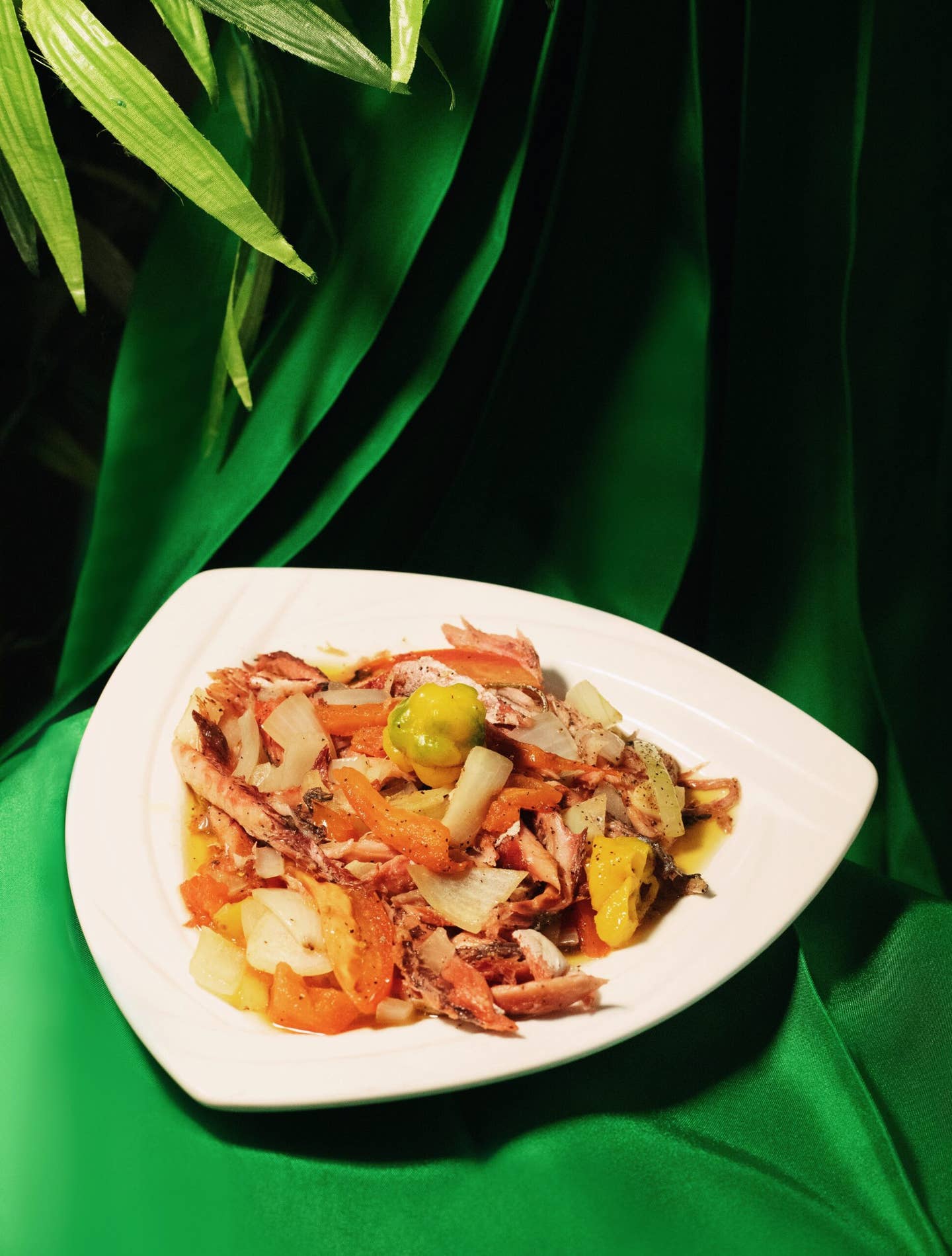
There was sliced song rong stir-fried with bacon, green chile, and scallions. She cooked the pine-scented mushrooms just to the point where they were luscious but still firm and had released some of their moisture, which reducd quickly to make a flavorful sauce. There was another stir-fry similar to the first, only with dried red chiles instead of fresh green ones, and meaty porcini instead of song rong, which made it a completely different dish. The umami flavors of the bacon and the mushrooms magnified each other exponentially. A whiff of wood smoke permeated everything.
There was a hot and sour, chile-flecked salad of sliced huangpi huzhang mushrooms that Duan boiled in the wok until they took on a satisfying firm and succulent texture. To make a soup she called "white wind mushroom noodle soup," she stepped into the garden and picked a young pumpkin, which she julienned into fine shards and cooked in a broth along with buckwheat noodles, lightly fried diced potatoes, bacon, chile, and scrambled egg. "Eat it right away," Duan said, "or the noodles will get soft." The potatoes and pumpkin released their starch to thicken the broth, and a dollop of red chile paste added color and heat.
Finally, Duan cooked jicong mushrooms in a quantity of bubbling oil along with dried red chile and Sichuan peppercorns. Once it was cool, she poured some of the infused oil into a jar for me to take home. "You can keep this in your kitchen and put a little in soups or noodles dishes," she said. A perfect souvenir of Shaxi: the essence of those mushrooms, captured and concentrated.
Keep Reading

Continue to Next Story