The Light of Morning: The Cuisine of Haiti
In a town in northwest Haiti, putting good food on the table is both a serious business and a reassuring ritual
The roosters in Gros-Morne start their screeching around four in the morning, which might explain why life in this Haitian town is already well under way by six. Motorbikes are zipping down the rubble-strewn roads, their drivers honking tinny horns as they navigate around pedestrians and potholes and donkeys. Schoolchildren march by wearing backpacks and neat uniforms; women balancing giant bundles on their heads gossip en route to market.
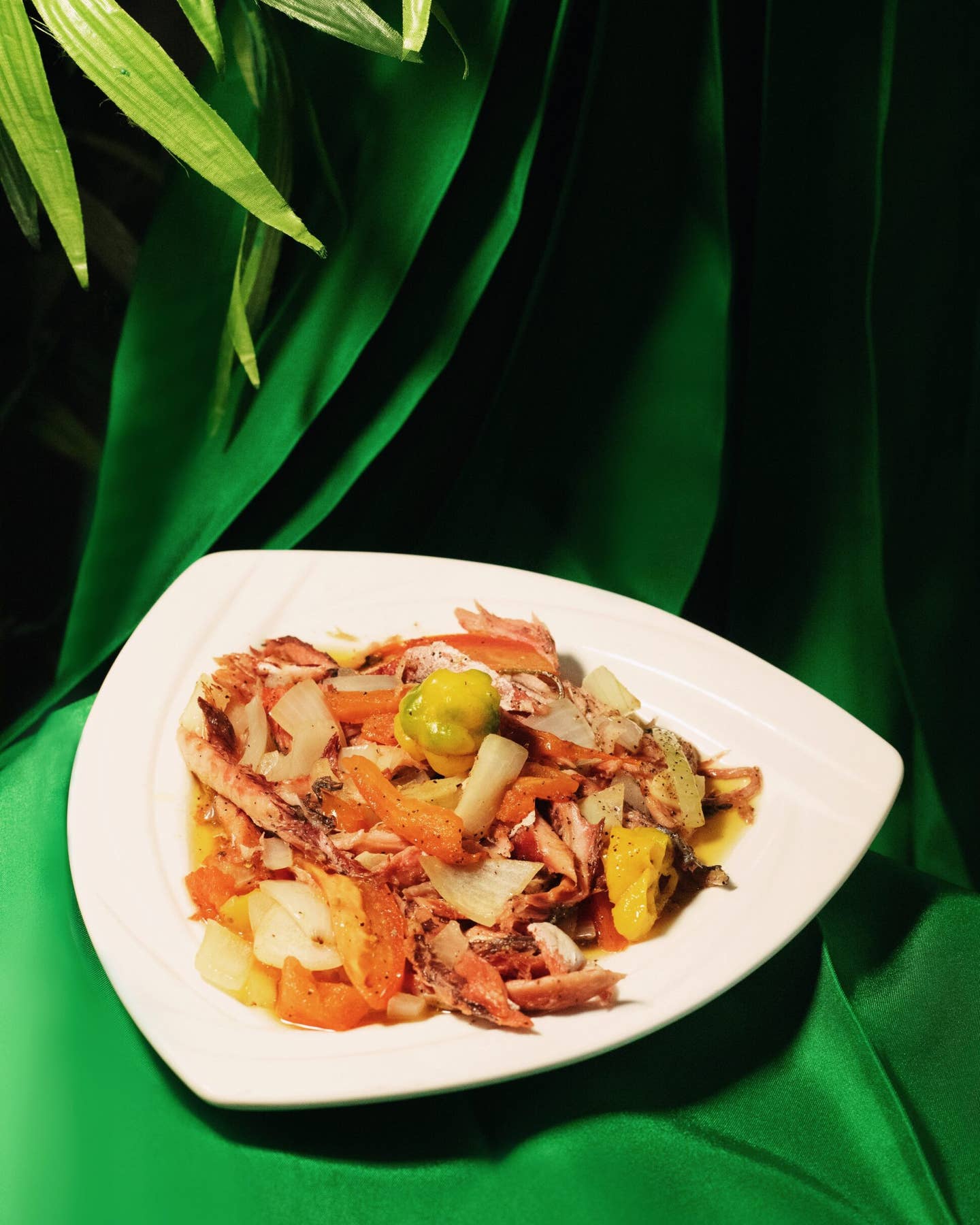
I've come to this part of Haiti to learn about the mango industry—what many see as a bright spot on otherwise grim economic and environmental fronts—but what I mostly hear about is Madame Ti Roche. The deputy mayor? He eats at her Ideal Bar Restaurant whenever his wife isn't around to cook. The head of the region's leading mango cooperative? Sunday nights invariably find him picking his way through a plate of Madame's chile-flecked poisson rouge. The truckers, the priests, the foreigners and NGO folks who rumble through this dusty outpost—they all turn up at Madame's at one point or another. It's a comfort in a place with few of them.
When I flew to Haiti to do some reporting just after last year's earthquake, I'd expected things to be rough. But returning this time, I had allowed myself hope for some improvement. On the four-hour drive from Port-au-Prince to Gros-Morne, though, the misery pretty much assaults me at every turn. There are the shantytowns materializing on the hills outside of the capital, slapped-together communities of cardboard and bedsheets and bright-blue foreign-issue tarpaulins. There is mountain beyond mountain denuded of plant life; endless stretches of road bordered by nothing but dirt and debris; plastic bottle—clogged rivers; men far too old for work, sweating beneath the weight of medieval-looking carts.
But there is also the sun-sweetened papaya I pick up in Saint-Marc, and the Madame Francis mangoes that will become the staple of my diet over the next few days. Wildly aromatic, they are also intensely juicy and hopelessly stringy—hard to eat, but impossible to resist. In Gros-Morne (or Gwo-Mon, in Creole—Big Mountain, in any case), I wander the open-air market, where women sit beneath plastic canopies minding bundles of cilantro, thyme, and parsley, little pyramids of oranges, passion fruits, and mirlitons. From a young girl I buy a gloriously sticky cluster of peanuts and cane syrup vibrant with the zing of fresh ginger. Women motion for me to inspect their garlic and shallots, their plastic basins, enamel plates, and preworn blouses, in a way that suggests they expect something from me, but not really.
Food seems to dictate the rhythm of the day. By the time I arrive at Madame's at seven in the morning, the doors have been thrown open and she and her cooks are out back at work. Shuffling around in canvas sneakers, short braids poking out from beneath a jaunty cap, Madame Ti Roche moves from the braziers of the open-air kitchen to the shadows of the enclosed one, checking on the contents of various saucepans sitting atop glowing coals in wrought-iron stands. She shaves beets with a sharp knife, dropping the scraps onto an upturned pot lid, while another cook peels plantains and hunks of snowy cassava. An older woman in a ragged dress and head kerchief stirs a sizzling pot of epis, the Haitian flavor base of garlic, shallots, and chiles, while a fourth breaks down a goat carcass into bite-size chunks. A girl of seven or eight in a Dora the Explorer nightie cuts onions by a storage shed housing a pile of plantains and three noisy chickens.
The conversation is minimal, though when I ask how to make the may moulen (cornmeal porridge with pinto beans) simmering in one of the pots, the younger cook patiently walks me through the recipe, my friend translating from her Haitian Creole. Madame's place has neither electricity nor running water, but it's one serious operation: in the height of mango season, when the truckers descend on Gros-Morne, the Ideal Bar Restaurant will send out scores of plates in a day.
Chatting on the dusty stoop out front with Madame's husband, Wesnel Timothe, I learn that she hasn't always been a cook. She and Timothe grew up together in Gros-Morne but left in 1978 to find work in Port-au-Prince. After saving what they'd made at the textile and shoe factories that employed them, says Timothe, a burly man in his 50s with a skinny gray mustache, they moved back home and found work as a seamstress and a tailor. They opened their restaurant in 1984, posting a menu not unlike the handwritten sheet you'll find taped to the Caribbean-pink wall today: poulets creole (spicy, citrusy stewed chicken), cabrit (goat's-head stew), and a half dozen other classic Haitian dishes.
But life was better then, says Timothe. "We used to have electricity. Then it became sporadic, and now we hardly have it at all." People also had faucets in their yards. Now he and Madame, who haven't had a tap since 1986, have to pay for water—and for someone to deliver it. In addition to helping run the restaurant, Timothe drives a truck and farms, but he and his wife and six kids still have trouble making ends meet. "We do our best," he shrugs.
It isn't easy. Though Gros-Morne is part of Haiti's fertile Artibonite region, this place faces the same environmental problems as the rest of the country. (For the past several months it's also been battling a cholera epidemic.) Whereas in 1923, 60 percent of Haiti was forested, by 2006 trees covered just 2 percent of the land. "Gros-Morne used to be very green," Deputy Mayor Ruben Beauge tells me later in the morning. "But when people wake up and don't have money for food or school fees, they chop a mango tree and sell it for charcoal. Or they sell it to a dry cleaner or a distillery." Despite reforestation efforts and the introduction of solar cookers, Haitians still rely on wood and charcoal as primary sources of fuel, and the impact has been devastatingly apparent.
And then came the earthquake that rocked the capital last January. In the days following the disaster, Gros-Morne's population swelled by more than 5,000, says Beauge, taxing the city's limited resources even further. "People who hadn't been back for 15 years have now come home," he says. (Among them is Madame's niece Sheriline Petit-Homme, who jumped from the second floor of her Port-au-Prince school and was hospitalized for eight days before decamping to the countryside, where she now helps out at the restaurant.) The World Food Programme showed up with a convoy, but after locals rioted, donors stayed away. "People are starving here," Beauge says.
He is a regular at Madame Ti Roche's, and he envisions a day when more locals will be able to appreciate her talent. "Most people here can't pay 200 gourdes [five dollars] for a plate of food," he says. Even so, today the 20-seat place is filling up by noon, as men drop their weary bodies into the molded-plastic chairs. (Other than the staff, I'm the only female in the place.) I'm trying to work out the logic behind the products displayed on the shelves—laundry detergent, straws, cornflakes, canned sports shakes, Bermudez, El Dorado rum—when a teenager in cutoff denim shorts and patent-leather flip-flops approaches to tell me what's available. (The posted menu represents the Platonic ideal of what might be on offer on any given day.) Staticky West African music floats up from a transistor radio; a faint breeze blows the ivory curtains in and out of the open door. Eventually she returns and sets a plate on the plastic place mat.
My poisson rouge, a whole red snapper from the nearby seaside town of Gonaives, swims in a brick-colored sauce rich with garlic and the heat of Scotch bonnets; it comes with hunger-busting mounds of rice and cornmeal mush and dense cylinders of boiled plantain and cassava. The preacher at the next table stops dismantling his cell phone the moment his goat's-head stew is set down, and he doesn't look up until his plate is clean. In fact, with food on all the tables, conversation in the place has come to a halt.
Hours later, as the sun begins to ease its way behind the mountains, and smoke from cooking fires rises in the distance, Madame and her crew are still at it. The women at the market have begun to pack up their wares and head for home; the men are throwing back beers in the local shipping-container-cum-bar. By ten, the staff of Ideal Bar Restaurant will finally clamp shut the padlock and step into the moonlit night. The roosters will be crowing before they know it.
Keep Reading

Continue to Next Story