Wild Georgian Wines
In the autumn of 2002, I found myself seated at a table set for dinner in the Republic of Georgia. The tablecloth was barely visible beneath the platters laden with food: fried eggplant slices topped with a garlicky walnut paste, veal-and-tarragon-stuffed dumplings, long thin loaves of fresh bread, chopped tomatoes, lightly salted cucumbers and bundles of fresh herbs, wedges of salty hard white cheese, fried potatoes, and skewers of grilled pork with tart plum sauce. But despite the lavish spread, it was the small earthenware cup brimming with wine at each place setting that captured my full attention, and a sip only heightened my interest. Amber-colored, tannic, raisiny, and redolent of apricot, it was like no wine I'd ever encountered.
There were several reasons for that. The grape, a varietal called rkatsiteli, is almost completely unknown in the West, and the wine had been made in a manner unique to Georgia. After grapes are harvested, they're crushed and dumped—seeds, stems, skins, and all—into vast earthenware amphorae called kvevri, which are then buried up to their necks in the soil and sealed with wax. No laboratory yeasts are introduced to the process; the wine is shaped by the temperature of the earth and by the wild yeasts clinging to the grape. A few months later, when the amphorae are unsealed, they reveal full-bodied, wild-tasting wines with dimensions I wasn't used to but with which I quickly fell in love.
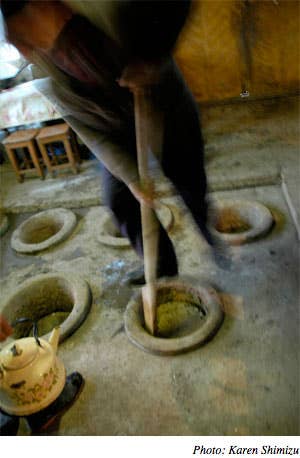
Once I'd come home to the U.S., the wines I'd fallen for were nowhere to be found. Georgian wines turned up here and there, but many were the syrupy sweet varieties popular in Russia, and even the drier European-style reds and whites lacked the bite of the backyard vintages. (Old-fashioned winemaking is mainly done at the household level in Georgia. Most commercial winemakers there use equipment and fermentation techniques that would not be out of place in, say, Napa.) Every few years, I might convince the occasional Georgia-bound traveler to bring me back a bottle of peasant wine smuggled in his or her carry-on luggage, but otherwise, zilch.
Zilch, that is, until a few months ago, when a small winery called Pheasant's Tears began selling kvevri-made wines in the U.S. Its saperavi, a single-varietal "black wine," is a deep, pokeberry purple, with the wild flavor that I associate with red old-style Georgian wines: pomegranate, black plum, whiffs of marzipan. Its other wine, a white rkatsiteli, is amber-colored, full-bodied, and tannic, tasting of citrus and bitter almond. Both are great with grilled meat, and I've started springing them on unsuspecting dinner guests. (So far so good.)
These wild wines have rarely crossed Georgia's borders (airport contraband aside), but we may be seeing more of them. Since embargoes have mostly halted the longtime export of Georgian wines to Russia, the West has come to look like the best option for Georgia's winemakers, particularly for those making wines that don't taste like anything else on the market. For the moment, Pheasant's Tears stands alone—but not for long, I hope.
2008 Saperavi ($18.99 for a 750-milliliter bottle) and 2008 Rkatsiteli ($15.99 for a 750 milliliter bottle) are both available from Potomac Wines and Spirits. Call 202/333-2847 or visit 3100 M Street Northwest, Washington, D.C., to purchase.
Keep Reading



Continue to Next Story