Home Cooking in Sicily
Pino Maggiore's restaurant, Cantina Siciliana, is in the old Jewish quarter of Trapani, a harbor town at the extreme western end of Sicily, where ferries for Tunis come and go. There's a raffish maritime air about this city; since long ago—since Phoenician times, to be exact—ships and sailors have called on Trapani from all the major Mediterranean ports. Still, you might be surprised to find that couscous, those tiny semolina grains ubiquitous across North Africa, play a significant part on the Trapanese table, and equally surprised that Pino, who is 51 years old, learned how to make it by hand as a child.
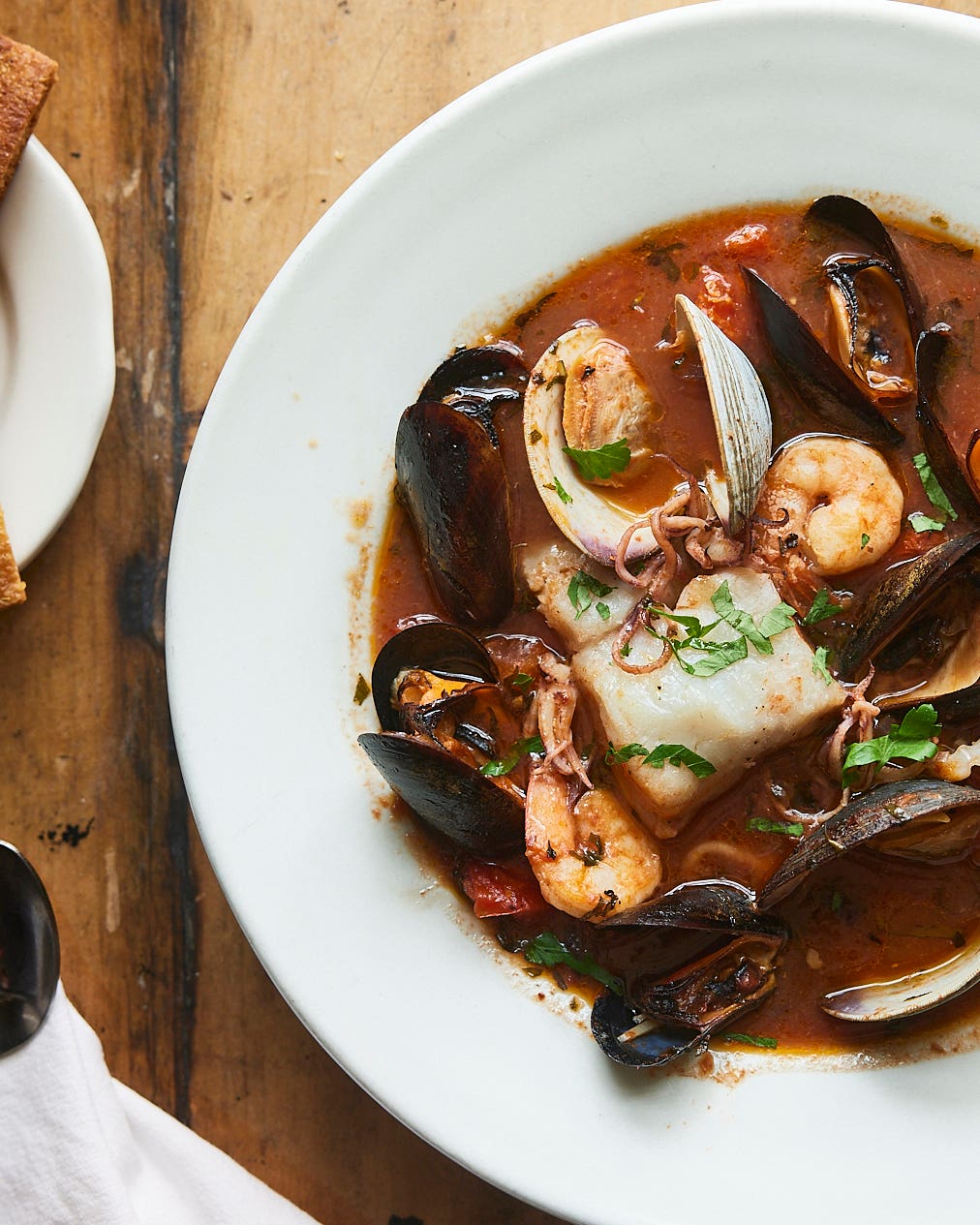
Couscous, or cuscusu as it's called in Sicilian dialect, is for me one of the most telling examples of Sicily's engaging melting-pot cuisine, a vestige (some historians believe) of the Berbers and North African Arabs who invaded the island more than a millennium ago and ruled it for a couple of centuries. Sicily's culinary history is like an intricate, multilayered pie—an 'mpanata, to use a Sicilian word borrowed from Spanish. The various elements come not just from Phoenicians and Arabs but also from Greeks and Romans, Byzantines, Normans, Germans, Aragonese, Spanish, and French, not to mention from modern-day Italians and other Europeans. Each group left its mark on Sicily—or rather, Sicily absorbed them all—and over the centuries, those influences have blended together in remarkable ways. Take Pino's couscous, which he prepares not with lamb and vegetables, as you'd see in the Arab world, but with a lusty brodo di pesce, or fish broth, scented with bay leaves and cinnamon sticks. It's a dish with one foot in Italy, another in North Africa, but it could belong only to Sicily.
I've been coming to Sicily for decades now, to research books and to introduce chefs and cooks to the foods of the island. My trips often begin with a meal at Pino's restaurant because his traditional approach elicits a quick understanding of what makes Sicily such a culinary gold mine. Here are the exotic touches—the couscous and currants and saffron—alongside beloved Sicilian staples; the hearty pastas, the incredible seafood and vegetables and citrus, the capers, the olives, the fresh ricotta, the wild fennel, and more. Unlike the rest of Italy, Sicily remains a bit mysterious and raw, the embodiment of an older Mediterranean culture and cuisine.
Over the years, I've come to believe that the heart and soul of Sicilian food, even as it's prepared at the best restaurants, is grounded in home cooking. The great cooks I've encountered here—from Pino Maggiore in Trapani to Eleonora Consoli, a teacher at the other end of the island on the slopes of Mount Etna, to Zia Pina, tough-minded purveyor of a cookshop in Palermo—have all, at one time or another, described a dish to me as "something my mother"—or "my grandmother"—"used to make." There's nothing new about this notion, for sure, but it seemed to me that what distinguishes Sicilian cuisine, what preserves it in a world where traditional foodways are often threatened, are those strong familial links going back generation upon generation, practically to the time of the ancients.
Think of Sicily as the ancients did—as a giant triangle (they called it Trinacria) with one point nearly touching the toe of the Italian boot. The largest island in the Mediterranean, Sicily is smaller than Maine but larger than Vermont, and it encompasses some of the oldest cities in Italy (Palermo, Catania, Siracusa), one of the world's most active volcanoes (Etna), a bustling tourist trade along the coast, and a deeply rural agricultural society in the island's interior (where much of Italy's organic produce is grown).
Palermo, its capital, is Sicily's liveliest town, with more people but also more markets, more monuments, more restaurants, and arguably more traffic jams than any other. Catania, a couple of hours southeast on the autostrada, is more sober, in part because of the dark gray palette of the city, the result of at least seven historical inundations of lava flows from nearby Etna. But the fish market just off the main square is one of the most colorful in the entire Mediterranean, like a giant stage set every weekday morning as fishmongers call out their wares. Then there are the quiet inland cities that rise up from the green landscape, a jumble of medieval buildings like Enna and Caltanissetta, and villages like Polizzi Generosa, Salemi, even storied Corleone, that seem to belong to another time entirely.
A look at the map shows why Sicilian cuisine is such a heterogeneous mix. The island, which lies at the very heart of the Mediterranean, is a true crossroads. Here Africa first encountered Europe, and the Christian West came into contact with the Orthodox, Jewish, and Islamic cultures of the East. Early Greeks may have brought the first olive trees to Sicily, while Arabs from North Africa possibly introduced pasta and a sweetened ice that evolved into gelato—along with almonds, which were first ground by the Arabs with sugar for the marzipan that is the basis for many of the island's most famous sweets. The Franco-Hispanic Bourbons established the fashion in the 19th century for a monzu or monsieur, a French-trained chef in aristocratic Sicilian households; and it was the Spanish, rulers of Sicily for almost 500 years, who brought from the New World capsicum peppers, both sweet and hot; chocolate, still made in the town of Modica, spiced with chile according to Aztec formulas; and, above all else, the tomato. With its sweet-tart flavors and vivid colors, tomatoes fit hand-in-glove with the Sicilian taste for agrodolce (sweet-sour), an ancient flavor pairing used with meat, fish, and vegetables.
The best illustration of Sicily's complexity—culinary, historical, and otherwise—is caponata, the luscious mixture of eggplant (from the Arabs), tomatoes, and peppers (brought from the New World by the Spanish), that is like ratatouille but made exotic with a sweet-sour sauce (ancient Sicilian) and often topped with crushed almonds (from the Greeks for sure). You'll find it all over Sicily, as a side dish to go along with whatever else is on the table.
The most surprising version I've encountered was made by Eleonora Consoli a few years ago at her cooking school, Cucina del Sole, in Viagrande. After mixing the caponata, Eleonora lines the outside of a metal bowl with plastic wrap, then paints it with layers of melted bittersweet chocolate, studded with pine nuts, to create a dome. When the chocolate is firm, she sets the dome over the caponata on its serving platter, brings it to the table, and cracks it with a spoon, shattering bits of chocolate and pine nuts throughout the mix. "Our family monzu [cook] taught me how to do that," she murmured by way of explanation.
I recently spent some time in the kitchen with Rosalba Lo Greco, who runs the kitchen at Le Case del Feudo, an agriturismo inn situated on a farm outside Siracusa that's owned by Barone Pietro Beneventano. Rosalba cooks each element of her caponata separately, then combines them, a technique she learned from her grandmother. When I mention Eleonora's chocolate, Rosalba tilts a skeptical eyebrow in my direction. "She says that in Catania they put chocolate in the caponata," she tells the Barone. She doesn't add, "I never heard of such an outlandish notion," but the unspoken comment hovers in her kitchen.
The point is that Sicilian cooks hold on to their traditions fiercely. This applies to everyday dishes as well as celebrated feast foods: elaborate confections like the brightly colored ricotta-cream-and-almond-paste cakes called cassatas that are as ornately decorated as a bride, or, on the savory side, the intricate timballo di maccheroni, made famous in The Leopard. Written in 1958, Giuseppe Tomasi di Lampedusa's novel details life amid the Sicilian aristocracy on the eve of Italian reunification in 1861 and the momentous social consequences that resulted. To this day it remains a brilliant analysis of Sicilian culture—and cuisine. When at a dinner party Prince Fabrizio cracks the burnished golden pastry crust of the timballo, it discloses, in Lampedusa's words, "[an aromatic vapor], then chicken livers, hard-boiled eggs, sliced ham, chicken, and truffles in masses of piping hot, glistening macaroni, to which the meat juices gave an exquisite hue of suede."
But this loyalty to culinary traditions also applies to humble street foods and country fare, like pasta con le sarde, spaghetti dressed with sardines and wild fennel, a fisherman's dish with the exotic notes of currants and pine nuts; or panelle, the fried strips of chickpea flour dough, served from mobile fry shops amid the pulsing cacophony of Palermo's Ballaro market; or skewered sheep's or goats' intestines, called stigghiole, which you're as likely to find on the Easter table as you are at a street-side stall. Sicilians love their snack foods, and none more than arancine, the fried saffron-tinted rice balls filled with meaty ragu; at trendy cafes you can find them behemoth and with lots of creative fillings, from spinach to Gorgonzola. And they adore offal. Take Palermo's favorite, pani cu' la meuza, a staggeringly tasty sandwich of boiled veal or beef spleen with an optional dollop of ricotta or a shower of grated Pecorino; you can get it at street-side snack shops like Ninu U Ballerinu, where taxi drivers gather between shifts, or more formally at the Antica Focacceria San Francesco, where Garibaldi himself supposedly consumed the dish. Nowadays you'll see Palermitano matrons with arms and chins extended to keep greasy gravy from dripping on their mink coats.
There's an informality to the way Sicilians eat that allows them to honor—relish, really—the food and the company. I was reminded of this when I passed an afternoon at Zia Pina in Palermo's old town near the smaller Vucciria market. It's hard to call this a restaurant—or a trattoria, or an osteria—because to eat here is far more like sitting down in Pina's kitchen to sample her seafood fried to a crisp in a perfect batter, her grilled fish scattered with herbs and lemons, or anything else she feels like making that day. There's caponata, stuffed mushrooms, marinated artichoke hearts, and dozens of other dishes, all laid out on a table in front of her grill and fryer. You take what you want and you don't ask how much anything costs. That would be rude. When you're ready to leave, one of Pina's sons hands you a piece of paper with an amount scrawled on it, and you leave that amount on the table in cash.
There are a handful of renowned chefs in Sicily, acclaimed by Italy's most influential food critics, and each is well worth a visit. (See "Sicilian Stars,") But when it comes to the Sicilian food I love, I look for home cooks above all, even if they happen to be cooking in a restaurant.
One of the most esteemed Sicilian home cooks is, alas, no longer with us. Anna Tasca Lanza died last year after a distinguished career as a writer and cooking teacher, promoting the island's complex food traditions along with the great wines of her family's Regaleali estate in the very heart of Sicily. In her heyday, Anna was also an adventurous culinary explorer. It was with her that I first sampled the fisherman's delicacy known as lattume, the rich, milky milt (or semen) of bluefin tuna, which the Tasca family chef, Monzu Mario Lo Menso, sliced and fried for us one lazy June afternoon. Another time she introduced me to the complex culinary folklore of San Giuseppe, whose feast day, March 19, is celebrated throughout Sicily with elaborate, ritualistic offering tables that almost always include breads molded to represent Joseph's beard, his staff, or his carpentry tools. In Vallelunga, near Regaleali, we went from house to house to admire and sample the breads.
Anna was a fine teacher, a trait her daughter Fabrizia—who now runs Regaleali's cooking school—has inherited. Anna loved to introduce early risers to the warm, soupy ricotta made each morning by the estate's shepherds and served in bowls with leftover bread to sop up the milky curds and whey. And she relished offering her astonishing 'strattu, a handmade tomato extract she made each year in late summer, spreading a fresh tomato puree onto flat boards that were set out to dry in the sun. Each evening the boards were brought in and the gradually reducing extract was scraped and mixed, then set out again in the morning; after three days of the intense late August heat, the puree was thick as paste, a deep mahogany red, with a flavor like the purest extract of Sicilian sunshine.
The powerful flavor and fragrance of that tomato 'strattu is what I've come to expect every time I go back to Sicily. It's not just tomatoes but the lemons, oranges, almonds, salted anchovies and capers, and bottarga (salted fish roe), not to mention the olive oils, the wines, the splendid sheep's and cows' milk cheeses. Whatever comes from this soil and this sea has a special intensity, a radiance that sets this blessed isle apart.
Keep Reading
Continue to Next Story