Hot Stuff: New Mexico’s Chile Pepper Culture
A road trip across New Mexico unearths the state’s finest chile peppers
We did not set out on a chile-centric road trip. New Mexico cookery, a unique tapestry of Spanish, Mexican, Native-American, and Anglo influences, offers plenty of other signature dishes, from puffy sopaipillas (fried flatbreads) to spectacular pecan pie made with locally grown nuts. But dinner at La Posta de Mesilla, a 72-year-old eatery in a frontier settlement at the outskirts of Las Cruces on New Mexico's southern border, and a stroll through chile fields in the surrounding Mesilla Valley, were all the convincing our taste buds needed to make the chile pod our road trip's Holy Grail.
A skeptic could be forgiven for having suspicions about La Posta, a popular tourist destination complete with a gift shop and gaudy squawking parrots in the lobby. But believe us when we tell you that this venerable establishment in no way dumbs down the chile's brilliance. Jerean Hutchinson, whose great aunt opened La Posta as a four-table eatery in what once was a stop on a stagecoach postal route, delights in pointing out that chile powder is anathema in her kitchen. Her crimson chile sauce is made from whole red chiles grown and sun-dried at nearby Chavez Farms; they are stemmed by hand and then soaked and pureed, becoming chile essence. How hot is it? Not numbingly so. Carne adobada, cubes of pork marinated in this sauce and slow-cooked to pot roast tenderness, is just hot enough for the earth-and-sun flavor of the chile to boldface the meat.
As we made our way across New Mexico, chile peppers, the Land of Enchantment's official state co-vegetable (with the pinto bean), were everywhere. It was mid-September—harvest time—when days grow short, nights turn cold, and jade green chiles ripen red. By the side of the road, metal roasters filled the air with the late summer smell of freshly picked Big Jims and Anaheims tumbling over flames, the crackle of their hot seeds like manic popcorn. Ristras (wreaths), newly strung with supple dried pods, hung on homes and ranch gates and above convenience store ATMs. Cafes, diners, taverns, and white-tablecloth restaurants all served capsicum in countless forms. No matter what the variety, they're often advertised here as "Hatch Chiles" when they're green, named for the Doña Ana County town where the best of them grow. Hatch's annual Chile Festival, held over Labor Day weekend, attracts tens of thousands of chile lovers and, until recently, crowned both a red and a green chile queen.
Not far from La Posta, at New Mexico State University, Paul Bosland, regents professor of horticulture and founder of the Chile Pepper Institute, is lobbying for chile heat to be recognized as the sixth taste, along with salty, sweet, sour, bitter, and umami. Bosland is currently known in pop-food circles as the man who cultivated the bhut jolokia chile, also known as "the ghost pepper," which, at a million-plus units on the Scoville scale that measures capsicum ferocity, is officially the world's hottest pepper. (By contrast, jalapeños rate a measly 5,000.) Bosland took us out to a University garden in which all kinds of chiles are grown, from common bell peppers to the incendiary bhut jolokia. After noting that a single drop of the latter's venom will ulcerate human skin, he picked one of the inconspicuous orange pods from its bush and merrily rubbed it all over his eyelids, nose, and lips. "If you enter a hot chile—eating contest, you can beat anyone if you bite only the wall of the pepper," he informed us. "All of chiles' heat is inside, in the membrane."
Two hours north of Las Cruces we stopped at a roadside stand run by Sichler Farms and convinced the man roasting peppers to hand us a hot (temperature-wise) green pod straight from the wire cooking basket that turned like a rotisserie against a flame. The batch, he said, was medium-hot on the Scoville scale, but New Mexicans' medium-hot is everybody else's pretty-damn-hot. So we did like Bosland advised and tried to avoid the membrane (the inner flesh where the seeds are stored), gingerly biting only the al dente wall. It is not so easy. Lips began to tingle, and soon we were glowing with that warm endorphin rush that makes chiles feel dangerously addictive.
What was so wonderful about this unadorned pod—which we ate standing up, holding it by its stem and peeling back scorched skin—was that it perfectly expressed the ambiguity of the chile: It's a berry of the nightshade family (like the tomato) that agronomists know as a fruit but is so intensely green-flavored that it tastes like the ultimate vegetable. Sichler Farms sells more than a dozen varieties fresh, dried, and roasted, and makes chile powder in three degrees of heat that is so aromatic a single, sealed bag of it in our luggage perfumed not only the car's trunk but the passenger compartment as well.
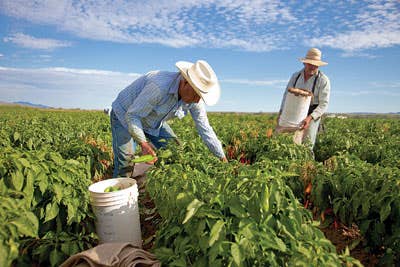

Photo: Penny de los Santos
Sichler Farms is located in San Antonio, an unincorporated crossroads on old U.S. Route 85 with a gas station—convenience store that makes fudge and sells locally bottled ciders. Aside from the store and the chile stand, the settlement's only other businesses are the Owl Bar & Cafe and the Buckhorn Tavern, a few hundred yards apart on opposite sides of Second Street. Despite their middle-of-nowhere location, these two joints attract hordes of pilgrims who come to eat green chile cheeseburgers.
While other parts of the country serve cheeseburgers garnished with chile (the pod) or chili (con carne), none can compare with New Mexico's best, in which the combination of juice-oozing, charred-edge red meat and creamy melted cheese is exalted by a full measure of flame-roasted, firm-walled, radiantly hot peppers. The Owl Bar lays claim to having invented the transcendent combo back in the early days of atomic bomb tests at nearby White Sands, when nuclear scientists used to come in after work for an explosive meal.
The Owl Bar is as much a place to drink as to eat—the sort of roadside oasis where you half expect to see Dean Moriarty pulling up in his road-ravaged 1949 Hudson. It opens at 8 a.m., and we well remember our first visit several years ago, when our worry about being viewed as weird for eating GCCBs (green chile cheeseburgers) at breakfast was allayed when we noted that other customers at the bar also were eating them along with shots and beers.
Since being featured on Throwdown with Bobby Flay on the Food Network recently, the modest-size Buckhorn Tavern has been nearly impossible to get into; when we arrived, well before the 11 a.m. opening time, the place was surrounded by customers. Media hype aside, chef Bobby Olguin does make a grand GCCB, here listed on the menu as a Buckhorn Burger, fully decked out with chunky roasted green peppers, tomato slices, mustard, red onion, lettuce, and pickle chips. The broad beef patty is wickedly juicy—30 percent fat—and shot through with garlic that underscores the vibrant flavor of its green chile crown. Olguin told us that he combines Sichler Farms medium-hots with chiles from Bueno Foods, a Mexican food company in Albuquerque.
The best GCCB, in our estimation, is made at Bobcat Bite on Old Las Vegas Highway at the southern fringe of Santa Fe, in the northern part of the state. Even discounting the chile and cheese, the burger itself is magnificent: Medium rare, the 10-ounce patty of ground chuck is more than an inch thick, its surface crisp from a spell on the 50-year-old cast-iron grill, its warm inside velvet-red and seeping juice that saturates the bottom of a broad bun that is artisan but not froufrou. Chopped green chiles are packed atop the burger and cheese is laid on top of those, heated just enough so it melts among the pepper bits and into crevices of meat. There could be no finer setting in which to enjoy the native dish than this snug, 26-seat cafe, a low-slung adobe building that started as a trading post along the original alignment of Route 66 and is still accoutered with a rail where you could hitch a horse if there weren't cars in the gravel lot. The name comes from its early days as a restaurant, when bobcats used to come down from the hills for backdoor snacks doled out by the kitchen staff.
Eating around Santa Fe is a whole other story, but when we arrived at the Plaza in the heart of town, there was one place we needed to visit to put an exclamation point on our heat-seeking road trip: Roque's Carnitas. At this food cart, which parks near the intersection of San Francisco Street and the Old Santa Fe Trail, carnitas is not merely a word meaning "little meat." It is an effulgent sandwich folded inside a broad flour tortilla. Strips of garlicky, marinated top round beef are sizzled on a smoky grill with onions and slices of hot pepper, and are heaped with salsa that packs big-time jalapeño heat. It used to be that customers would have to find a bench on the Plaza to eat one of these behemoths because even though proprietor Roque Garcia wraps it well, inevitable spillage makes stand-up dining a wardrobe disaster. But Garcia recently has acquired about a half-dozen little yellow plastic stools that are scattered around the cart. Seating is catch-as-catch-can, but once you have secured your stool, you are free to move it upwind or downwind, depending on whether you want to inhale the intoxicating chile—meat smoke that puffs from the cart.
Correction: In the print version of this story, the photograph of a green chile cheeseburger was incorrectly identified as being from Bobcat Bites in Santa Fe, New Mexico. It is in fact from the Buckhorn Tavern in San Antonio, New Mexico. SAVEUR regrets the error.
Keep Reading
Continue to Next Story