Italian Food You’ve Never Dreamed Of
To assemble one of the most original and addictively delicious specialties of northern Italian cuisine, split some firm, dry gallette marinare (ship's biscuits), rub the cut sides with garlic, drizzle them with vinegar, and place the gallette on a large platter. Upon this hardscrabble foundation, begin to construct an architectural fantasy of alternating layers of fish (crushed anchovies or cured tuna roe and thin pieces of hake or cod) and sliced cooked vegetables—carrots, celery, potatoes, beets, and salsify, whatever. Cement the layers with a green sauce of capers, green olives, and parsley. Scatter some slender green beans around as straw in the mortar. Stud the joints with fresh green peas or fava beans. Ornament the finished structure with hard-boiled eggs, olives, capers, oil-packed mushrooms or artichokes, and any impressive seafood you can afford—shrimp, oysters, even lobster.
You have just made cappon magro—literally, ''fast-day capon''—which is to say, chicken you could eat even on days when the old dietary laws of the Catholic Church forbade the consumption of meat and fowl. That there is no capon involved is, of course, the point.
Cappon magro is not something you're likely to find at your local Tuscan grill, much less at the mom-and-pop checkered-tablecloth place down the block; few self-styled exponents of ''Mediterranean cuisine'' would recognize it. It is perhaps the ultimate emblematic dish of an ancient and often complex culinary tradition almost unknown in this country—the cuisine of Genoa. Like a number of other Genoese specialties, cappon magro exemplifies a kind of Italian food most Americans have never even dreamed of.
The cuisine of Liguria—the crescent-shaped region that arcs along Italy's northwestern coast, connecting Tuscany and Provence and encompassing the storied Italian Riviera—is inventive to the point of ingenuity, but poor in resources and sometimes so modest as to seem almost penitential. In Genoa, however, which is Liguria's capital city, there is a tradition of dishes that are immensely complicated and ornate, even baroque—and often imbued with celebratory, almost ritualistic importance.
Genoa has for centuries been wealthy, cosmopolitan, and well fed. It developed as a commercial and maritime center in the 11th century, by the end of which it had become a powerful commune, with a budding rivalry with Pisa and Venice. By the 12th century, it had transformed itself into an independent republic with a population of 100,000 (today, it exceeds 600,000), and by the 13th, into a major capital of banking and trade. Visiting the city in the 14th century, the poet Petrarch dubbed it La Superba—which the Genoese usually translate as The Proud (though it can also mean The Arrogant). This has remained its sobriquet.
At the height of its economic powers, Genoa bought, sold, and shipped goods all over Europe, even far beyond the Mediterranean, and established trade colonies on the Black Sea, in the Crimea and Turkey. (A story is told of a sailor caught stealing figs from a Turk's orchard in Anatolia. ''What navy are you from?'' he is asked. ''Genoese,'' he replies. ''Then eat freely, son,'' answers the Turk, ''from the tree your father has planted.'') There was even a Genoese concession in Brazil in the 16th century. It is little wonder that a medieval proverb was ''Genuensis ergo mercator''—Genoese, therefore a trader—or that today the city is the largest port in Italy and one of the busiest in the Mediterranean.
The first recipe identified in print as Genoese was a formula for torta alla genovese (a sort of pie filled with apples, dates, raisins, and pulverized almonds, hazelnuts, and pine nuts) appearing in 1520, not in an Italian text but in the Libre del coch, the seminal Catalan-language cookbook by Mestre Robert, probably chef to the king of Naples. In the centuries that followed, Genoa's culinary sophistication grew. Local cooks developed some of Europe's most savory interpretations of tripe, stockfish (which is dried cod from Norway, a staple of the Mediterranean diet since medieval times), and stuffed vegetables. They refined the thin-crusted vegetable-filled torta into an art form. They invented, or at least perfected and disseminated, such now-universal Italian specialties as minestrone, ravioli, focaccia, and, of course, pesto—the remarkable basil-based sauce that is indisputably a local creation. However, with the possible exception of ravioli (whose traditional filling can include a dozen or more ingredients, some as exotic as calf's spinal marrow and heifer's udder), these recipes are straightforward. Genoa developed a number of more complicated local dishes, primarily because it could afford to, and then perhaps because it had access, through its widespread trade, to ingredients and culinary notions from many parts of the world. (One example: The Genoese are the only Italians who regularly use walnuts in savory dishes—a habit they might well have imported from their Black Sea outposts.) It is also possible that the very nature of the republic's trade inspired ornate dishes: Its sailors traveled such great distances that their homecomings were events to be celebrated. No trouble was spared in preparing their welcome—and because they had existed for so long on ships' rations, that welcome inevitably involved enthusiastic feasting on intricately prepared, memorable dishes. It was special-occasion food for one of the most poignant of occasions—the safe return.
Greater Genoa—the city absorbed 19 surrounding communes in 1926—stretches from Voltri in the west to Nervi in the east, along nearly 15 miles of coastline, and reaches about seven miles inland into the Val di Polcevera. But the heart of the city is its old quarter, between the port and the piazza Corvetto. Of the caruggi—ancient, narrow streets—that wind up into the city from the edges of the port, one guidebook says: ''[E]fforts to gentrify this area have encountered serious difficulties, so that when the sun sets the ingenuous visitor may worry about unpleasant encounters.'' There's an even better reason to visit the area in the daytime: The shops are open—greengrocers, rice-and-flour merchants, herbalists, wine merchants, old-fashioned take-out shops selling farinata (the Genoese socca, a flat chickpea-flour pancake) and vegetable-filled tortas, delicatessens, and specialists in things dried and pickled, even a tripe shop (on the vico della Casana), in which tripe broth is brewed over wood fires in big copper cauldrons. If the flavor of old Genoese cooking is still anywhere out in public these days, it's in places like these.
When he was a schoolboy, 30 years ago or so, Gianni Belforte liked nothing better than to prowl the caruggi, looking, sniffing, tasting—thoroughly enjoying the vibrant heart of his native city. Today, he makes his professional home not on one of these small byways but nearby, on Genoa's most famous thoroughfare, the broad and stately via Garibaldi. Begun in 1551, the via Garibaldi may well have been the first totally planned European street. All its perspectives were worked out in advance; all the Renaissance-style palaces that line it were designed to ideal proportions. One of these, the Palazzo Spinola, is home to the oldest men's club in the city, the Circolo Artistico Tunnel (founded in 1891), where Belforte directs the restaurant.
Belforte is part of a small Genoese culinary dynasty: His brother Renato occupies a comparable post at Genoa's Yacht Club Italiano (the oldest yacht club in Italy, dating from 1893). Their mother, Linda, was the chef there for some 35 years, as long as their father, Benito, was maitre d'hotel. Though the two are now retired, they still frequent both the Yacht Club and the Circolo Tunnel—where Linda likes nothing better than to cook her traditional Genoese dishes for special occasions.
Today, it's hard to find real Genoese cooking in Genoa's restaurants. Most of the city's better-known dining places are either not very Genoese or not very good. In this latter category is one famous establishment, which I will not name, whose attractions are particularly high prices and the fact that Frank Sinatra likes it. This restaurant, a critic from Turin once proposed, ''is a place the rich Genoese go to eat in the style of the poor Genoese.'' In fact, many of the city's ''poorer'' restaurants serve better, and certainly more authentically local, food. But they rarely offer the cuisine's grand dishes—and when they do, their preparation is modest and homey.
Because Gianni and Renato are cousins of a friend of mine, and because they're always anxious to introduce novices to the pleasures of Genoese cooking, I was recently able to convince them to prepare (at their respective clubs and with Linda's help) seven of Genoa's greatest dishes, including cappon magro, cima, lattughe ripiene, stecchi, tacchino alla storiona, torta pasqualina, and mandilli de saea. I'd sampled all of these before, and had even tried making some of them myself—but tasting them all at once, superbly and correctly executed, was a revelation.
If cappon magro is perhaps the most salient example of complex Genoese cuisine, cima (çimma in Genoese) is the gastronomic peak; at least that's what its name (literally ''summit'') implies. Cima is veal paunch or breast (goat or lamb was also used in earlier times) stuffed with chopped or pureed organ meats accented with vegetables—a kind of firm, main-course terrine, engagingly earthy and faintly sweet. Lattughe ripiene—stuffed lettuces—little packets enclosing a flavorful veal forcemeat, simmered in broth—has been traditional Genoese Easter fare since the 16th century. (An ancient Genoese proverb says ''Pe Pasqua nu ghe cuxin-a ca nu fasse a laituga pin-a''—For Easter, there's no kitchen that doesn't make stuffed lettuce.) Though stuffed cabbage may be more familiar, the mildness and, again, faint sweetness of the lettuce function as a perfect link between the richness of the filling and the simplicity of the broth.
I first learned of stecchi from Linda Belforte years ago, on the sunny terrace of a seaside caffe run by her sons. There was one particularly complicated Genoese specialty that she enjoyed making, she told me, involving various veal parts strung onto skewers with artichokes and other vegetables, coated in besciamella (bechamel) sauce, and... At that point I interrupted and said, ''And then you dip the skewers in an egg-wash, dredge them in bread crumbs, and fry them?'' ''Yes, exactly,'' she replied, somewhat surprised. ''These are what we call stecchi, or skewers.'' Maybe so, but what she described, almost exactly, was also a genre of classical French preparations known as _attereaux _(which also means skewers). Were stecchi, then, a French invention adopted by the Genoese? Or did they originate in Genoa and travel to France, where they were elaborated upon? Because their ingredients are so typically Genoese, I'd suspect the latter. Whatever their origins, they're a mysteriously pleasant surprise of ingredients, similar in texture and color, encased in a crisp, golden-brown coating.
Tacchino alla storiona, which literally means ''turkey like a sturgeon'', is a curious dish—cold boneless turkey that has been marinated and decorated to suggest a cold, marinated, similarly decorated fish. The Magra River east of Genoa, it is said, once teemed with sturgeon, and tacchino alla storiona has been cited by modern gastronomic writers as proof of, as one of them puts it, an ''atavistic nostalgia'' of the Genoese for the now-forgotten flavor of sturgeon— delicious flesh. In earlier times, sturgeon turkey was de rigueur at fancy Christmas Day banquets.
Torta pasqualina, the chard-filled queen of Genoese tortes,was traditionally made with 33 layers of dough—ten underneath the vegetables and 23 on top—one for each year of Christ's life. Modern versions are content with five or six. It is said that Nietzsche, when he was living in Genoa, thought it worthwhile to spend an entire afternoon learning how to make torta pasqualina from his landlady. Considering how it contrasts a chewy, politely salty crust with a rich, bitterish interior to achieve an unexpected complexity of flavor, it's easy to see why he bothered.
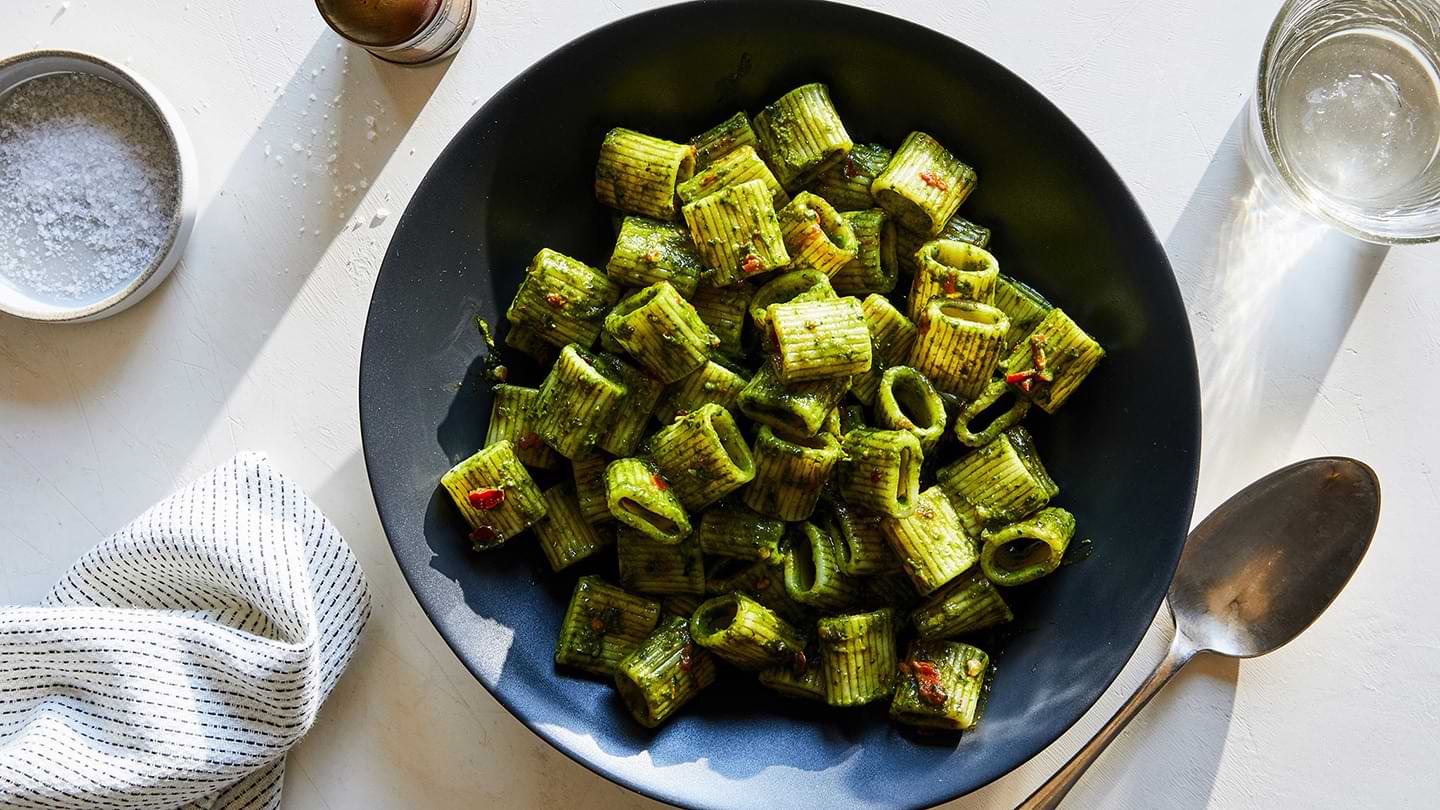
The pasta squares called mandilli de saea, Genoese for ''silk handkerchiefs'' (for their size and thinness), are large, paper-thin egg-dough sheets that drape beautifully in the bowl, almost always dressed with pesto. The result is a kind of purity of pasta—certainly less complex than some other Genoese dishes, but with an elegance and grace not ordinarily associated with a plate of noodles. Like other Genoese set pieces, it seems wonderfully anachronistic—deliciously edible link with a fabled past.
Keep Reading
Continue to Next Story