Modernist Cuisine: Defending the Spaceman
Nathan Myhrvold’s magnum opus might be the most important culinary book ever. Why do so many people hate it?
Among the many culinary wonders to be found inside Nathan Myhrvold's Kitchen Lab - a warehouse space in an industrial park just outside Seattle that's filled with toys ranging from a weapons-grade laser to a 50-G centrifuge - one of the most striking is the hood over the cooktop. It's a standard piece of kitchen equipment, but here it's a behemoth, 14 feet from end to end. Myhrvold picked up the hood at a scrap auction four years ago for a relatively paltry $600; his team spent nearly a month scrubbing off the rust before installing it, gleaming, as the visual centerpiece of the lab. Where two massive pieces of metal join in a vertical seam at the center, Myhrvold has affixed a little plaque bearing a quote from Thomas Edison: "Hell, there are no rules here. We're trying to accomplish something."
That something, as most everyone knows by now, is Modernist Cuisine, a 2,400-page, six-volume guide to the science of contemporary cookery that's been variously hailed as the most important culinary volume to be published in the last decade, the last century, the last 150 years, and ever. It's not hyperbole - and once you know Myhrvold, it's also not a surprise. He's an extremely interested person, and he's also an extremely wealthy one, which in combination means that he pursues his interests on an epic scale. When Myrhvold was into dinosaurs, he funded bone-hunting expeditions that turned up more T. rex skeletons than any endeavor in history; when he started getting into food, he funded and led a lab that produced a world-changing book — but with its scientific slant and gleeful support of culinary technology, it's not one that all of the world seems ready to embrace.
I went to the Kitchen Lab for dinner last week, joining chef Thomas Keller, Culinary Institute of America president Tim Ryan, Seattle restaurant emperor Tom Douglas, and a spectacular man known only as Oyster Bill at a white-tableclothed folding table tucked in a narrow pass between a prep counter and industrial shelves packed with scrap machinery and cases of wine. Over four hours and 29 courses, we ate things few people have eaten before: paper-thin dill pickle chips, blood-red "rare" beef broth, centrifuged pea butter, short ribs cooked sous-vide for 72 hours, super-crispy "ultrasonic" french fries made via a wave-pulsing method that Myhrvold has patented. See photos from the dinner in our gallery »
The dinner, one of several Myhrvold is hosting in February, was many things: a celebration, after years of research, of the book's completion; a thank-you to the chefs, writers, suppliers, and well-wishers who supported the project; and, maybe more than anything else, a live-action demo of the importance of Myhrvold's no-holds-barred experimentation. Much of what we ate was delicious, but all of it was extraordinary: the meal was a greatest-hits compilation of Modernist Cuisine's strangest, coolest, and most innovative techniques.
Of the twenty-nine courses, a few - while technical successes - were, on the palate, misses: gummy (but shelf-stable!) cheese souffles; a foie gras rocher whose sweet, livery taste was lessened by its frozen temperature, and then overwhelmed by a wedge of meyer lemon; and a mignardise of olive oil-flavored gummy worms flecked with vanilla bean. But then there were the moments of transcendence: my tablemates looked askance at the tiny quail eggs poured out, raw, onto porcelain soup spoons dotted with yellow chili paste. "Shoot it all down in one bite," Myhrvold directed us; as soon as the yolk hit the tongue, it exploded into a sweet bath of fruit and heat. This was no egg at all: it was spherified passion fruit suspended in a lime broth thickened to mimic albumen. Myhrvold laughed, watching our faces light up: "The really hard part was cleaning out all those quail eggs!"
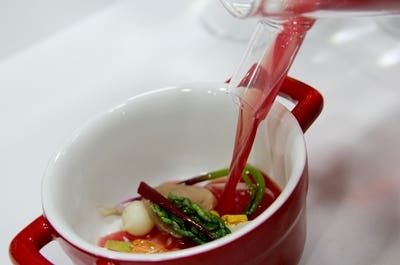

Beef stew with rare beef broth
Credit: Helen Rosner
While Modernist Cuisine is being billed as a cookbook, that's an inaccurate - and insufficient - categorization. Only the last two of the book's six volumes, "Plated-Dish Recipes" and "Kitchen Companion," in any way resemble conventional cooking collections; the other five are a veritable encyclopedia of contemporary cooking, comprehensive chronologically (from the discovery of fire to the most Adria-esque deconstructions), categorically (entire volumes are dedicated to vegetables, meats, starches), and by accessibility (anyone can blend a precisely emulsified vinaigrette; you can't, alas, make pea butter unless you shell out $20,000 for a centrifuge). To be sure, the books have breathtaking photography and a warm, witty narrative voice, but there are also minutely detailed charts and matrices, strange symbols, non-dumbed-down chemical and biological notation. To anyone who's spent time reading scientific journals, the format is familiar; to most readers (including myself and, let's be honest, more chefs than are likely to admit it), it skews towards the intimidatingly impenetrable.
In the current culinary landscape - one that's dominated by an obsessive, virtue-driven concern for provenance, sustainability, and rustic simplicity - a multi-thousand-page book full of impenetrable science writing isn't going to land lightly. As the newly-crowned king of molecular gastronomy, Myhrvold has been called upon to defend himself and his work against the criticisms of the local-sustainable crowd, many of whom view his work as an affront to their own. He appeared on the podcast Freakonomics Radio in January, in a segment that also featured Alice Waters, queen of the greens. Listeners were promised they'd hear "the chieftains of the two camps square off"; in actuality, the two were not in the studio at the same time, and neither addressed the other directly, but Waters did get to fire off a few zingers: "I am so hungry for the taste of the real that I'm just not able to get into that which doesn't feel real to me," she said by way of dismissal. Chris Young, Modernist Cuisine co-author and Myhrvold's culinary number two, will soon be sitting down with Seattle-area chef-farmer Kurt Timmermeister for an as-yet unscheduled debate with the same line drawn in the sand between them.
This feud - science vs. nature! - is so narratively compelling, so brilliantly and intuitively straightforward, that perhaps Myhrvold and team are too polite to point out that it doesn't actually exist. There is, in fact, no war between locavorism and molecular gastronomy: the former concerns itself with what the ingredients are, the latter concerns itself with how those ingredients are prepared. Nothing stops the modernist chef from using ingredients of impeccable ethical pedigree; in fact, some of the most extraordinary culinary accomplishments exist at that intersection. "I think it's a false division," Alinea chef Grant Achatz told the crowd at a 2009 lecture in Chicago when asked about the supposed antipathy between camps. "I feel for a long, long time — going back to '97, '96 — for a long time, there was a very clear division. A rivalry if you will. The Alice Waters camp, and the Ferran Adria camp. If you were practicing modern gastronomy, you were a hater, you were growing everything in a petri dish and test tube, you were putting all those funky chemicals in there. But that's not it at all. We love produce too."
"You know, I'm concerned with nutrition," a chef in Seattle said to me when I mentioned I'd been to dinner at the Kitchen Lab. "What Nathan's doing, that's not my thing. I believe in taking a vegetable or a piece of tuna and keeping it as wholesome as possible, keeping all the nutrients intact." (Myhrvold had unknowingly preempted the argument the night before, when a guest asked whether the baking soda in a butternut squash soup undermined the dish's nutritional value. It did, but Myhrvold rejected the question's underlying premise: "We're sufficiently nourished, luckily," he explained; dialing down the vitamin content in one dish isn't going to have much of a lasting effect unless you eat literally nothing else, for weeks.) In the New York Times, Seattle chef Becky Selengut said "I'm wary of intense manipulation of foods when it involves chemicals, expensive tools and gadgets that only .002 percent of the population has access to."
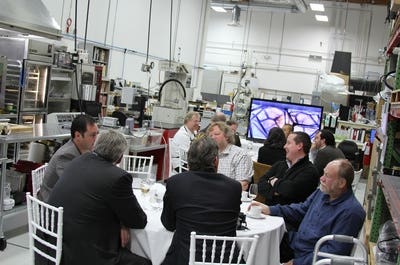

Inside the Modernist Cuisine lab
Credit: Helen Rosner
Beneath most of these concerns seems to be a fear that Myhrvold has a nefarious and unstoppable agenda, one in which he plans to replace all conventional cookery with sci-fi, 100-percent Modernist Cuisine meals like the one I attended at the Kitchen. What seems poised to happen instead is much less threatening: the gradual introduction of certain techniques into the canon of culinary knowledge. That pinch of baking soda for a caramelized, Maillard-esque flavor without direct heat; dunking oysters in liquid nitrogen so they shuck more cleanly; an equilibrium-based brining method that makes it impossible to over-salt meat. At our dinner, Keller and Tom Douglas marveled as Myhrvold explained the "enzyme-peeled citrus" that garnished a dish of cocoa pasta with sea urchin: by bathing oranges in "peelzyme" (its real name), the pith and fibrous membranes dissolve, leaving segments of a perfection and beauty that, in a non-Modernist kitchen, would otherwise require hours of messy labor from an unfortunate prep cook.
It's telling, though, that despite his nutritional skepticism, that Seattle chef has still pre-ordered a copy of the book: "Of course I bought it!" The book won't officially be available until March 1, and the entire first print run has already sold out. (A second printing is underway, but be patient: "if you order your book tomorrow," Chris Young told me, "you probably won't get it until summer.") Keller and Ryan both have copies, and were at dinner in the lab in part because they're working with Myhrvold on ways to incorporate his techniques into the curriculum at the CIA.
Myhrvold was so confident of the eventual acceptance of Modernist Cuisine's philosophy that he included a little bit of a preemptive neener-neener in the book itself: the first volume contains a discussion of the decidedly non-culinary Impressionist movement of the late nineteenth century led by soon-to-be superstar Claude Monet. The Impressionists' paintings, when first publicly displayed, were considered so offensive that they were banned — but soon they were embraced. In the Impressionists, Myhrvold sees echoes of his own fight. "Much like Impressionism, the Modernist culinary movement was often misunderstood by the public in its early days," he and his team write. "And as happened with the masters of Impressionism, the creative geniuses of Modernist cooking eventually surmounted the initial confusion to achieve prominence and acclaim."
Keep Reading
Continue to Next Story