Korea's national dish, bibimbap, is colorful, refreshing, and infinitely varied
For years, I thought I knew bibimbap (See the Bibimbap recipe). It's on just about every Korean menu in the States, and what you get, from restaurant to restaurant, tends to be consistent: a kaleidoscope of vegetables arranged atop steamed rice. Maybe there's some minced beef; often there's a fried egg on top; always, on the side, there is gochujang, the fermented, deep-red chile paste. You drop in a spoonful, mix up all the ingredients (bibimbap literally means mixed-up rice), and wreak havoc in that bowl. It's interactive and dramatic, all the more so if it comes to the table sizzling in a dolsot, or hot stone bowl, which continues to cook the bibimbap as you eat. Then there's that crust of toasted rice when you reach the bottom—a delicious reward.
Yet when I was traveling in South Korea recently, I had a revelation. It was in Dong-daemun market, a sprawling, glass-roofed arcade in East Seoul. With my traveling companion, Jimmy Cho, a native of the city, I walked down the rows of hawkers tending bubbling pots and steaming woks. But one stall stopped me short. Lined up along the counter were about a dozen bowls, each one overflowing with a different leafy green, kimchi, or namul (quick-sauteed vegetables). It was all brightness and abundance. There was fresh chicory leaf, raw green chiles, perilla leaf chives, and soybean sprouts. Jimmy pointed out the moo saeng chae (radish with chiles) and bom dong kimchi (fermented spring cabbage). I recognized gosari, bracken fern fiddleheads. Displayed there in front of me was bibimbap, deconstructed, as I'd never seen it before.
The lady in charge, whom Jimmy introduced as Soon Ja, invited us to snack on dried anchovies as she bustled around her open kitchen, filling a metal bowl with steamed barley and rice and then using tongs to pluck the ingredients, one by one. When she'd gathered everything she needed, she went at the bowl with a pair of scissors until the vegetables were snipped down to bite-size, then garnished the dish with sesame seeds and gochujang. It was clean and bracing, more like a rice salad than the heavier dolsot versions I'd tried. Who knew bibimbap could be so light and fresh?
There were other epiphanies, as I learned about all the regional versions. The luxurious bibimbap of Jeonju, in the southwest, is made with rice cooked in rich beef stock, the region's succulent soybean sprouts, and a mound of raw minced beef with a raw egg yolk quivering on top. Jinju bibimbap, from the southern tip of the Korean peninsula, near the sea, gets a briny boost from the addition of marinated clams. For the fabled Haeju bibimbap, a hearty North Korean specialty, the rice is cooked in pork fat and topped with pan-fried pork and strips of chicken. Some of the versions were served in a dolsot; more often, they were presented in a metal bowl. When I asked Jimmy about it, he said, "Dolsot is something you see only in restaurants. We never make it that way at home." Though stone bowls were used centuries ago, they were limited almost exclusively to royal tables and then disappeared from use entirely during the Japanese occupation of Korea, from 1910 to 1945. It wasn't until the 1960s that restaurants began reintroducing this method of serving bibimbap—a novelty, bringing a dash of drama to the homeliest of dishes. Still, my favorite of all was the summery version I had in that market in Seoul. The meal was simple and satisfying, and the ritual of assembling it before my eyes made me feel cosseted and fussed over—no small comfort when you're 7,000 miles from home.
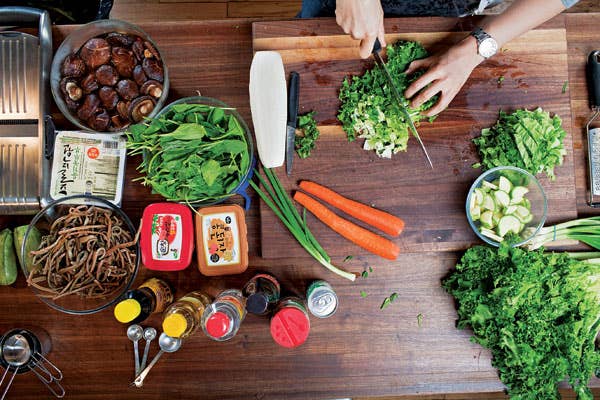
photo by Todd Coleman
Maeng assembles and prepares shiitake mushrooms, bracken fern, baby spinach, Korean radish, and other ingredients for her bibimbap
One of my favorite things about the SAVEUR office is its location, in Manhattan's Koreatown. I've made my way through the neighborhood in hopes of reliving my ur-bibimbap experience, and in the interest of perfecting my own homemade version, I've also reached out to Korean friends. Though a seemingly straightforward dish, bibimbap is freighted with emotional associations. "Bibimbap will be my last meal on earth!" was the response from Jen Song, a friend here in New York. According to Yun Ho Rhee, who lives in Seoul, "Many people like to mix the ingredients madly, just like hitting a gallon of ice cream, to release stress." The term comfort food doesn't quite suffice; therapy food is more like it, which makes sense, given that the notion of food as medicine is a fundamental one in Korean cooking.
As for the origins of the dish, there are various legends: royal cooks attempting to assemble something beautiful under less-than-ideal conditions for a 13th-century king on the run from Mongolian invaders; a harvesttime dish eaten from a communal bowl by farmers in the fields. People still eat bibimbap as part of a rite called jaesa, in which families prepare a spread of dishes to offer to gods and ancestors, then sit down to share the meal. After any big feast day, when there are plenty of banchan (small dishes) left over, bibimbap becomes like a post-Thanksgiving turkey sandwich—a way of both using leftovers and extending the celebration.
My best instruction in the ways of bibimbap came from Jennifer Maeng, who used to own a Korean restaurant in New York City called Korean Temple Cuisine. "There are as many versions of bibimbap as there are Korean cooks," she told me. "I hardly ever make the same one twice." Her ingredients included a Korean radish; pale-green Korean squash ("You could use zucchini," Jennifer said, "but this is sweeter and more delicious!"); chewy, smoky reconstituted dried shiitake mushrooms; and gosari (Jennifer prefers the water-packed version to dried fiddleheads, which she said don't reconstitute well). She began by making a sauce from gochujang, doenjang (soybean paste), corn syrup, garlic, ginger, rice vinegar, sesame oil, and—her secret ingredient—lemon-lime soda, which loosens the texture and adds a sweet-tart note. Some of the vegetables she blanched, sauteed quickly with garlic and ginger, and seasoned with salt and sesame oil to make a few kinds of namul; the chicory leaf and green-leaf lettuce she left raw, explaining that the sweetness of the lettuce tempers the chicory's bite. "It's all about balance," she advised. "You don't want any flavor or texture to overwhelm the others."
Finally, Jennifer spooned some steamed sushi rice into a bowl, drizzled sesame oil over the top, and placed a fried egg in the middle. Then she arranged the fresh vegetables and sauteed namul in a circle on top of the egg white, leaving only the sunny yolk visible in the center and alternating the ingredients according to color. "The goal, as in any Korean dish, is to incorporate five colors— red, yellow, black, white, and green," Jennifer said, "as well as five flavors: hot, sour, salty sweet, and bitter." She finished by sprinkling sesame seeds and sliced scallions on the yolk. Then we mixed in the sauce and gleefully demolished her creation. "In most Korean homes, you wouldn't have to do all this cooking from scratch to make a bibimbap," Jennifer said. "You'd have prepared vegetables on hand in the fridge, ready to put together in whatever combination you feel like making that day." Simple. And exactly the way I want to eat all summer long.
Keep Reading

Continue to Next Story