Paris at Christmastime is heaven for a cake lover like me. True, a patisserie on virtually every street corner is seductive at any time of year, but there's something magical about windows packed with elaborately decorated buches de Noel. Few French people celebrate Christmas without one of these cakes, a sponge roulade filled and iced with buttercream in flavors such as coffee, praline, chocolate, and chestnut. Modeled after the Yule log, the buche is typically decorated with such embellishments as meringue mushrooms, marzipan holly, stumps whorled in a wood grain pattern, and frosting that's scored to resemble bark.
I adore these traditional gateaux. Yet over the last decade, I've noted a mounting trend: New interpretations of the buche de Noel are proliferating; shapes and decorations have departed from the classic log; textures and flavors have grown markedly lighter, fruitier, and more adventurous. Strolling past the Montmartre pastry shop of Arnaud Delmontel some Christmases ago, I noticed a selection of buches in a range of Technicolor hues: a glossy sea foam-green roulade of pistachio sponge and mousse, with a sour cherry core; another in school bus yellow that was flavored with yuzu, the Asian citrus that seems as common as chocolate in Parisian pastry these days. They were devoid of stumps and meringue mushrooms, yet they were still, clearly, buches de Noel. These whimsical departures made me wonder about the evolution of this iconic cake. Spurred by my curiosity, last winter I contacted Delmontel, who offered to show me how he prepares a buche de Noel a la creme au beurre cafe, the version he believes is at the root of the tradition.
Christmas is an exceptionally busy time for Delmontel, who owns three pastry shops in Paris. He starts planning his seasonal offerings in June, developing recipes and creating brochures to showcase his collection. In early December, he displays the cakes in his shops' windows. Closer to the holiday, he sets up a tent outside for those who have preordered. In the two weeks before Christmas, the chef and his team produce close to 2,500 buches de Noel.
The key to making a great buche de Noel, according to Delmontel, a stocky man with a silver ponytail, is mastering the sponge cake, or as it's called in French, biscuit: "If it's cooked correctly, the cake is already done." He began by making a meringue, beating it until it was glossy and stiff enough to form a bec d'oiseau, or bird's beak, when the whisk was pulled from the bowl. Mixed into the biscuit batter, the meringue helped produce a cake that was springy to the touch and flexible enough to roll. For the coffee buttercream, Delmontel mixed more fluffy meringue, coffee extract, and soft butter until the cream took on a satiny sheen.
Once the cake had baked and cooled, Delmontel brushed on a coffee-flavored syrup, waited a few minutes for it to absorb, and then spread buttercream over the cake from edge to edge. To form the log shape, he rolled the cake and sliced off the ends on the bias, arranging the "stumps" on top of the log. Using a pastry bag, he piped on more buttercream, covering the exterior of the cake. Finally, he warmed a fork in hot water and slashed bark-like markings through the frosting. He cut me a slice, and I took a bite. My mouth filled with bittersweet coffee essence and silky buttercream; the sponge was delicate, yet kept the whole thing grounded. It was simply one of the most delicious cakes I could hope to eat.
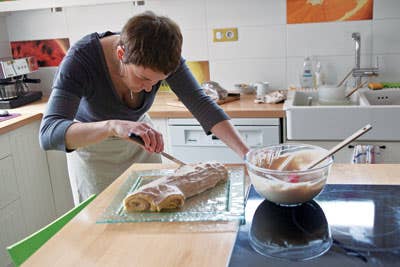

photo by Beth Rooney
The buche de Noel has its roots in Yule, a monthlong celebration of the winter solstice observed by Northern Europe's Germanic tribes. The holiday peaked with the burning of an enormous log whose purpose was to ward off the darkness, both literal and figurative, associated with winter. The burning of the Yule log is one of many pre-Christian rituals incorporated into Christmas celebrations across Europe. But by the late 19th century in France, as smaller stoves replaced large hearths, the tradition had all but faded. Soon enough, the confectionery version of the Yule log emerged to fill the void.
The first recorded mention of the buche de Noel appeared in 1898, in Le Memorial Historique et Geographique de la Patisserie, a cookbook by the Parisian pastry chef Pierre Lacam. The recipe's primary elements are identical to those of Delmontel's buche de Noel: biscuit rolled with either chocolate or coffee buttercream. According to Michael Krondl, author of Sweet Invention, A History of Dessert (Chicago Review Press, 2011), the buche de Noel is an emblem of the era that produced it. With the advent of the railroad and tourism in the 19th century, the Parisian middle class was having a love affair with the countryside. Krondl believes this cake is an urban pastry chef's interpretation of a provincial Yuletide tradition.
Totemic as the Yule log shape may be, in the last decade, on the quest for novelty, many Parisian patissiers have abandoned it altogether. Recent examples include the buche created by the celebrated pastry chef Christophe Michalak of the Hotel Plaza Athenee, modeled after the hotel's cascading staircase. At the tea room Angelina, chef Sebastian Bauer created a buche that paid tribute to another iconic sweet, the macaron, by casting a chocolate mold in the shape of three of the cookies lined up in a row. And at the restaurant 114 Faubourg, pastry chef Laurent Jeannin dreamed up a version in the form of a white-chocolate mountain peak.
Innovation among Parisian pastry chefs is nothing new, of course. Back in 1873, Jules Gouffe wrote in Le Livre de Patis-serie: "In order to succeed in the art of pastry, a youth…must have a lively and inventive fancy, one able to originate ideas." When I was in Paris last winter, several patissiers I spoke to cited the game-changing influence of the visionary pastry chef Pierre Herme on the new exhibitionism in the buches de Noel. By creating new fall, winter, spring, and summer lines of pastry each year, much like Paris's couturiers, Herme solidified the notion of pastry art as fashion, and his peers followed suit. Now, the annual unveiling of buches de Noel by the city's pastry chefs is attended by feverish media buzz. "Every year," said Jeannin, "there's more and more pressure to create for Christmas."
At the same time, even as pastry chefs have pulled out all the stops devising ever more radical renditions of the buche de Noel, it seems there's been a parallel trend, equally radical in its way, among home cooks. Parisians have, historically, left pastry to the patissiers, making simple cakes at home but purchasing more elaborate desserts from the cake shop. In the case of buches de Noel, it's possible to find versions at every price point; even supermarkets sell them, both frozen and fresh, made from cake, ice cream, and sorbet. But there's a new movement toward professional-style baking at home, spurred in part by the recent abundance of books geared toward home cooks by masters such as Herme and Michalak.
Pascale Weeks, a French food blogger, makes buche de Noel for her family. "Ten years ago it was unusual to make your own," Weeks told me when at her house in Nogent Sur Marne, a suburb of Paris. "Now more people do; it's easy to buy all the utensils to make them at home." The day I visited, she had made a chestnut buche de Noel. Her biscuit was pliant, without a single crack, and she had set a couple of slices at an angle to form the customary stumps. On top of the log swathed in chestnut buttercream, she lined up three marrons glaces (candied chestnuts) and then sprinkled on balls of edible silver "frost." It was as enchanting—and delicious—as any buche de Noel I ate that winter.
Keep Reading
Continue to Next Story