I learned how to make boiled eggs when working in the Deli of a grocery store many years ago. The trick is to put a large amount of salt in the water you boil the eggs in. For a medium pot, I put in about 1/2 cup or more. The salt doesn't affect the taste of the eggs at all and peeling even the freshest eggs are a breeze.
Easy Peeling: How to Peel Hard-Boiled Eggs
By
Enlarge Image
Credit: Michael Kraus
When you hard-boil as many eggs as we did to test deviled egg recipes for the SAVEUR 100, you start to wonder what the best way is to peel the darned things. We rolled, cracked, and carefully peeled our way through hundreds of them before we arrived at a few simple truths.
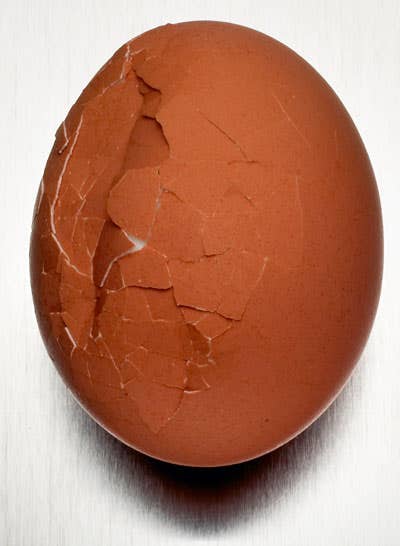
The most important step to getting a perfect, pock-free peel is to tap your hard-boiled eggs with a spoon or roll them on the countertop to crack the shells before you shock the eggs in cold water. This will loosen the membrane and make them easier to peel. We also found that the longer you leave eggs in cold water, the harder it is to remove their shells. Ideally, peel the eggs as soon as they're cool. Start at the broad end, and hold the egg under running water to loosen any bits of stubborn shell clinging to the sides.
Another thing to keep in mind is the freshness of your eggs. It turns out there's truth to the old saying "Fresh eggs are for frying and older eggs are for boiling." As Harold McGee notes in his book Keys to Good Cooking (Penguin, 2010), "Very fresh egg whites tend to stick to the inner shell and tear." To test eggs' freshness, drop them gently into a bowl of cold water. The freshest ones will immediately sink on their sides, while slightly older ones will tilt or even sit upright at the bottom of the bowl. Just be careful to avoid using eggs that float to the surface, a sign that they're past their prime.
Try deviled eggs in these recipes from Saveur Issue #135:
Deviled Eggs with Pickled Jalapeños
Bacon and Cheese Deviled Eggs
Deviled Eggs with Smoked Trout
Southern Style Deviled Eggs
Comments (7)


Very interesting! When I drain the hard cooked eggs I plunge them (literally) into an ice bath (fill a bowl with ice then with water) to ensure the eggs are cracked. Then I put the bowl in the fridge for an hour. Maybe that hour in ice in the fridge is how long it takes and we are talking about the same method and amount of time. I swear by it.

I will corroborate Stellar's advice on peeling hard-boiled eggs that are hen-fresh: salt in the boiling water does the trick. It does not require a large amount of salt, in my experience. A teaspoonful in a 3-quart pot of water seems to do just fine. Eggs still warm from the henhouse can be successfully boiled and peeled. I'd be curious to know the physics/chemistry behind this phenomenon.

These instructions are too simplistic to be useful. This article needs to list: Temperature of the egg pre-cooking (room temp or right from the fridge). Temperature and amount of water the egg was added to. Cooking time and temp (boiling or near boiling). How the eggs were cooled and for how long (ice water or cold). Without this sort of information, the cook has to guess on these parameters. Some will guess correctly and forward on the instructions as effective. Others will get poor results and give up. I have boiled eggs a few different ways and it drastically affects the peeling. There is no way that the technique in the article works for any and every boiled egg.

I plunge the hot eggs in an ice bath. I then add about 1/2 cup of ice cold water to a sauce pan, add one egg at a time and whirl the egg around in the pan, occasionally jogging the egg against the side of the pan sharply, until the shell crumples and begins to come apart. Once the water gets under the shell, the water and whirling motion works the shell off of the egg white, and makes it easier to rinse off the rest of the shell under running water. Most of the shell will come off in almost one piece.

Why bother peeling at all when you don't have to now? There's a new gadget on Technorati: http://technorati.com/blogs/www.squidoo.com%2Feggies-reviews

thank you for this...