Breaking the Fast
In the United Arab Emirates, Ramadan is a period of both reflection and revelry
It all started with a short tweet about a trip I was planning to Dubai, which attracted the attention of a woman named Bodour. She lived in Sharjah, one of the seven United Arab Emirates, only a 30-minute drive north from Dubai. "So few people know about Emirati food," she tweeted back. "I'd be happy to give you a culinary tour." I had been to Dubai in the 1970s, when it was still a modest fishing village and neighboring Abu Dhabi was more developed, but the visit was brief, and apart from going to the fish market, I saw very little of Emirati life and never got to taste any of the local fare. Of course, a lot has changed since then; Dubai is now much glitzier than Abu Dhabi, the UAE's capital city. But the emirate of Abu Dhabi—meaning the territory ruled by its emir—still accounts for more than 80 percent of all the emirates.
I was going back to work as a host on a cooking and travel show for Abu Dhabi TV, so you can imagine my excitement at this unexpected offer of hospitality. I accepted, not knowing that my generous guide was Sheika Bodour bint Sultan Al Qasimi, the daughter of Sharjah's ruler. (Each emirate has its own royal family that rules as a separate monarchy.) I couldn't have asked for a better introduction: Not only did we bond over a shared love of Middle Eastern cooking (Al Qasimi owns a restaurant in Sharjah city, in fact) but within two days she had arranged for me to sample a range of the emirate's signature dishes.
When I arrived in the city of Sharjah, a modern metropolis of about 800,000, I met my new friend, a lovely woman in her early 30s, at a heritage center where local cooks give classes. Half a dozen women—all of them, like Al Qasimi, wearing black thobs, long robes that covered their clothes, their hair hidden by scarves—were in a large, traditional open-air kitchen preparing a goat stew, some spiced rice, and other dishes. Al Qasimi explained that while the country's large expat population from Iran, Palestine, India, and other countries had certainly influenced the local fare over the decades, true Emirati cuisine has its own distinct character. Fish from the Arabian Sea plays a major part in the diet, and meat and rice dishes are complexly spiced: Saffron and cardamom are the predominant flavors, and a spice mix called bzar, made with spices like cumin and coriander, is added to practically everything. Rice and flat breads are staples, and some of the dishes Al Qasimi served straddled the line between savory and sweet, thanks to a touch of sugar or date syrup. Al Qasimi also told me that camel meat is a specialty, particularly among Bedouin families, but that nowadays it is mostly reserved for special occasions.
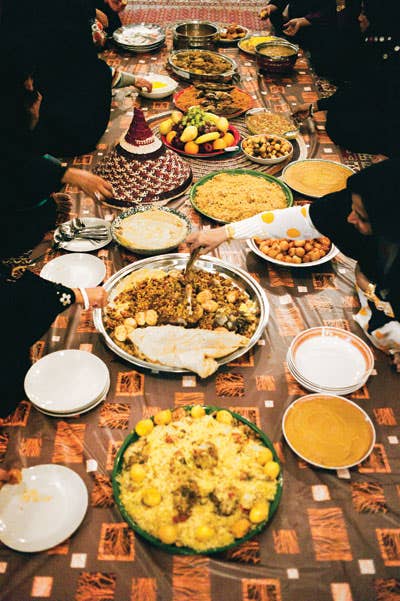

photo by Jason Lowe
"You'll have to come back during Ramadan," she told me when I thanked her for the wonderful culinary tour. "That's the best time to sample all the special dishes." It was a sentiment I heard time and again during that trip. I knew that Ramadan, which is always held during the ninth month of the lunar calendar, is a delicious time of the year in the Muslim world: Since people fast from sunrise to sunset, not letting even a drop of water into their mouths, meals take on a special meaning. It's a holiday I came to appreciate growing up in Beirut: Even though my family is Christian, I loved Ramadan because our Muslim neighbors would always bring my mother special sweets or dishes they had prepared for the nightly feasting. And before dawn, I would rise to the sound of the tabbal—a drum beater who roamed the neighborhood, waking people up so that they could have their last meal before the fast would begin again.
Throughout the month of Ramadan, life takes on a different rhythm, slow and sleepy during the day—many people work shorter hours this time of year—and absolutely joyful at night. Ramadan is also a month of reflection, piety, and charity. Those who are well off gather with their families to feast and enjoy each other's company, and those who are less privileged eat in mosques or in tents erected in public places where wealthy patrons provide nightly meals.
I had heard that Ramadan tents are set up everywhere in the Emirates—big, lavish ones in luxury hotels and public squares and small ones in the courtyards of private homes. And when I asked people about their favorite Emirati foods, they almost always answered with a story about a Ramadan iftar, the meal that breaks the daily fast. So before I even left Abu Dhabi I started making plans to return the following September, when Ramadan would take place (the dates change each year) to experience Emirati food during Islam's holiest month.
A few months later, I returned to Sharjah toward the end of Ramadan. Al Qasimi had recently given birth to her third child and was not able to meet me, but Mariam Saeed, a warm and cheerful woman who works as the heritage center's main cook, had gathered a group of her friends for a special iftar. The kitchen was filled with conversation and activity when I arrived; one woman was mixing pureed pumpkin to make assidat al-boubar, a pumpkin halvah, and other cooks set up a long rectangular mat in the breezy courtyard and started covering it with platters of food.
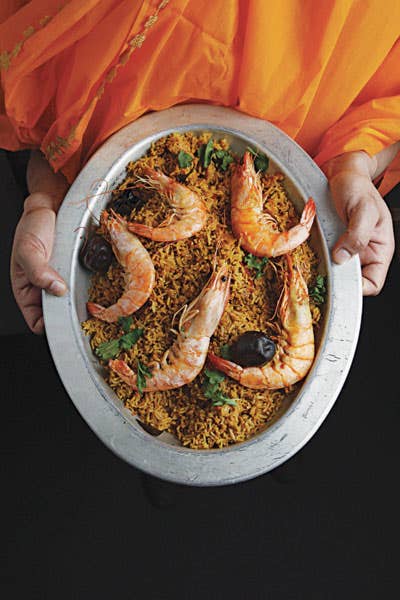

photo by Jason Lowe
This is the traditional way to eat in the Emirates: sitting on a mat on the floor, using your right hand to ferry food to the mouth, as was decreed by the Prophet Muhammad; the only utensils were spoons for soups and desserts. As the guest of honor, I was directed to sit to the right of the host, Saeed, who took her place at a spot in the middle.
As we ate, Saeed explained that even though the iftar menu changes daily, there are some dishes that are always served during Ramadan. One is h'riss, a porridge made with wheat berries and lamb that's cooked until fall-apart tender. The version we ate was drizzled with ghee blended with bzar, which gave the h'riss a warm, toasty flavor. Tharid, also known as the Prophet Muhammad's favorite dish, is another Ramadan essential. It's made of layers of paper-thin, cracker-like bread called regag, which I'd watched the women make by rolling a very soft ball of dough over a large hot plate until a thin, crisp layer forms. The regag is broken up and spread in a thick layer over a dish; then it's topped with a vegetable and meat stew called salona. I did as the others did and picked up pieces of the bread together with a bit of the tender spiced meat and vegetables.
Aside from these dishes and the requisite platter of cabbage, sweet onion, and mints for refreshing the palate, anything else is fair game. My hosts had prepared a few other Emirati classics—ghoozi, baby goat roasted and served over basmati rice with a semisweet mixture of chickpeas, raisins, and onion, and machbuss rubian, a pilaf made with head-on prawns and flavored with bzar and dried limes.
For dessert, there was lgeimat, airy fritters drizzled with date syrup; balaleet, a sweet-savory vermicelli and egg dish that's sometimes served for breakfast; and that creamy pumpkin halvah, a puddinglike version made with rose water and saffron. As we finished the feast, I asked one woman how often families typically prepare elaborate meals like this during the month of Ramadan. "As often as possible," she replied.
The next day I visited my friend Tariq Al Mehyass, a wonderful poet from Abu Dhabi with whom I worked on the television show a few months prior. Al Mehyass's father hosts an open house meal every Sunday evening, which is common practice throughout the Gulf. I attended one while filming the show and was eager to return during Ramadan, when Al Mehyass told me that the meals often last until midnight.
The cooks employed in his home are all men, mostly from India, whom Al Mehyass's mother and grandmother taught to cook Emirati food. And their tharid is the best I have eaten anywhere: its moist bread layered with stew enriched with small, luscious nuggets of melted lamb tail fat. That evening they also prepared a dish I had not tasted before called al-marqoq, made of balls of fried dough in a tomatoey sauce, and khobz chebab, an addictive flatbread drizzled with date syrup.
It was a huge privilege for me to be received so sumptuously as one of the family. But for anyone who doesn't have local friends, I realized, Ramadan is the perfect opportunity to experience Emirati cooking because iftars can be found practically everywhere, from mosques to markets, and it's tradition to share.
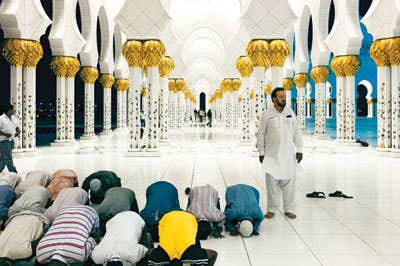

photo by Todd Coleman
There's a ritual to breaking the fast that I became attuned to after a few days. First, you wait for the muezzin (the man who chants the daily prayers in the mosque) to announce the setting of the sun. And when the announcement is made, no one rushes to a meal. Instead they gently break their fast by drinking a glass of water and eating a few dates, always an odd number—one, three, or five, as favored by the Prophet—and never too many. I am always impressed by how patient people are despite the fact that they have not eaten or drunk anything the whole day. Then everyone goes to pray, and only after that will iftar be served.
I went one late afternoon, as the sun was setting, to Sheikh Zayed Grand Mosque in Abu Dhabi, the Emirates' largest, and, for me, the most beautiful of those that have been built recently there; with its 82 white marble domes and four slender minarets, it is both vast and elegant at the same time. As I neared the mosque, hordes of people rushed past me; hundreds of people, mostly foreign workers, running up the hill to reach the dining areas, some in the gardens and others in tents. The men went one way, and the women, many of whom had brought their children, were directed to their own tent on the other side of the mosque.
Tarps had been laid right on the ground, and boxes of food had been placed on top at regular intervals. Each box contained a full meal: lamb biryani (roasted meat and rice layered with a spicy onion sauce), salad, dates, water, orange juice, and a small tub of halvah. Because they had been fasting all day and really needed to eat, I felt embarrassed about starting a conversation with my neighbors to find out who they were and why they were there. By then I had mastered how to eat rice with my hand without being messy, and except for my clothes, I seemed to fit in.
The food we ate was very good, and I made my way back to a large catering kitchen to see how it was prepared. Gargantuan amounts of rice and meat were cooking in huge pots, and dozens of cooks were packing the food in boxes, which they placed in large metal cabinets to be sent to mosques and other public places. Abu Dhabi's ruler, Sheikh Khalifa bin Zayed Al Nahyan, was paying for these thousands of meals to be prepared and distributed daily. And there was no stinting on the quality. Real saffron was stirred into the rice, and the meat was beautifully seasoned and perfectly cooked.
The Ramadan tents set up in the gardens of Emirati luxury hotels offer a completely different iftar experience. There, you need to book your table and pay for your meal, which is normally a hybrid of local and Western dishes. At the Emirates Palace in Abu Dhabi, where I was staying, the iftar tent was booked with supremely elegant women, many wearing beautifully embroidered thobs, and stylish men in their crisp white robes (called kandura). I visited the post-dinner tent, a hazy world filled with smoke from hookah pipes, where men and women were whiling the night away smoking, playing games, and listening to live music.
There are iftars on the streets, too. Wherever I walked just after sunset, I saw people eating right on the pavement or off the back of trucks in the market areas. I stopped to talk to one market vendor who was heating stuffed vegetables on a small makeshift grill he had set up near his produce truck. As is the norm with Arab hospitality, he and his business partner invited me to share their iftar. I couldn't resist. I love stuffed vegetables, and theirs looked so delicious.
We sat and ate eggplants and baby zucchini stuffed with rice, lamb, and tomatoes, and for a good half hour we talked about our favorite vegetables and the many different ways of preparing them. It was a delightful and surprising impromptu meal, and like so many I encountered during Ramadan in the Emirates, it made me feel so welcome.
_Anissa Helou is the author of _Offal: The Fifth Quarter _(Absolute Press, 2011). She lives in London. _
Keep Reading
Continue to Next Story