Seed Savers Are Working to Preserve Palestinian Cuisine in Diaspora
Amidst efforts at erasure, a network of farmers is maintaining regional culture and identity by propagating familiar foods in unfamiliar soils.

By Doug Bierend


Published on December 23, 2025

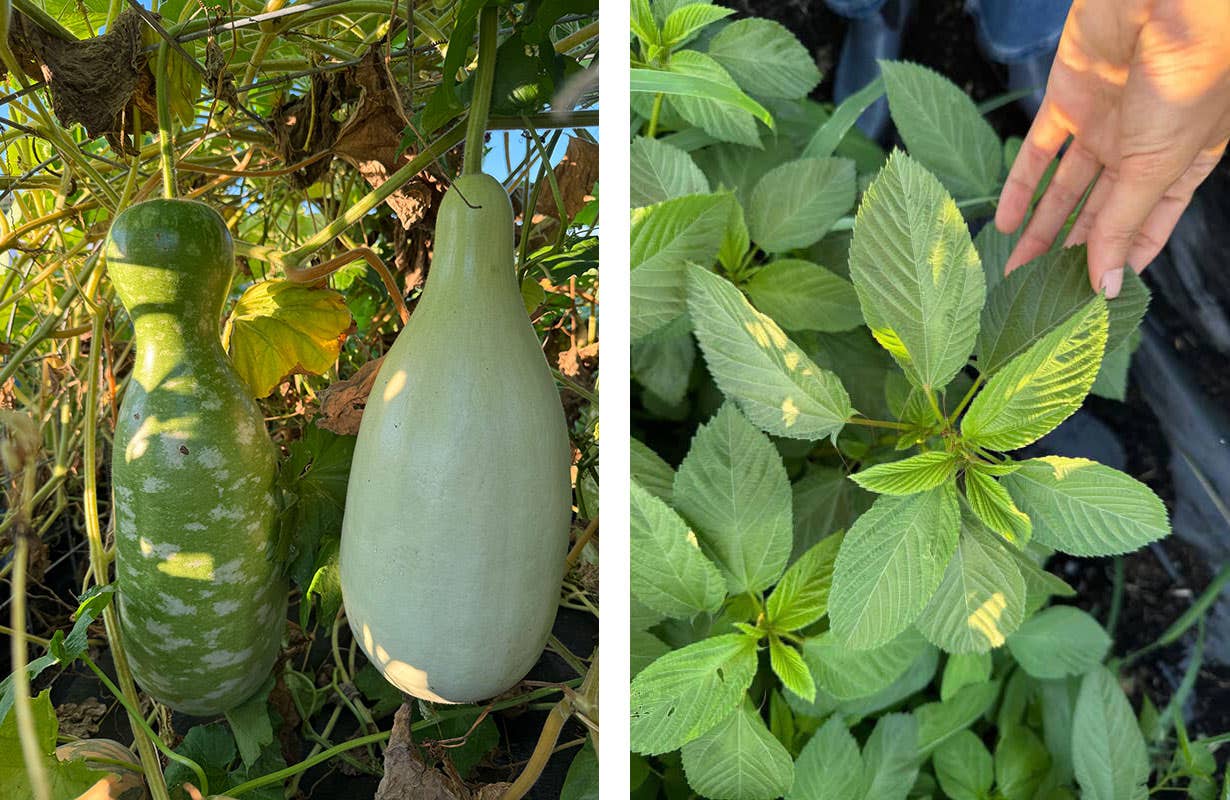
On a humid September day at Saboon Maazeh farm, the lambskin-soft leaves of yakteen cast an emerald glow in the afternoon sun, while the enormous gourds laze in the shade of their own vines. Nearby are kousa squash, sesame plants, and chest-high rows of mulukhiyah—a jute mallow used in stews throughout the Levant. Half a world away, in the black dirt of Chester, New York, these ingredients thrive under the care of farmers cultivating the flavors of home.

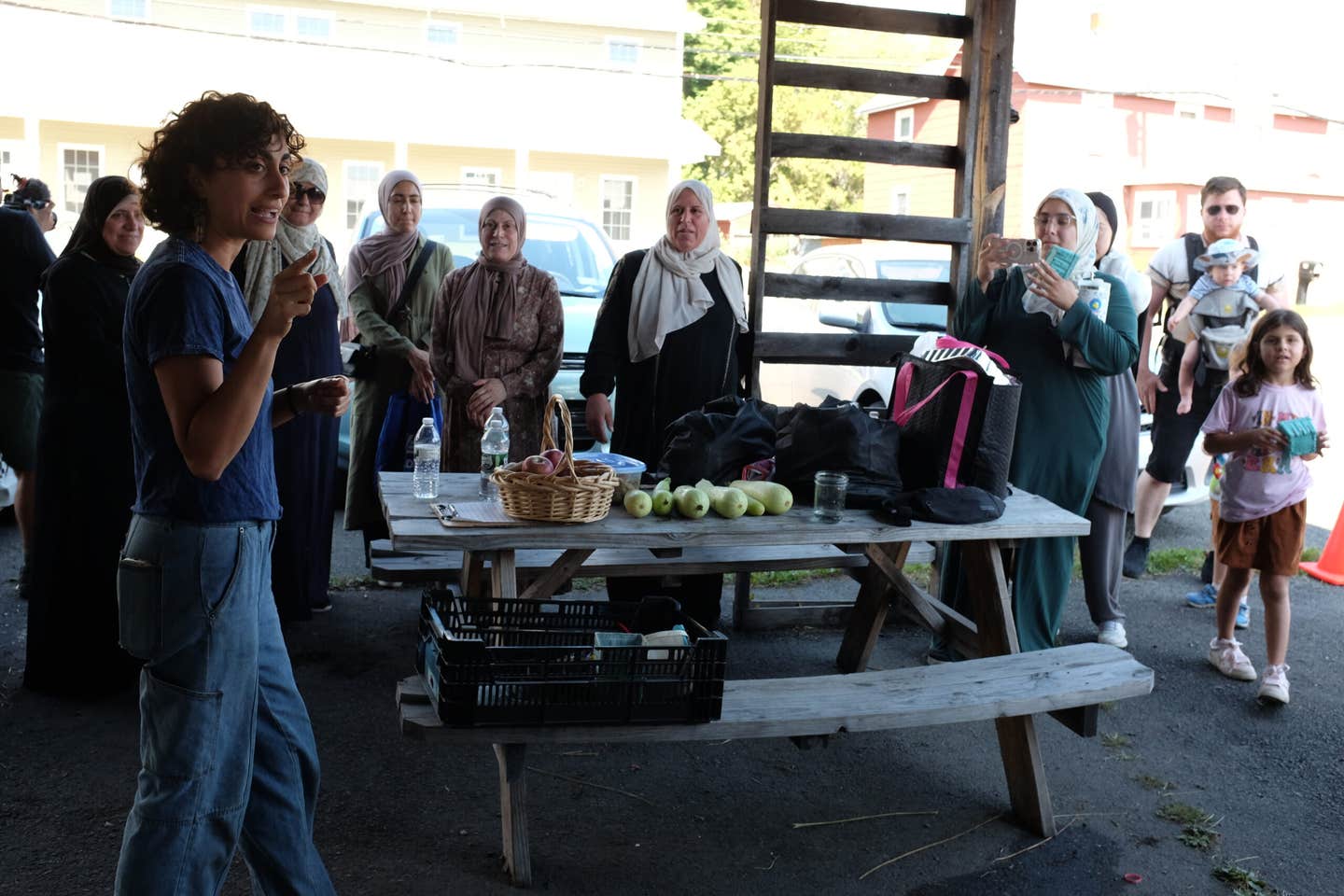
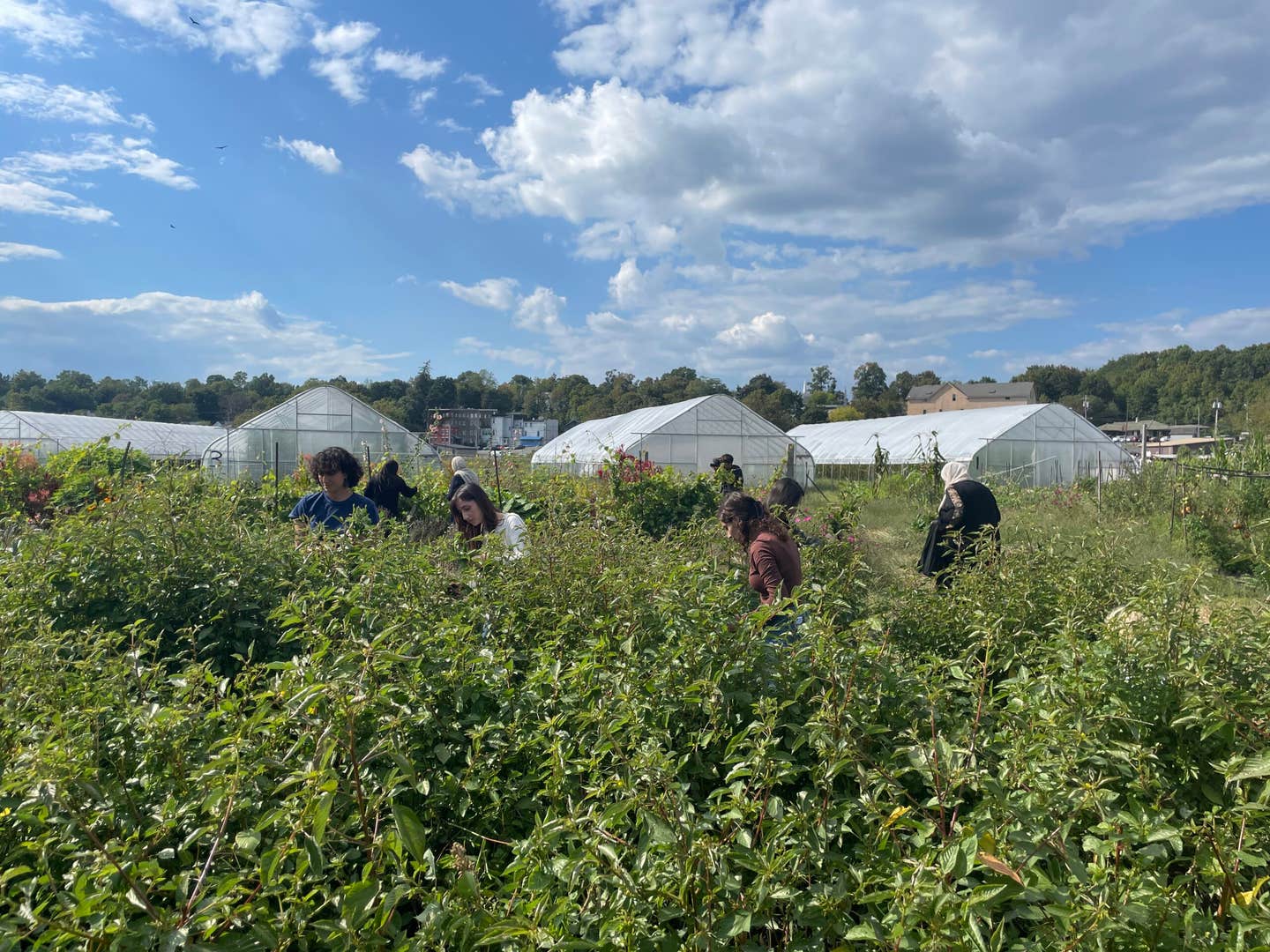
 Browsing the rows of crops were visitors from the Palestinian American Community Center in Clifton, New Jersey—mostly women and girls. For the oldest among them, it was a reunion with fresh mulukhiyah after years apart; for the rest, their first glimpse outside of a specialty market.
Saboon Maazeh
Saboon Maazeh founder Joy Youwakim with visitors from the Palestinian American Community Center (Photo: Courtesy Doug Bierend)

Such gatherings are about fostering connection, said Joy Youwakim, Saboon Maazeh’s 29-year-old Palestinian-Lebanese-American founder. “These are calming and nurturing ways to spend time with recipes that are all unique to different people’s families,” she said. “We eat the same food, then that opens the door to questions like, ‘How do you prepare this? What are your recipes? How was this food grown in your family?’”
Yakteen and mulukhiyah grown at Saboon Maazeh
Yakteen and mulukhiyah grown at Saboon Maazeh (Photos: Courtesy Saboon Mazeh)

Saboon Maazeh is a small soap workshop and vegetable farm, which Youwakim moved to New York from Texas in 2024. Alongside heirloom vegetables, Youwakim’s farm grows herbs like chamomile and sage for her traditional Aleppo-style soaps. Preservation of Palestinian seeds has become a core part of the farm’s work, carried out in collaboration with a network of seed-saving organizations such as the Palestine Heirloom Seed Library (PHSL). Their efforts to safeguard and propagate these heirloom crops are about more than niche ingredients or nostalgia: They continue a long tradition of resistance and food sovereignty, one that spans the histories of oppressed and displaced peoples who, like these plants, have been forced far from their native soils.

That tradition takes on even deeper urgency today. The United Nations and numerous human rights organizations, including Médecins Sans Frontières, International Association of Genocide Scholars, Physicians for Human Rights–Israel, Oxfam, Human Rights Watch, and Amnesty International have documented Israel’s ongoing campaign of genocide in Gaza alongside decades of apartheid policies in the West Bank. Central to this violence is the control and destruction of foodways. Olive groves, seed banks, farms, and fields across the occupied territories have been systematically razed; even foraging is outlawed. This is not merely the denial of sustenance, but an assault on the foundations of Palestinian cultural identity rooted in an enduring connection to the land. 
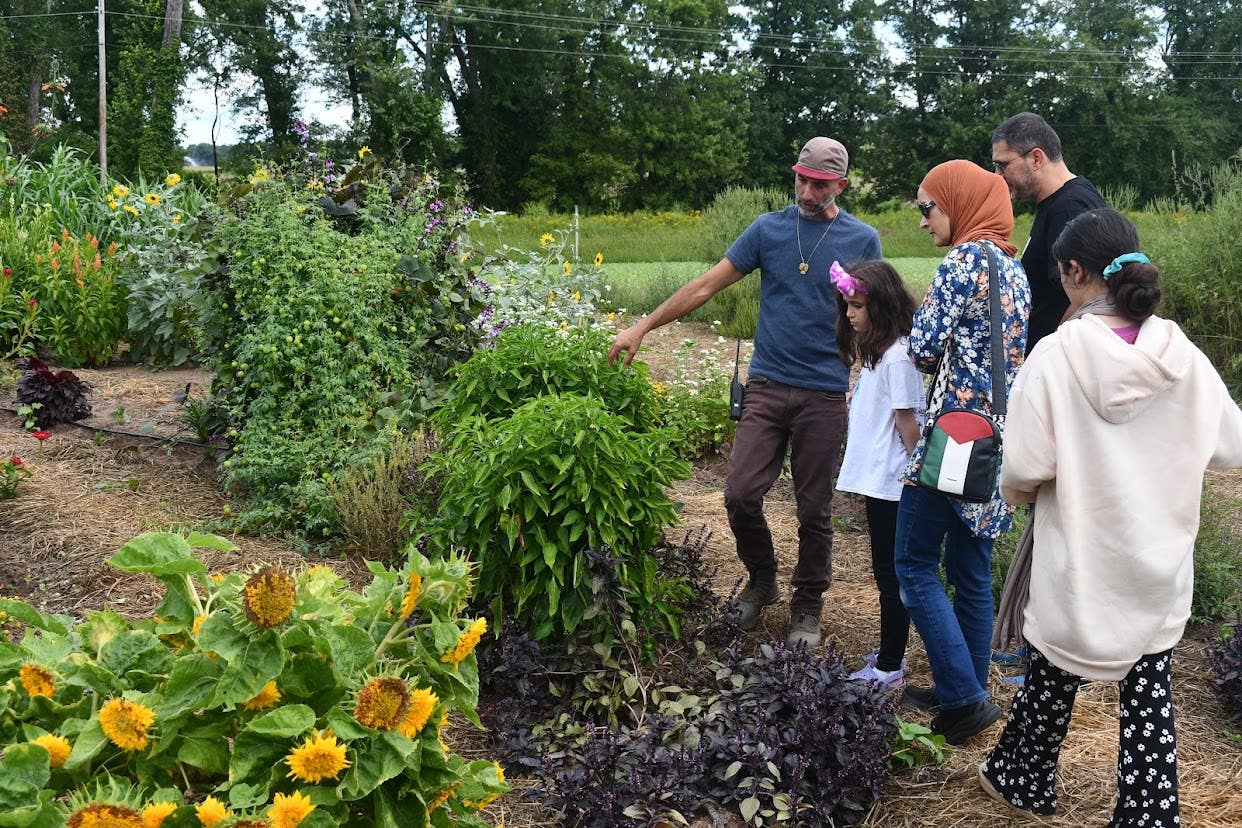
Youwakim and guests browsing rows of mulukhiyah at Saboon Maazeh
Youwakim and guests browsing rows of mulukhiyah at Saboon Maazeh (Photo: Courtesy Doug Bierend)

At Saboon Maazeh, members of the Palestinian diaspora can touch and smell these plants—a powerful connection to home and a vital reminder of shared identity. Mulukhiyah, typically available only frozen or dried in the United States, is one such example. “They’ll come and say, ‘I just want to make kousa,’” said Youwakim. “‘I can’t find it anywhere, and making it makes me feel like myself—grounded, at home.’”

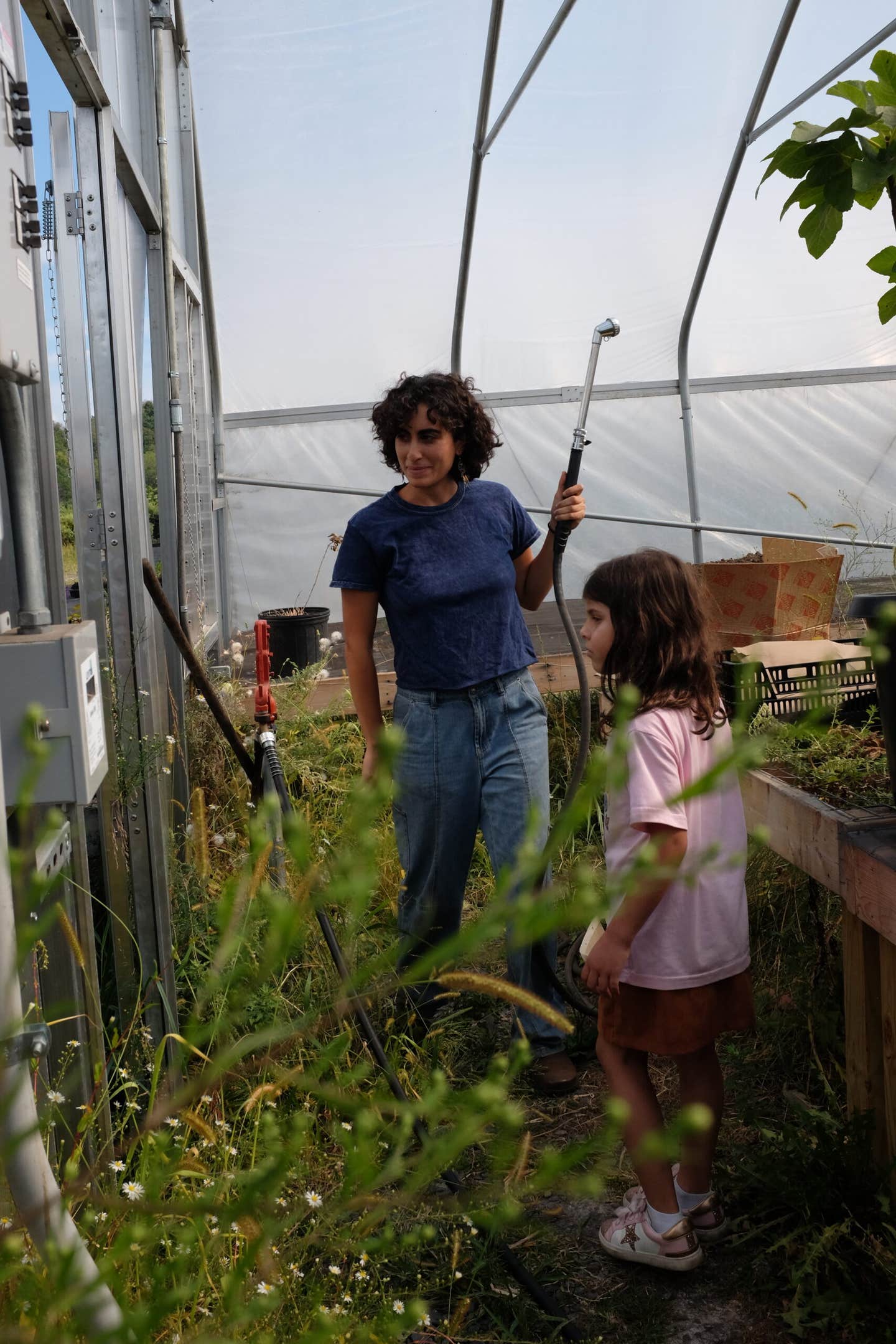
Youwakim waters an heirloom fig tree with a young visitor from the Palestinian American Community Center
Youwakim waters an heirloom fig tree with a young visitor from the Palestinian American Community Center (Photo: Courtesy Doug Bierend).

In a hoop house, Youwakim introduced the visitors to a young fig tree grown from a cutting taken from her father’s yard—its lineage tracing back to Lebanon and brought over in the 1880s. “There was a time where this work felt more joyful,” she said. “Just like, ‘Let me show you what I’m saving. Let me show you what I’m growing.’ Now it has this heavier sense of duty, like we have to save the seeds or they will be erased.”

Seed banks exist to sustain agricultural practices and safeguard crops that have been cultivated for millennia. In times of war or natural disaster, they’re crucial not just to maintain crop genetics but also for ensuring cultural and physical survival. Seeds are alive, after all: They must germinate and reproduce regularly for a landrace to remain viable, thereby entwining the lives of crops, farmers, and the land itself. 

The first major institutional seed bank, the Institute of Plant Industry in today’s St. Petersburg, Russia, narrowly escaped destruction during World War II. Undoubtedly, the best-known modern facility is the doomsday seed vault in frigid Svalbard, Norway—it is home to more than a million varieties of seeds, including those spirited away from recent conflicts in Ukraine, Sudan, and Palestine

In August, Israeli forces demolished the multiplication unit of a seed library run by the Union of Agricultural Work Committees. “The very backbone of the Bank’s ability to regenerate and supply seeds was directly targeted,” said Fuad AbuSaif, the organization’s general director. Recovery efforts are underway, but the extent of the damage to more than 70 heirloom seed varieties remains unclear, leaving local farmers who depend on them at heightened risk. The facility was raided again at the beginning of December.

Similar forms of cultural destruction and economic expropriation occur throughout the world. In the first months of the war in Ukraine, Russian forces struck the Plant Genetic Resources Bank in Kharkiv, which houses more than 150,000 crop varieties, including rare cultivars of barley, peas, and wheat. Reports also indicate the seizure of Ukrainian wheat and sunflower seeds. Sudan’s national seed bank, containing rare varieties of sorghum and pearl millet, was occupied and gutted. Meanwhile, Yemen’s National Genetic Resources Center struggles to operate amid ongoing armed conflict, economic sanctions, and airstrikes by the U.S. and Israel.

In recent years, one phrase has gained traction in antiracist, anticolonial movements: “They tried to bury us; they didn’t know we were seeds.” Though the phrase likely traces back to a Greek poet, it has taken on a deeper meaning as seed saving is increasingly recognized as a means of preserving culture.

In the U.S., BIPOC communities have long worked to preserve fragments of traditional cuisines and their agricultural heritage amidst systematic displacement and efforts at erasure. Staples of modern American cooking, such as black eyed peas, sesame seeds, and peanuts, first crossed the Atlantic to Turtle Island on slave ships. As Leah Penniman, founder of Soul Fire Farm, wrote in Farming While Black, when enslaved Africans were kidnapped from Africa, “As insurance for an uncertain future, they began the practice of braiding rice, okra, and millet seeds into their hair.” 

Soul Fire Farm propagates heirloom Palestinian seeds with the ultimate goal of repatriating them to their home soils. Among them are native varieties of tomatoes, fava beans, watermelons, and a white cucumber gifted to Palestinian Jordanian farmer Hana’ Maaiah by growers in the West Bank village of Wadi Fukin.

“As I started, it felt like the seeds were saying, ‘Hold on—you’re doing this wrong,’” said Maaiah. “I paused and thought, ‘What is this resistance I’m feeling?’ It was like they were telling me, ‘You’re supposed to do this in community.’”

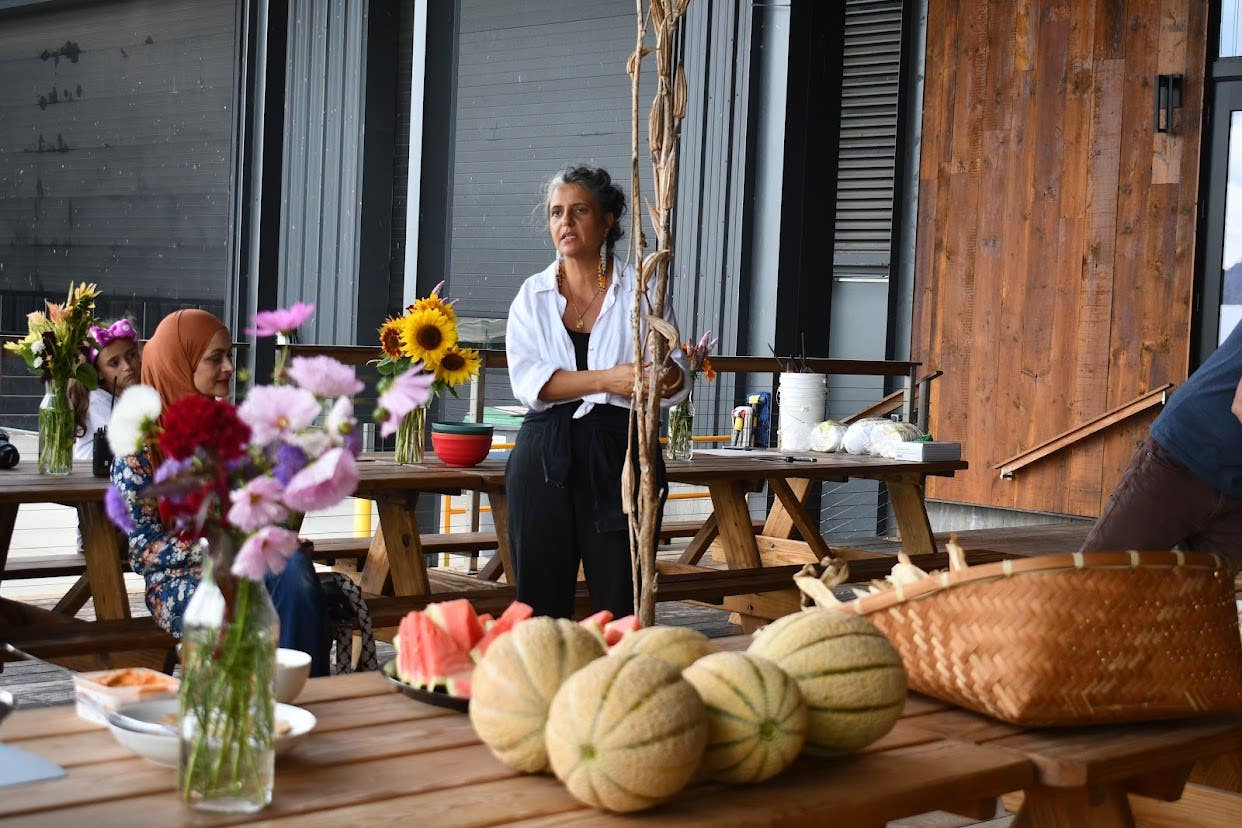
Vivien Sansour
Vivien Sansour, founder and director of the Palestine Heirloom Seed Library, holding a dried stalk of heirloom bamyeh, or okra (Photo: Tara Rodríguez Besosa, Courtesy Palestine Heirloom Seed Library)

The power of seeds to bond people together speaks to the reciprocal, resilient relationship between humans and their silent fellow travelers. Seeds have “sprouted wings,” as Vivien Sansour of PHSL puts it, voyaging far and wide alongside their traditional stewards, whether due to choice or circumstance. 

Laila El-Haddad and family with K Greene, director of seed programs at Hudson Valley Farm Hub, harvesting peppers
Laila El-Haddad and family with K Greene, director of seed programs at Hudson Valley Farm Hub, harvesting peppers (Photo: Tara Rodríguez Besosa, Courtesy Palestine Heirloom Seed Library)

For Laila El-Haddad, Maryland-based Palestinian journalist and author of The Gaza Kitchen, the flavors of home are distinctly bold. “There’s the love of the chile pepper, abundant spice, and souring agents—a lot of lemon,” she said. “Instead of regular sesame seed paste, [in Gaza] we use roasted sesame tahini, and it results in this really rich, nutty signature flavor.” 

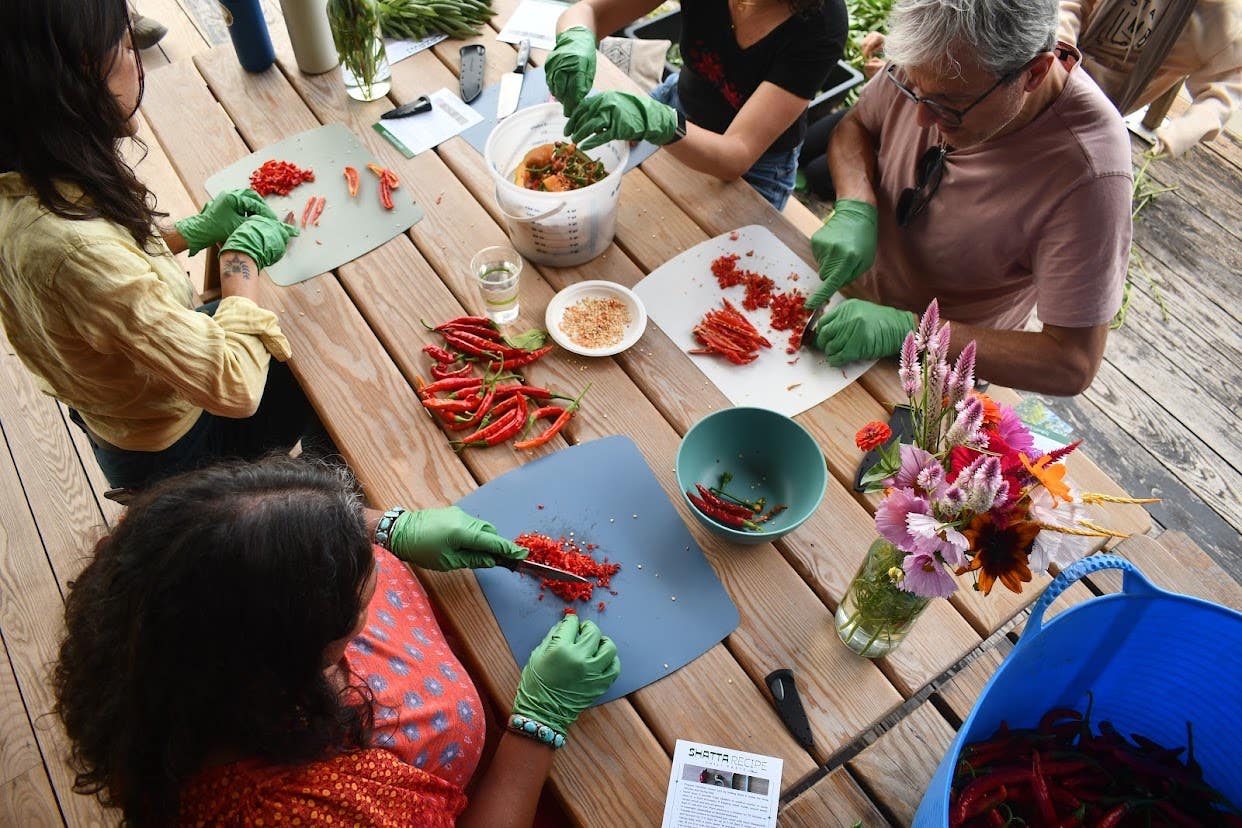
Chopping peppers for shatta
Chopping peppers for shatta (Photo: Tara Rodríguez Besosa, Courtesy Palestine Heirloom Seed Library)

A week before our conversation, at another seed-saving gathering, El-Haddad took part in making shatta, a traditional Palestinian fermented red chile paste. The simple task belied a complex, months-long process: The seeds had passed through many hands, routing from Gaza to Jordan, then to the American state of Georgia, and finally to New York’s Hudson Valley. “We saw farmers in [Gaza’s] far north attempt to retrieve many of these seeds before they, too, were destroyed in barren, bombed-out fields,” El-Haddad said. She germinated the seeds herself before passing them to PHSL, which organized the shatta event. 

Jarring shatta to share
Jarring shatta to share (Photo: Tara Rodríguez Besosa, Courtesy Palestine Heirloom Seed Library)

El-Haddad described the event as a spiritual experience, one that brought to mind the struggle of her family enduring forced starvation in the north of Gaza. Her friend’s brother, who had initially brought the pepper seeds out of Gaza, later returned and was killed in an Israeli airstrike. After the workshop, she contacted his family and showed them pictures of her crop. “They were overwhelmed,” she said. “They told his kids, ‘Your father lives on through the pepper plants.’”

To see the thriving yakteen and the smiling faces among the mulukhiyah at Saboon Maazeh—like old friends reunited far from where they first took root—one could almost overlook the traumas underpinning this moment. Yet scenes like this also embody the continuation of an unbroken chain of hands, passing seed to earth and back again for generations. It is an image of resilience—what Palestinians call sumud—tying together people, plants, and soil, wherever they may be. “All of that was wrapped into a single, tiny seed,” said El-Haddad.

How to get involved: If you’re interested in learning more about Palestinian heirloom seeds and other food sovereignty and seed preservation initiatives, here is a short list of organizations to get you started.
Palestine Heirloom Seed Library
Soul Fire Farm
Truelove Seeds
Experimental Farm Network

Halima Aziz
Culture

Seed Savers Are Working to Preserve Palestinian Cuisine in Diaspora

Amidst efforts at erasure, a network of farmers is maintaining regional culture and identity by propagating familiar foods in unfamiliar soils.

Seed Savers Are Working to Preserve Palestinian Cuisine in Diaspora
HALIMA AZIZ

By Doug Bierend


Published on December 23, 2025

On a humid September day at Saboon Maazeh farm, the lambskin-soft leaves of yakteen cast an emerald glow in the afternoon sun, while the enormous gourds laze in the shade of their own vines. Nearby are kousa squash, sesame plants, and chest-high rows of mulukhiyah—a jute mallow used in stews throughout the Levant. Half a world away, in the black dirt of Chester, New York, these ingredients thrive under the care of farmers cultivating the flavors of home.

 Browsing the rows of crops were visitors from the Palestinian American Community Center in Clifton, New Jersey—mostly women and girls. For the oldest among them, it was a reunion with fresh mulukhiyah after years apart; for the rest, their first glimpse outside of a specialty market.

Saboon Maazeh
Saboon Maazeh founder Joy Youwakim with visitors from the Palestinian American Community Center (Photo: Courtesy Doug Bierend)

Such gatherings are about fostering connection, said Joy Youwakim, Saboon Maazeh’s 29-year-old Palestinian-Lebanese-American founder. “These are calming and nurturing ways to spend time with recipes that are all unique to different people’s families,” she said. “We eat the same food, then that opens the door to questions like, ‘How do you prepare this? What are your recipes? How was this food grown in your family?’”

Yakteen and mulukhiyah grown at Saboon Maazeh
Yakteen and mulukhiyah grown at Saboon Maazeh (Photos: Courtesy Saboon Mazeh)

Saboon Maazeh is a small soap workshop and vegetable farm, which Youwakim moved to New York from Texas in 2024. Alongside heirloom vegetables, Youwakim’s farm grows herbs like chamomile and sage for her traditional Aleppo-style soaps. Preservation of Palestinian seeds has become a core part of the farm’s work, carried out in collaboration with a network of seed-saving organizations such as the Palestine Heirloom Seed Library (PHSL). Their efforts to safeguard and propagate these heirloom crops are about more than niche ingredients or nostalgia: They continue a long tradition of resistance and food sovereignty, one that spans the histories of oppressed and displaced peoples who, like these plants, have been forced far from their native soils.

That tradition takes on even deeper urgency today. The United Nations and numerous human rights organizations, including Médecins Sans Frontières, International Association of Genocide Scholars, Physicians for Human Rights–Israel, Oxfam, Human Rights Watch, and Amnesty International have documented Israel’s ongoing campaign of genocide in Gaza alongside decades of apartheid policies in the West Bank. Central to this violence is the control and destruction of foodways. Olive groves, seed banks, farms, and fields across the occupied territories have been systematically razed; even foraging is outlawed. This is not merely the denial of sustenance, but an assault on the foundations of Palestinian cultural identity rooted in an enduring connection to the land. 

Youwakim and guests browsing rows of mulukhiyah at Saboon Maazeh
Youwakim and guests browsing rows of mulukhiyah at Saboon Maazeh (Photo: Courtesy Doug Bierend)

At Saboon Maazeh, members of the Palestinian diaspora can touch and smell these plants—a powerful connection to home and a vital reminder of shared identity. Mulukhiyah, typically available only frozen or dried in the United States, is one such example. “They’ll come and say, ‘I just want to make kousa,’” said Youwakim. “‘I can’t find it anywhere, and making it makes me feel like myself—grounded, at home.’”
Youwakim waters an heirloom fig tree with a young visitor from the Palestinian American Community Center
Youwakim waters an heirloom fig tree with a young visitor from the Palestinian American Community Center (Photo: Courtesy Doug Bierend).

In a hoop house, Youwakim introduced the visitors to a young fig tree grown from a cutting taken from her father’s yard—its lineage tracing back to Lebanon and brought over in the 1880s. “There was a time where this work felt more joyful,” she said. “Just like, ‘Let me show you what I’m saving. Let me show you what I’m growing.’ Now it has this heavier sense of duty, like we have to save the seeds or they will be erased.”

Seed banks exist to sustain agricultural practices and safeguard crops that have been cultivated for millennia. In times of war or natural disaster, they’re crucial not just to maintain crop genetics but also for ensuring cultural and physical survival. Seeds are alive, after all: They must germinate and reproduce regularly for a landrace to remain viable, thereby entwining the lives of crops, farmers, and the land itself. 

The first major institutional seed bank, the Institute of Plant Industry in today’s St. Petersburg, Russia, narrowly escaped destruction during World War II. Undoubtedly, the best-known modern facility is the doomsday seed vault in frigid Svalbard, Norway—it is home to more than a million varieties of seeds, including those spirited away from recent conflicts in Ukraine, Sudan, and Palestine

In August, Israeli forces demolished the multiplication unit of a seed library run by the Union of Agricultural Work Committees. “The very backbone of the Bank’s ability to regenerate and supply seeds was directly targeted,” said Fuad AbuSaif, the organization’s general director. Recovery efforts are underway, but the extent of the damage to more than 70 heirloom seed varieties remains unclear, leaving local farmers who depend on them at heightened risk. The facility was raided again at the beginning of December.

Similar forms of cultural destruction and economic expropriation occur throughout the world. In the first months of the war in Ukraine, Russian forces struck the Plant Genetic Resources Bank in Kharkiv, which houses more than 150,000 crop varieties, including rare cultivars of barley, peas, and wheat. Reports also indicate the seizure of Ukrainian wheat and sunflower seeds. Sudan’s national seed bank, containing rare varieties of sorghum and pearl millet, was occupied and gutted. Meanwhile, Yemen’s National Genetic Resources Center struggles to operate amid ongoing armed conflict, economic sanctions, and airstrikes by the U.S. and Israel.

In recent years, one phrase has gained traction in antiracist, anticolonial movements: “They tried to bury us; they didn’t know we were seeds.” Though the phrase likely traces back to a Greek poet, it has taken on a deeper meaning as seed saving is increasingly recognized as a means of preserving culture.

In the U.S., BIPOC communities have long worked to preserve fragments of traditional cuisines and their agricultural heritage amidst systematic displacement and efforts at erasure. Staples of modern American cooking, such as black eyed peas, sesame seeds, and peanuts, first crossed the Atlantic to Turtle Island on slave ships. As Leah Penniman, founder of Soul Fire Farm, wrote in Farming While Black, when enslaved Africans were kidnapped from Africa, “As insurance for an uncertain future, they began the practice of braiding rice, okra, and millet seeds into their hair.” 

Soul Fire Farm propagates heirloom Palestinian seeds with the ultimate goal of repatriating them to their home soils. Among them are native varieties of tomatoes, fava beans, watermelons, and a white cucumber gifted to Palestinian Jordanian farmer Hana’ Maaiah by growers in the West Bank village of Wadi Fukin.

“As I started, it felt like the seeds were saying, ‘Hold on—you’re doing this wrong,’” said Maaiah. “I paused and thought, ‘What is this resistance I’m feeling?’ It was like they were telling me, ‘You’re supposed to do this in community.’”
Vivien Sansour
Vivien Sansour, founder and director of the Palestine Heirloom Seed Library, holding a dried stalk of heirloom bamyeh, or okra (Photo: Tara Rodríguez Besosa, Courtesy Palestine Heirloom Seed Library)

The power of seeds to bond people together speaks to the reciprocal, resilient relationship between humans and their silent fellow travelers. Seeds have “sprouted wings,” as Vivien Sansour of PHSL puts it, voyaging far and wide alongside their traditional stewards, whether due to choice or circumstance. 
Laila El-Haddad and family with K Greene, director of seed programs at Hudson Valley Farm Hub, harvesting peppers
Laila El-Haddad and family with K Greene, director of seed programs at Hudson Valley Farm Hub, harvesting peppers (Photo: Tara Rodríguez Besosa, Courtesy Palestine Heirloom Seed Library)

For Laila El-Haddad, Maryland-based Palestinian journalist and author of The Gaza Kitchen, the flavors of home are distinctly bold. “There’s the love of the chile pepper, abundant spice, and souring agents—a lot of lemon,” she said. “Instead of regular sesame seed paste, [in Gaza] we use roasted sesame tahini, and it results in this really rich, nutty signature flavor.” 
Chopping peppers for shatta
Chopping peppers for shatta (Photo: Tara Rodríguez Besosa, Courtesy Palestine Heirloom Seed Library)

A week before our conversation, at another seed-saving gathering, El-Haddad took part in making shatta, a traditional Palestinian fermented red chile paste. The simple task belied a complex, months-long process: The seeds had passed through many hands, routing from Gaza to Jordan, then to the American state of Georgia, and finally to New York’s Hudson Valley. “We saw farmers in [Gaza’s] far north attempt to retrieve many of these seeds before they, too, were destroyed in barren, bombed-out fields,” El-Haddad said. She germinated the seeds herself before passing them to PHSL, which organized the shatta event. 
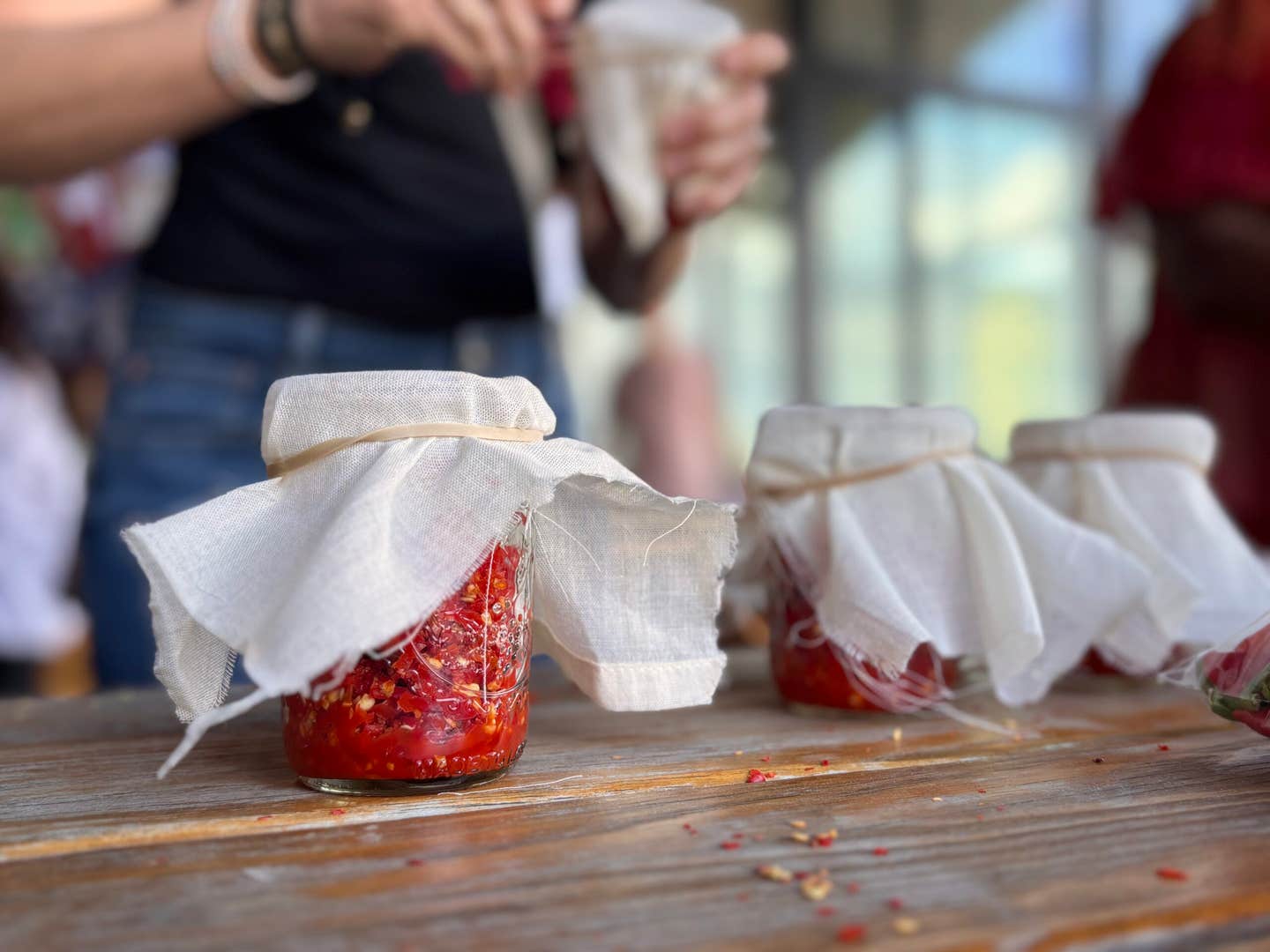
Jarring shatta to share
Jarring shatta to share (Photo: Tara Rodríguez Besosa, Courtesy Palestine Heirloom Seed Library)

El-Haddad described the event as a spiritual experience, one that brought to mind the struggle of her family enduring forced starvation in the north of Gaza. Her friend’s brother, who had initially brought the pepper seeds out of Gaza, later returned and was killed in an Israeli airstrike. After the workshop, she contacted his family and showed them pictures of her crop. “They were overwhelmed,” she said. “They told his kids, ‘Your father lives on through the pepper plants.’”

To see the thriving yakteen and the smiling faces among the mulukhiyah at Saboon Maazeh—like old friends reunited far from where they first took root—one could almost overlook the traumas underpinning this moment. Yet scenes like this also embody the continuation of an unbroken chain of hands, passing seed to earth and back again for generations. It is an image of resilience—what Palestinians call sumud—tying together people, plants, and soil, wherever they may be. “All of that was wrapped into a single, tiny seed,” said El-Haddad.

How to get involved: If you’re interested in learning more about Palestinian heirloom seeds and other food sovereignty and seed preservation initiatives, here is a short list of organizations to get you started.
Palestine Heirloom Seed Library
Soul Fire Farm
Truelove Seeds
Experimental Farm Network

Continue to Next Story

Want more SAVEUR?

Get our favorite recipes, stories, and more delivered to your inbox.