"God Bless us, every one!" is the famous benediction that Tiny Tim Cratchit pronounces over what is perhaps the most famous holiday meal of all time, in Charles Dickens' A Christmas Carol. On the Cratchit family's holiday table are potatoes, gravy, applesauce, a pudding "like a speckled cannon-ball" blazing with ignited brandy. But at the center of the meal—and the heart of Tiny Tim's prayer—is a glorious roast goose.
That goose has always stuck with me, and no wonder: It moved Dickens to a culinary rapture unparalleled in the thousands of pages he wrote. The Cratchits rush to take their places at the table with their spoons crammed in their mouths "lest they should shriek for goose before their turn came to be helped." The family says grace, and a breathless pause ensues as Mrs. Cratchit prepares to plunge the carving knife into the goose. "Bob said he didn't believe there ever was such a goose cooked. Its tenderness and flavor, size and cheapness, were the themes of universal admiration. Eked out by the applesauce and mashed potatoes, it was a sufficient dinner for the whole family; indeed, as Mrs. Cratchit said with great delight (surveying one small atom of a bone upon the dish), they hadn't ate it all at last! Yet everyone had had enough, and the youngest Cratchits, in particular, were steeped in sage and onion to the eyebrows!"
There's lots to love in this passage: the atom of leftover bone, the children sauced in sage and onion. But what's always most delighted me is the vision of the little Cratchits politely sucking their spoons so as not to clamor out of turn for their helping of goose.
Certainly that was the feeling in our family when, a few years ago, we cooked our first Christmas goose. Without the sense to put our spoons in our mouths, we relied on some notion of civilized behavior to keep from yelping and scrambling as my husband took the goose out of the oven, carved it while we hungrily watched, and brought it to the table.
In our extended family, which now includes two grown sons, spouses, grandchildren, relatives, and friends, we've cooked dozens of holiday turkeys. I say we, but my husband is the cook; my job is to page through the Joy of Cooking for its ruling, which we can never recall, on how many minutes per pound it needs to cook. But though our kitchen has produced some truly gorgeous, glistening, and flavorful birds, none of them has sparked quite the excitement that greeted that platter of goose.
Attracted by the challenge, the novelty, and—to be honest—a certain competitiveness with a friend who had boasted about his success in roasting a goose, we decided to try it. We also knew that it would mean lots of flavorful goose fat left over for roasting vegetables, baking, and making luscious confit. The prospect sent my husband, a skilled and effortlessly confident home cook, to consult several cookbooks and the Internet. His hesitation stemmed partly from the fact that we'd had to special-order the goose. And we were definitely not exulting, as Bob Cratchit had, in its cheapness. Even at our enlightened, reasonable, noncorporate local supermarket, the sticker shock had inspired one of those what-the-heck-it's-the-holidays moments of giddy abandon. On principle, you don't want to screw up an expensive 12-pound bird you've personally had to ask the butcher for—especially when it's the main course at the family holiday dinner.
Far more daunting was the rumor that cooking a goose is tricky. What you hear is that it requires hard work, mostly because it's so fatty, and the grease must be closely monitored and frequently siphoned off to avoid ruining the bird—and the oven. Several of the cookbooks from which my husband read aloud were not only unhelpful but positively alarming as they warned us about the challenge of getting the legs to come out done and the breast still moist.
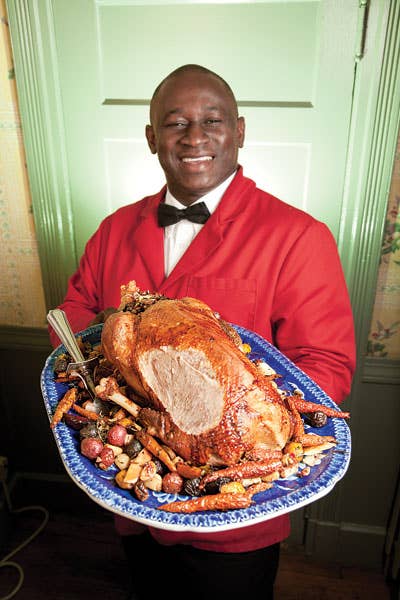
photo by Todd Coleman
As it turned out, cooking the goose wasn't difficult so much as it was demanding. Unless you have a squad of professional helpers rushing to mop every spatter, it does require the sort of organization and concentration involved in, say, canning tomatoes. But that is only if you care about the yummy goose fat winding up in jars rather than on the kitchen floor.
My husband stuffed the goose with an onion, an apple, and a lemon to draw out what one cookbook referred to as the "off" flavors. He tied up the bird and pricked holes in the skin with a curved needle, careful not to cut into the flesh. Then he placed the goose on a rack in the oven and kept turning it from side to side as it roasted, frequently draining off the fat, which he ultimately strained and poured into a jar. When the skin was crisp and the meat thermometer had registered 160 degrees, he declared it ready.
In the end, our goose was spectacular—astonishingly delicious! We all agreed with Bob Cratchit: We didn't believe there ever was such a goose cooked. Juicy, moist, delicately gamey, richer by far than any turkey; every mouthful reminded us that we were eating something special. Golden, crisp-skinned, with no signs of a struggle for doneness and tastiness among its various body parts, our goose was not only a thing of beauty, but of power. It had earned not merely our love but also our respect.
Would I have felt so strongly if I hadn't known something about the simultaneously humble and exalted role that the goose has played in food history? Its history as a feast dish, for Christmas and other celebrations, dates back to ancient times. Among French and German Jewish communities, beginning in the early Middle Ages, geese were fattened through the autumn and butchered around the time of Hanukkah, before the coming of winter. The Pilgrims brought the domesticated goose to this country, where it was a popular holiday dish until the 19th century, when it was gradually supplanted by the turkey, a bird now farmed on an industrial scale as the goose never has been.
Would I have enjoyed our goose more had I not known that, throughout much of Western Europe, the traditional Christmas goose had once been the traditional Michaelmas goose, served at the end of September, on the feast day of the Archangel Michael? That its timing in the culinary calendar had been moved from the autumn equinox to the winter solstice to better assert its symbolic promise that the seasons are turning and the darkest days are over? Would I have been as delighted if I hadn't known that the goose was, historically, not only a source of nourishment and pleasure but also of consolation and hope?
I wish I could pretend that I thought about any of this as I ate the goose. In fact I was too focused on how scrumptious (and not greasy!) it was. But later, clearing the dishes and standing at the sink, I reflected on the meaning of tradition and of traditional food. I thought about how tradition can transcend one's personal life and the circle of one's immediate family, how a culinary heritage can tie us to history and to literature, and to the lives and the feasts that came before us.
As I put away the goose stock for a soup that would last until the end of the week; as I collected the scraps for the goose mole tacos we would have the next day; and for weeks afterward, as we ate potatoes, root vegetables, peppers, onions, and even eggs fried in goose fat, I heard, in my mind, the echo of Tiny Tim's brave and grateful voice, moved to prayer by a roast goose. God bless us, every one.
Keep Reading

Continue to Next Story