Panettone
Everything you love about the classic Italian holiday treat but easy enough to make at home.

By Jason Schreiber


Published on December 19, 2025

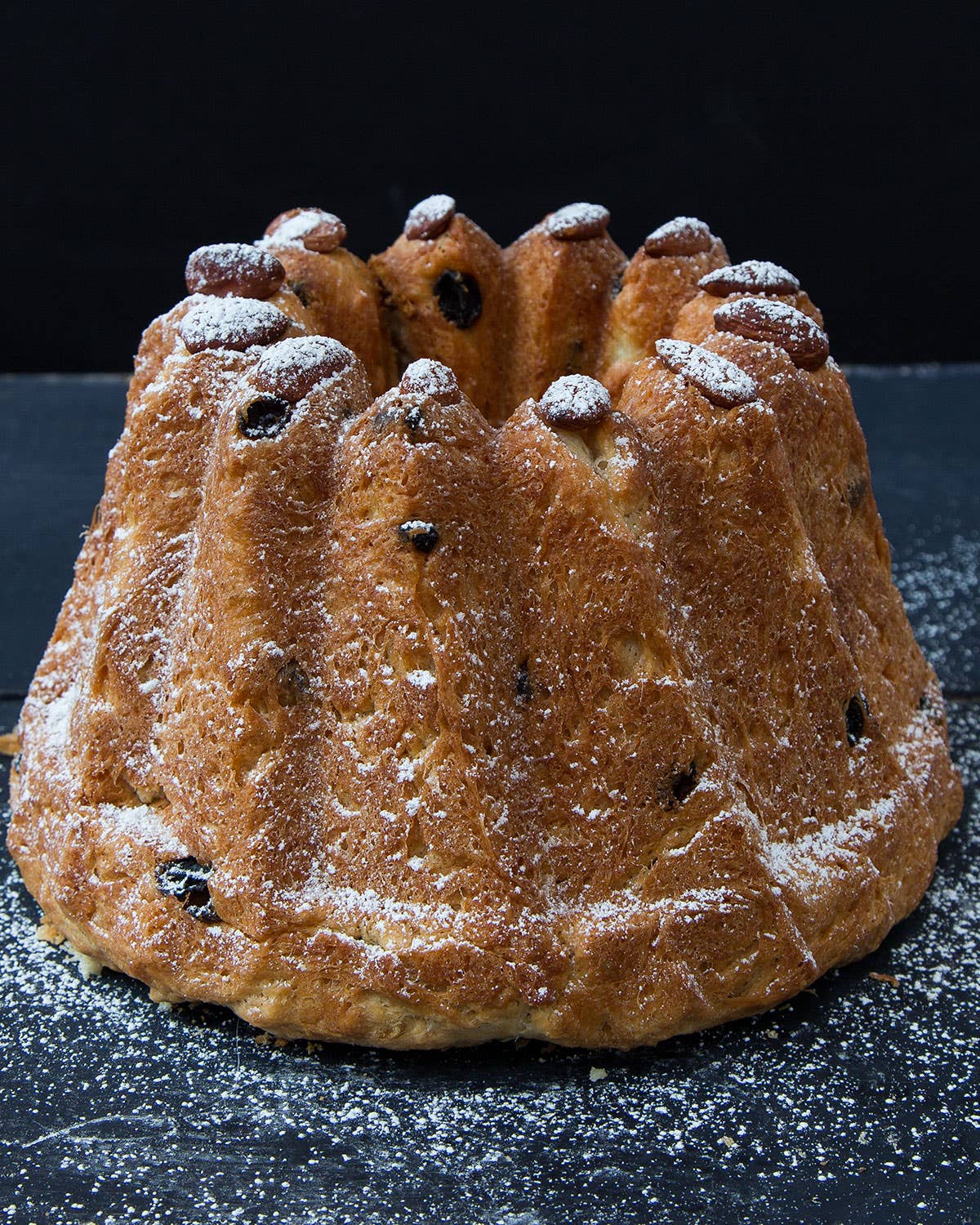
In Italy, the word “panettone” is regulated by the government, much like Champagne is in France, with strict requirements about its ingredients and methods. Butter, eggs, raisins, and candied citrus are nonnegotiable, as is the lievito madre (mother yeast), a stiff sourdough starter specific to panettone and other Italian grandi lievitati (literally “big leavened”). This at-home version of the classic Italian holiday treat from Jason Schreiber, food stylist, baker extraordinaire, and author of Fruit Cake, skips the lievito madre and is leavened only with commercial yeast but maintains everything you love about the original. A harmony of bread, cake, and fruit, it’s irresistibly tender, soft, and sweet and bursting with bright candied citrus and juicy raisins. 

Panettone needs no accompaniment but will happily oblige your morning coffee or evening digestivo. Baking panettone is a labor of love; Schreiber recommends weighing your ingredients for the best results.

Special Equipment: 

  • Two 5¼- by 3¾-inch (134- by 95-millimeter) paper panettone molds
  • Fine-mist spray bottle
  • 4 metal or sturdy bamboo skewers, 12–14 inches long (or long enough to span the diameter of your cooling vessels)
  • 2 large pots, bowls, or containers at least 6 inches deep and 10 inches wide

Suggested Timeline:

  • Day 1: 8:00 a.m.—Make biga; 1 p.m.—Make primo impasto; 4 p.m.—Make secondo impasto
  • Day 2: 8:00 a.m.—Proof panettoni; 3 p.m.—Bake panettoni

Proofing Tips

Finding a good spot to proof your panettoni may be the hardest part of the recipe. You’ll need a fairly warm, humid spot, about 84°F, that can hold its temperature for around 6 hours. An oven with the light on or a bowl of hot water on the oven floor is a good option, but you’ll want to keep an eye on the temperature to make sure it doesn’t get too hot or too cold. Some ovens have dedicated proofing modes; just make sure to set it as close to 84°F as possible, and consider adding a bowl of hot water to keep the surface of the dough moist. In the past, Schreiber has used a box with a heating pad or a large picnic cooler with a bowl of hot water. For the diehards, there’s always the Brod and Taylor Folding Proofer

If none of these options work for you, you can proof the panettoni at warm room temperature (about 78°F), each tented with a large plastic produce bag, but it will take significantly longer for them to rise: possibly as long as 12 hours, depending on the exact temperature and humidity.

  • Makes

    Two 6- by 8-inch loaves

  • Time

    About 36 hours, including overnight rise

Photo: Heami Lee • Food Styling: Jason Schreiber

Ingredients

For the biga:

  • ¼ tsp. (1 g) active dry yeast
  • ½ cup (60 g) bread flour, preferably 12.7% protein

For the primo impasto:

  • 1 tsp. (3 g) active dry yeast
  • 1¼ cups plus 2 Tbsp. plus 1 tsp. (175 g) bread flour, preferably 12.7% protein
  • 2 Tbsp. (20 g) sugar
  • 1 Tbsp. plus ¼ tsp. (10 g) nonfat dry milk powder
  • 1¾ tsp. (5 g) kosher salt, preferably Diamond Crystal
  • 1 large (18 g) egg yolk
  • 3½ Tbsp. (50 g) unsalted butter, softened

For the aromatic mixture and soaked raisins:

  • 1 Tbsp. (20 g) honey
  • 1½ tsp. (3 g) finely grated orange zest
  • 1 vanilla bean, split lengthwise and seeds scraped (pod reserved for another use)
  • ⅔ cup (100 g) raisins

For the secondo impasto:

  • 1 cup plus 2 Tbsp. (135 g) bread flour, preferably 12.7% protein
  • 1¼ tsp. (8 g) vital wheat gluten
  • 1¾ tsp. (5 g) active dry yeast
  • 5 large (80 g) egg yolks, lightly beaten
  • ¼ cup (85 g) sugar
  • 8 Tbsp. (113 g) unsalted butter, softened
  • 1 cup (150 g) candied orange peel, cut into ¼-in. pieces
  • Vegetable oil, for greasing
  • Pearl sugar, for sprinkling

Instructions

Step 1

Make the biga: In a small bowl, stir together the yeast and 2 tablespoons plus 2 teaspoons (40 grams) of warm water (about 110°F) with a silicone spatula until the yeast has softened, about 1 minute. Stir in the flour until shaggy, then gently knead in the bowl until a soft dough forms, about 1 minute. Cover with plastic and set aside at room temperature until about doubled in size, 1–2 hours, then refrigerate until ready to make the primo impasto, up to 8 hours.

Step 2

Make the primo impasto: In the bowl of a stand mixer, stir together the yeast and 6 tablespoons (90 grams) of warm water (about 110°F) with a silicone spatula until the yeast has softened, about 1 minute. Add the flour and the biga and stir until a shaggy dough forms. Cover the bowl with a kitchen towel and set aside for 10 minutes to allow the flour to hydrate.

Step 3

Add the sugar, milk powder, salt, and egg yolk to the bowl. Using the dough hook attachment, knead on low, scraping down the sides of the bowl and redistributing the dough around the hook as needed, especially during the first few minutes, until the dough cleans the sides of the bowl and is smooth and tight, about 12 minutes. Test the gluten development by pulling a window pane. The dough should stretch when gently pulled but will tear when pulled with force.

Step 4

With the mixer still on low, add about a third of the butter and knead until incorporated, about 2 minutes. Turn the mixer to medium and add the remaining butter in two additions, kneading about 2 minutes after each addition until incorporated. Continue kneading, scraping down the sides of the bowl and redistributing the dough around the hook as needed, especially during the first few minutes, until the dough once again cleans the sides of the bowl and is soft, smooth, and very elastic, about 12 minutes total. Test the gluten development by pulling a window pane. This time, the dough should stretch easily and form a translucent window without tearing.

Step 5

Form the dough into a ball, creating a little tension on the surface, and transfer to an ungreased 2-quart container with a lid. Mark the height of the dough on the side of the container, cover, and set aside in a warm spot (about 84°F) until the dough has tripled in size, 1–2 hours, then refrigerate for 1 hour before making the secondo impasto.

Step 6

Meanwhile, make the aromatic mixture and soaked raisins: In a small bowl, combine the honey, orange zest, and vanilla seeds. In a second small bowl, combine the raisins and 3 tablespoons (45 grams) of hot water. Cover the bowls and set aside at room temperature until ready to use, or up to 24 hours. Drain the raisins just before using.

Step 7

Make the secondo impasto: In a small bowl, whisk together the flour and vital wheat gluten. Set aside. In the bowl of the stand mixer, stir together the yeast and 3 tablespoons plus 1 teaspoon (50 grams) of cold water with a silicone spatula until the yeast has softened, about 1 minute. Add the primo impasto, egg yolks, and flour mixture. Using the dough hook attachment, knead on low until the flour is moistened, about 1 minute. Add the sugar in three additions, continuing to knead on low and scraping down the bowl and redistributing the dough around the hook as needed, especially during the first few minutes, until the dough cleans the sides of the bowl and is soft, smooth, and moderately elastic, about 15 minutes.

Step 8

Kneading on low, begin adding the butter about 1 tablespoon (14 grams) at a time. After incorporating about a third of the butter, turn the mixer to medium and continue kneading and adding the butter in batches, waiting until each addition has been absorbed before adding more (it may feel impossible at first—it’s a lot of butter!) and scraping down the bowl and redistributing the dough around the hook as needed, until the dough cleans the sides of the bowl and is soft, smooth, and very elastic, 10–12 minutes. Test the dough by pulling a translucent window pane, or grab a portion of dough and pull it up out of the bowl. It should stretch generously.

Step 9

With the mixer still on medium, add the aromatic mixture, and knead until combined, 1–2 minutes. Turn the mixer to low and add the candied orange peel, followed by the drained raisins. Continue kneading on low until evenly distributed, about 5 minutes more.

Step 10

Lightly grease a work surface with oil. Turn the dough out onto it and divide into two equal portions. Working with one portion at a time, perform a series of slap-folds to pre-shape the dough: Grab the edge of the dough farthest from you and lift the dough off the counter, allowing it to elongate and stretch the gluten strands. Return the dough to the counter, letting it fold over itself as it lands. Rotate the dough 90 degrees and repeat three times until the dough is roughly rounded. Repeat with the second portion. Give the dough its final shape by gently cupping a round with the sides of your hands, palms up, or a bench scraper. Gently slide the dough along the work surface, rotating it slightly, repeating to form the dough into a taut circle. Gently place into a panettone mold without inverting and repeat with the remaining dough. Slide both molds into a large plastic produce bag and onto a baking sheet. Close the bag to prevent moisture from escaping and transfer the baking sheet to the fridge for at least 8 hours, or up to 16 hours.

Step 11

Proof the panettoni: Remove the panettoni from the bag and return to the baking sheet. Set aside in a warm spot, about 84°F, to proof until the dough peaks just above the top of the paper molds, 5–6 hours. 

Step 12

At least 30 minutes before baking, position a rack in the center of the oven and preheat to 350°F.

Step 13

Finishing the panettoni: Lightly mist the surface of the panettoni with water and sprinkle with pearl sugar. Bake for 20 minutes without opening the oven (the panettoni are delicate at this stage, and the vibration of the oven door or the shock of cold air could cause them to fall), then turn the temperature to 300°F. Continue baking until the panettoni are puffed, deep golden brown, and reach an internal temperature of 185°F, 15–20 minutes more (the panettoni are safe to check after 15 minutes).

Step 14

Meanwhile, prepare the two large pots. Work quickly to skewer and invert the panettoni: Using a dry kitchen towel, gently hold a panettone from the side and insert two skewers, spaced about 1 inch apart and 1 inch from the bottom, crosswise through the mold. Using the skewers, pick up the panettone and invert it, then place it into one of the pots, letting the skewers rest on the rim. (Be careful, metal skewers can get hot!) Repeat with the second panettone. Set aside inverted until cooled completely.

Step 15

The panettoni can be served once cooled, but the flavor will be best if they are allowed to age at least 1 day. Unsliced panettoni can be stored in an airtight container or plastic bag for up to 2 weeks. Sliced panettoni are best enjoyed within a few days.
  1. Make the biga: In a small bowl, stir together the yeast and 2 tablespoons plus 2 teaspoons (40 grams) of warm water (about 110°F) with a silicone spatula until the yeast has softened, about 1 minute. Stir in the flour until shaggy, then gently knead in the bowl until a soft dough forms, about 1 minute. Cover with plastic and set aside at room temperature until about doubled in size, 1–2 hours, then refrigerate until ready to make the primo impasto, up to 8 hours.
  2. Make the primo impasto: In the bowl of a stand mixer, stir together the yeast and 6 tablespoons (90 grams) of warm water (about 110°F) with a silicone spatula until the yeast has softened, about 1 minute. Add the flour and the biga and stir until a shaggy dough forms. Cover the bowl with a kitchen towel and set aside for 10 minutes to allow the flour to hydrate.
  3. Add the sugar, milk powder, salt, and egg yolk to the bowl. Using the dough hook attachment, knead on low, scraping down the sides of the bowl and redistributing the dough around the hook as needed, especially during the first few minutes, until the dough cleans the sides of the bowl and is smooth and tight, about 12 minutes. Test the gluten development by pulling a window pane. The dough should stretch when gently pulled but will tear when pulled with force.
  4. With the mixer still on low, add about a third of the butter and knead until incorporated, about 2 minutes. Turn the mixer to medium and add the remaining butter in two additions, kneading about 2 minutes after each addition until incorporated. Continue kneading, scraping down the sides of the bowl and redistributing the dough around the hook as needed, especially during the first few minutes, until the dough once again cleans the sides of the bowl and is soft, smooth, and very elastic, about 12 minutes total. Test the gluten development by pulling a window pane. This time, the dough should stretch easily and form a translucent window without tearing.
  5. Form the dough into a ball, creating a little tension on the surface, and transfer to an ungreased 2-quart container with a lid. Mark the height of the dough on the side of the container, cover, and set aside in a warm spot (about 84°F) until the dough has tripled in size, 1–2 hours, then refrigerate for 1 hour before making the secondo impasto.
  6. Meanwhile, make the aromatic mixture and soaked raisins: In a small bowl, combine the honey, orange zest, and vanilla seeds. In a second small bowl, combine the raisins and 3 tablespoons (45 grams) of hot water. Cover the bowls and set aside at room temperature until ready to use, or up to 24 hours. Drain the raisins just before using.
  7. Make the secondo impasto: In a small bowl, whisk together the flour and vital wheat gluten. Set aside. In the bowl of the stand mixer, stir together the yeast and 3 tablespoons plus 1 teaspoon (50 grams) of cold water with a silicone spatula until the yeast has softened, about 1 minute. Add the primo impasto, egg yolks, and flour mixture. Using the dough hook attachment, knead on low until the flour is moistened, about 1 minute. Add the sugar in three additions, continuing to knead on low and scraping down the bowl and redistributing the dough around the hook as needed, especially during the first few minutes, until the dough cleans the sides of the bowl and is soft, smooth, and moderately elastic, about 15 minutes.
  8. Kneading on low, begin adding the butter about 1 tablespoon (14 grams) at a time. After incorporating about a third of the butter, turn the mixer to medium and continue kneading and adding the butter in batches, waiting until each addition has been absorbed before adding more (it may feel impossible at first—it’s a lot of butter!) and scraping down the bowl and redistributing the dough around the hook as needed, until the dough cleans the sides of the bowl and is soft, smooth, and very elastic, 10–12 minutes. Test the dough by pulling a translucent window pane, or grab a portion of dough and pull it up out of the bowl. It should stretch generously.
  9. With the mixer still on medium, add the aromatic mixture, and knead until combined, 1–2 minutes. Turn the mixer to low and add the candied orange peel, followed by the drained raisins. Continue kneading on low until evenly distributed, about 5 minutes more.
  10. Lightly grease a work surface with oil. Turn the dough out onto it and divide into two equal portions. Working with one portion at a time, perform a series of slap-folds to pre-shape the dough: Grab the edge of the dough farthest from you and lift the dough off the counter, allowing it to elongate and stretch the gluten strands. Return the dough to the counter, letting it fold over itself as it lands. Rotate the dough 90 degrees and repeat three times until the dough is roughly rounded. Repeat with the second portion. Give the dough its final shape by gently cupping a round with the sides of your hands, palms up, or a bench scraper. Gently slide the dough along the work surface, rotating it slightly, repeating to form the dough into a taut circle. Gently place into a panettone mold without inverting and repeat with the remaining dough. Slide both molds into a large plastic produce bag and onto a baking sheet. Close the bag to prevent moisture from escaping and transfer the baking sheet to the fridge for at least 8 hours, or up to 16 hours.
  11. Proof the panettoni: Remove the panettoni from the bag and return to the baking sheet. Set aside in a warm spot, about 84°F, to proof until the dough peaks just above the top of the paper molds, 5–6 hours. 
  12. At least 30 minutes before baking, position a rack in the center of the oven and preheat to 350°F.
  13. Finishing the panettoni: Lightly mist the surface of the panettoni with water and sprinkle with pearl sugar. Bake for 20 minutes without opening the oven (the panettoni are delicate at this stage, and the vibration of the oven door or the shock of cold air could cause them to fall), then turn the temperature to 300°F. Continue baking until the panettoni are puffed, deep golden brown, and reach an internal temperature of 185°F, 15–20 minutes more (the panettoni are safe to check after 15 minutes).
  14. Meanwhile, prepare the two large pots. Work quickly to skewer and invert the panettoni: Using a dry kitchen towel, gently hold a panettone from the side and insert two skewers, spaced about 1 inch apart and 1 inch from the bottom, crosswise through the mold. Using the skewers, pick up the panettone and invert it, then place it into one of the pots, letting the skewers rest on the rim. (Be careful, metal skewers can get hot!) Repeat with the second panettone. Set aside inverted until cooled completely.
  15. The panettoni can be served once cooled, but the flavor will be best if they are allowed to age at least 1 day. Unsliced panettoni can be stored in an airtight container or plastic bag for up to 2 weeks. Sliced panettoni are best enjoyed within a few days.
Recipes

Panettone

Everything you love about the classic Italian holiday treat but easy enough to make at home.

  • Makes

    Two 6- by 8-inch loaves

  • Time

    About 36 hours, including overnight rise

Panettone
PHOTO: HEAMI LEE • FOOD STYLING: JASON SCHREIBER

By Jason Schreiber


Published on December 19, 2025

In Italy, the word “panettone” is regulated by the government, much like Champagne is in France, with strict requirements about its ingredients and methods. Butter, eggs, raisins, and candied citrus are nonnegotiable, as is the lievito madre (mother yeast), a stiff sourdough starter specific to panettone and other Italian grandi lievitati (literally “big leavened”). This at-home version of the classic Italian holiday treat from Jason Schreiber, food stylist, baker extraordinaire, and author of Fruit Cake, skips the lievito madre and is leavened only with commercial yeast but maintains everything you love about the original. A harmony of bread, cake, and fruit, it’s irresistibly tender, soft, and sweet and bursting with bright candied citrus and juicy raisins. 

Panettone needs no accompaniment but will happily oblige your morning coffee or evening digestivo. Baking panettone is a labor of love; Schreiber recommends weighing your ingredients for the best results.

Special Equipment: 

  • Two 5¼- by 3¾-inch (134- by 95-millimeter) paper panettone molds
  • Fine-mist spray bottle
  • 4 metal or sturdy bamboo skewers, 12–14 inches long (or long enough to span the diameter of your cooling vessels)
  • 2 large pots, bowls, or containers at least 6 inches deep and 10 inches wide

Suggested Timeline:

  • Day 1: 8:00 a.m.—Make biga; 1 p.m.—Make primo impasto; 4 p.m.—Make secondo impasto
  • Day 2: 8:00 a.m.—Proof panettoni; 3 p.m.—Bake panettoni

Ingredients

For the biga:

  • ¼ tsp. (1 g) active dry yeast
  • ½ cup (60 g) bread flour, preferably 12.7% protein

For the primo impasto:

  • 1 tsp. (3 g) active dry yeast
  • 1¼ cups plus 2 Tbsp. plus 1 tsp. (175 g) bread flour, preferably 12.7% protein
  • 2 Tbsp. (20 g) sugar
  • 1 Tbsp. plus ¼ tsp. (10 g) nonfat dry milk powder
  • 1¾ tsp. (5 g) kosher salt, preferably Diamond Crystal
  • 1 large (18 g) egg yolk
  • 3½ Tbsp. (50 g) unsalted butter, softened

For the aromatic mixture and soaked raisins:

  • 1 Tbsp. (20 g) honey
  • 1½ tsp. (3 g) finely grated orange zest
  • 1 vanilla bean, split lengthwise and seeds scraped (pod reserved for another use)
  • ⅔ cup (100 g) raisins

For the secondo impasto:

  • 1 cup plus 2 Tbsp. (135 g) bread flour, preferably 12.7% protein
  • 1¼ tsp. (8 g) vital wheat gluten
  • 1¾ tsp. (5 g) active dry yeast
  • 5 large (80 g) egg yolks, lightly beaten
  • ¼ cup (85 g) sugar
  • 8 Tbsp. (113 g) unsalted butter, softened
  • 1 cup (150 g) candied orange peel, cut into ¼-in. pieces
  • Vegetable oil, for greasing
  • Pearl sugar, for sprinkling

Instructions

Step 1

Make the biga: In a small bowl, stir together the yeast and 2 tablespoons plus 2 teaspoons (40 grams) of warm water (about 110°F) with a silicone spatula until the yeast has softened, about 1 minute. Stir in the flour until shaggy, then gently knead in the bowl until a soft dough forms, about 1 minute. Cover with plastic and set aside at room temperature until about doubled in size, 1–2 hours, then refrigerate until ready to make the primo impasto, up to 8 hours.

Step 2

Make the primo impasto: In the bowl of a stand mixer, stir together the yeast and 6 tablespoons (90 grams) of warm water (about 110°F) with a silicone spatula until the yeast has softened, about 1 minute. Add the flour and the biga and stir until a shaggy dough forms. Cover the bowl with a kitchen towel and set aside for 10 minutes to allow the flour to hydrate.

Step 3

Add the sugar, milk powder, salt, and egg yolk to the bowl. Using the dough hook attachment, knead on low, scraping down the sides of the bowl and redistributing the dough around the hook as needed, especially during the first few minutes, until the dough cleans the sides of the bowl and is smooth and tight, about 12 minutes. Test the gluten development by pulling a window pane. The dough should stretch when gently pulled but will tear when pulled with force.

Step 4

With the mixer still on low, add about a third of the butter and knead until incorporated, about 2 minutes. Turn the mixer to medium and add the remaining butter in two additions, kneading about 2 minutes after each addition until incorporated. Continue kneading, scraping down the sides of the bowl and redistributing the dough around the hook as needed, especially during the first few minutes, until the dough once again cleans the sides of the bowl and is soft, smooth, and very elastic, about 12 minutes total. Test the gluten development by pulling a window pane. This time, the dough should stretch easily and form a translucent window without tearing.

Step 5

Form the dough into a ball, creating a little tension on the surface, and transfer to an ungreased 2-quart container with a lid. Mark the height of the dough on the side of the container, cover, and set aside in a warm spot (about 84°F) until the dough has tripled in size, 1–2 hours, then refrigerate for 1 hour before making the secondo impasto.

Step 6

Meanwhile, make the aromatic mixture and soaked raisins: In a small bowl, combine the honey, orange zest, and vanilla seeds. In a second small bowl, combine the raisins and 3 tablespoons (45 grams) of hot water. Cover the bowls and set aside at room temperature until ready to use, or up to 24 hours. Drain the raisins just before using.

Step 7

Make the secondo impasto: In a small bowl, whisk together the flour and vital wheat gluten. Set aside. In the bowl of the stand mixer, stir together the yeast and 3 tablespoons plus 1 teaspoon (50 grams) of cold water with a silicone spatula until the yeast has softened, about 1 minute. Add the primo impasto, egg yolks, and flour mixture. Using the dough hook attachment, knead on low until the flour is moistened, about 1 minute. Add the sugar in three additions, continuing to knead on low and scraping down the bowl and redistributing the dough around the hook as needed, especially during the first few minutes, until the dough cleans the sides of the bowl and is soft, smooth, and moderately elastic, about 15 minutes.

Step 8

Kneading on low, begin adding the butter about 1 tablespoon (14 grams) at a time. After incorporating about a third of the butter, turn the mixer to medium and continue kneading and adding the butter in batches, waiting until each addition has been absorbed before adding more (it may feel impossible at first—it’s a lot of butter!) and scraping down the bowl and redistributing the dough around the hook as needed, until the dough cleans the sides of the bowl and is soft, smooth, and very elastic, 10–12 minutes. Test the dough by pulling a translucent window pane, or grab a portion of dough and pull it up out of the bowl. It should stretch generously.

Step 9

With the mixer still on medium, add the aromatic mixture, and knead until combined, 1–2 minutes. Turn the mixer to low and add the candied orange peel, followed by the drained raisins. Continue kneading on low until evenly distributed, about 5 minutes more.

Step 10

Lightly grease a work surface with oil. Turn the dough out onto it and divide into two equal portions. Working with one portion at a time, perform a series of slap-folds to pre-shape the dough: Grab the edge of the dough farthest from you and lift the dough off the counter, allowing it to elongate and stretch the gluten strands. Return the dough to the counter, letting it fold over itself as it lands. Rotate the dough 90 degrees and repeat three times until the dough is roughly rounded. Repeat with the second portion. Give the dough its final shape by gently cupping a round with the sides of your hands, palms up, or a bench scraper. Gently slide the dough along the work surface, rotating it slightly, repeating to form the dough into a taut circle. Gently place into a panettone mold without inverting and repeat with the remaining dough. Slide both molds into a large plastic produce bag and onto a baking sheet. Close the bag to prevent moisture from escaping and transfer the baking sheet to the fridge for at least 8 hours, or up to 16 hours.

Step 11

Proof the panettoni: Remove the panettoni from the bag and return to the baking sheet. Set aside in a warm spot, about 84°F, to proof until the dough peaks just above the top of the paper molds, 5–6 hours. 

Step 12

At least 30 minutes before baking, position a rack in the center of the oven and preheat to 350°F.

Step 13

Finishing the panettoni: Lightly mist the surface of the panettoni with water and sprinkle with pearl sugar. Bake for 20 minutes without opening the oven (the panettoni are delicate at this stage, and the vibration of the oven door or the shock of cold air could cause them to fall), then turn the temperature to 300°F. Continue baking until the panettoni are puffed, deep golden brown, and reach an internal temperature of 185°F, 15–20 minutes more (the panettoni are safe to check after 15 minutes).

Step 14

Meanwhile, prepare the two large pots. Work quickly to skewer and invert the panettoni: Using a dry kitchen towel, gently hold a panettone from the side and insert two skewers, spaced about 1 inch apart and 1 inch from the bottom, crosswise through the mold. Using the skewers, pick up the panettone and invert it, then place it into one of the pots, letting the skewers rest on the rim. (Be careful, metal skewers can get hot!) Repeat with the second panettone. Set aside inverted until cooled completely.

Step 15

The panettoni can be served once cooled, but the flavor will be best if they are allowed to age at least 1 day. Unsliced panettoni can be stored in an airtight container or plastic bag for up to 2 weeks. Sliced panettoni are best enjoyed within a few days.
  1. Make the biga: In a small bowl, stir together the yeast and 2 tablespoons plus 2 teaspoons (40 grams) of warm water (about 110°F) with a silicone spatula until the yeast has softened, about 1 minute. Stir in the flour until shaggy, then gently knead in the bowl until a soft dough forms, about 1 minute. Cover with plastic and set aside at room temperature until about doubled in size, 1–2 hours, then refrigerate until ready to make the primo impasto, up to 8 hours.
  2. Make the primo impasto: In the bowl of a stand mixer, stir together the yeast and 6 tablespoons (90 grams) of warm water (about 110°F) with a silicone spatula until the yeast has softened, about 1 minute. Add the flour and the biga and stir until a shaggy dough forms. Cover the bowl with a kitchen towel and set aside for 10 minutes to allow the flour to hydrate.
  3. Add the sugar, milk powder, salt, and egg yolk to the bowl. Using the dough hook attachment, knead on low, scraping down the sides of the bowl and redistributing the dough around the hook as needed, especially during the first few minutes, until the dough cleans the sides of the bowl and is smooth and tight, about 12 minutes. Test the gluten development by pulling a window pane. The dough should stretch when gently pulled but will tear when pulled with force.
  4. With the mixer still on low, add about a third of the butter and knead until incorporated, about 2 minutes. Turn the mixer to medium and add the remaining butter in two additions, kneading about 2 minutes after each addition until incorporated. Continue kneading, scraping down the sides of the bowl and redistributing the dough around the hook as needed, especially during the first few minutes, until the dough once again cleans the sides of the bowl and is soft, smooth, and very elastic, about 12 minutes total. Test the gluten development by pulling a window pane. This time, the dough should stretch easily and form a translucent window without tearing.
  5. Form the dough into a ball, creating a little tension on the surface, and transfer to an ungreased 2-quart container with a lid. Mark the height of the dough on the side of the container, cover, and set aside in a warm spot (about 84°F) until the dough has tripled in size, 1–2 hours, then refrigerate for 1 hour before making the secondo impasto.
  6. Meanwhile, make the aromatic mixture and soaked raisins: In a small bowl, combine the honey, orange zest, and vanilla seeds. In a second small bowl, combine the raisins and 3 tablespoons (45 grams) of hot water. Cover the bowls and set aside at room temperature until ready to use, or up to 24 hours. Drain the raisins just before using.
  7. Make the secondo impasto: In a small bowl, whisk together the flour and vital wheat gluten. Set aside. In the bowl of the stand mixer, stir together the yeast and 3 tablespoons plus 1 teaspoon (50 grams) of cold water with a silicone spatula until the yeast has softened, about 1 minute. Add the primo impasto, egg yolks, and flour mixture. Using the dough hook attachment, knead on low until the flour is moistened, about 1 minute. Add the sugar in three additions, continuing to knead on low and scraping down the bowl and redistributing the dough around the hook as needed, especially during the first few minutes, until the dough cleans the sides of the bowl and is soft, smooth, and moderately elastic, about 15 minutes.
  8. Kneading on low, begin adding the butter about 1 tablespoon (14 grams) at a time. After incorporating about a third of the butter, turn the mixer to medium and continue kneading and adding the butter in batches, waiting until each addition has been absorbed before adding more (it may feel impossible at first—it’s a lot of butter!) and scraping down the bowl and redistributing the dough around the hook as needed, until the dough cleans the sides of the bowl and is soft, smooth, and very elastic, 10–12 minutes. Test the dough by pulling a translucent window pane, or grab a portion of dough and pull it up out of the bowl. It should stretch generously.
  9. With the mixer still on medium, add the aromatic mixture, and knead until combined, 1–2 minutes. Turn the mixer to low and add the candied orange peel, followed by the drained raisins. Continue kneading on low until evenly distributed, about 5 minutes more.
  10. Lightly grease a work surface with oil. Turn the dough out onto it and divide into two equal portions. Working with one portion at a time, perform a series of slap-folds to pre-shape the dough: Grab the edge of the dough farthest from you and lift the dough off the counter, allowing it to elongate and stretch the gluten strands. Return the dough to the counter, letting it fold over itself as it lands. Rotate the dough 90 degrees and repeat three times until the dough is roughly rounded. Repeat with the second portion. Give the dough its final shape by gently cupping a round with the sides of your hands, palms up, or a bench scraper. Gently slide the dough along the work surface, rotating it slightly, repeating to form the dough into a taut circle. Gently place into a panettone mold without inverting and repeat with the remaining dough. Slide both molds into a large plastic produce bag and onto a baking sheet. Close the bag to prevent moisture from escaping and transfer the baking sheet to the fridge for at least 8 hours, or up to 16 hours.
  11. Proof the panettoni: Remove the panettoni from the bag and return to the baking sheet. Set aside in a warm spot, about 84°F, to proof until the dough peaks just above the top of the paper molds, 5–6 hours. 
  12. At least 30 minutes before baking, position a rack in the center of the oven and preheat to 350°F.
  13. Finishing the panettoni: Lightly mist the surface of the panettoni with water and sprinkle with pearl sugar. Bake for 20 minutes without opening the oven (the panettoni are delicate at this stage, and the vibration of the oven door or the shock of cold air could cause them to fall), then turn the temperature to 300°F. Continue baking until the panettoni are puffed, deep golden brown, and reach an internal temperature of 185°F, 15–20 minutes more (the panettoni are safe to check after 15 minutes).
  14. Meanwhile, prepare the two large pots. Work quickly to skewer and invert the panettoni: Using a dry kitchen towel, gently hold a panettone from the side and insert two skewers, spaced about 1 inch apart and 1 inch from the bottom, crosswise through the mold. Using the skewers, pick up the panettone and invert it, then place it into one of the pots, letting the skewers rest on the rim. (Be careful, metal skewers can get hot!) Repeat with the second panettone. Set aside inverted until cooled completely.
  15. The panettoni can be served once cooled, but the flavor will be best if they are allowed to age at least 1 day. Unsliced panettoni can be stored in an airtight container or plastic bag for up to 2 weeks. Sliced panettoni are best enjoyed within a few days.

Proofing Tips

Finding a good spot to proof your panettoni may be the hardest part of the recipe. You’ll need a fairly warm, humid spot, about 84°F, that can hold its temperature for around 6 hours. An oven with the light on or a bowl of hot water on the oven floor is a good option, but you’ll want to keep an eye on the temperature to make sure it doesn’t get too hot or too cold. Some ovens have dedicated proofing modes; just make sure to set it as close to 84°F as possible, and consider adding a bowl of hot water to keep the surface of the dough moist. In the past, Schreiber has used a box with a heating pad or a large picnic cooler with a bowl of hot water. For the diehards, there’s always the Brod and Taylor Folding Proofer

If none of these options work for you, you can proof the panettoni at warm room temperature (about 78°F), each tented with a large plastic produce bag, but it will take significantly longer for them to rise: possibly as long as 12 hours, depending on the exact temperature and humidity.

Continue to Next Story

Want more SAVEUR?

Get our favorite recipes, stories, and more delivered to your inbox.